By Dr. Asnat Raziel, bariatric surgeon specializing in obesity treatment, metabolic health and healthy longevity; Director of the Multidisciplinary Center for Obesity Treatment, Assia Medical, Assuta Ramat HaChayal, Tel Aviv
A nasal spray as an anti-aging drug? What the study really found
A nasal spray as an anti-aging drug makes a tempting headline, but the real story is far more interesting. For decades, aging researchers have been searching for a drug that slows the pace of human aging. Now a study published in June 2026 in the journal Nature Aging offers a different approach. Instead of developing new drugs from scratch, the researchers searched among thousands of drugs that are already on pharmacy shelves.
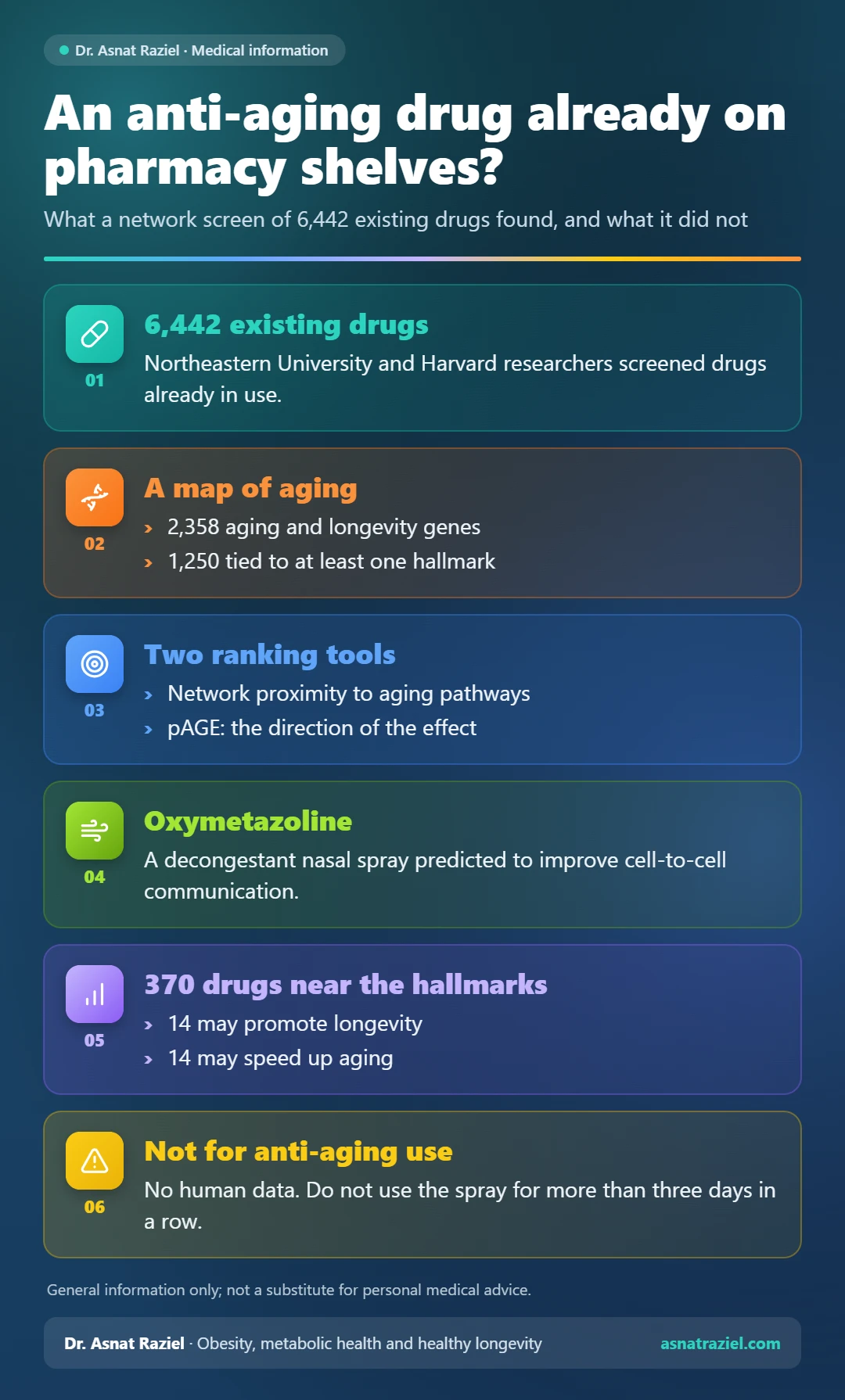
A team from Northeastern University, together with colleagues from Harvard, examined 6,442 existing drugs. One of the standout drugs on the list surprised everyone: oxymetazoline. It is the active ingredient in common decongestant nasal sprays such as Afrin and Sinex. In some countries, it also appears in eye drops and in a cream for rosacea. However, it is important to say right away that there is no proof here that the spray extends life. This is only a research direction, and it still needs a great deal of testing.
A new approach to aging research
One of the big challenges in longevity medicine is that aging is not a single disease. Rather, it is a network of biological processes that affect one another. As a result, it is very hard to find one drug that acts on all of them. You can read about these processes, known as the hallmarks of aging, in the leading review in the field.
In the new study, the researchers built a map of the mechanisms of aging in the body. They took 2,358 genes linked to aging and longevity, of which 1,250 genes belong to at least one hallmark. They placed these genes within a huge network of connections between proteins called the human interactome, a map of protein interactions in the human body. Then they checked which drugs act close to these pathways. I have also written about the link between genes and aging in my article on genetics and longevity.
Two tools for ranking anti-aging drug candidates
To assess each drug, the researchers used two measures. The first is network proximity. This measure checks how close the drug’s target is to the aging pathways. In other words, the closer it is, the greater the chance that the drug will affect that mechanism.
The second measure, pAGE, checks the direction of the effect. It looks at whether the drug shifts gene expression toward that of young tissue or, on the contrary, toward that of aging tissue. Thanks to the combination of the two measures, the researchers ranked the drugs by their expected effect on different aging mechanisms.
What makes oxymetazoline special
Doctors have used oxymetazoline for years to treat nasal congestion. It narrows the local blood vessels and makes breathing easier. Until now, it had no known connection to the field of longevity. For a very different use of the nose as a route for medicine, see my article on a nasal epinephrine powder.
By contrast, according to the computational model, the drug may improve communication between cells (cell-to-cell communication). This is one of the hallmarks of aging. With age, this communication weakens. Consequently, processes such as the inflammatory response, insulin signaling and tissue function go awry. In addition, the researchers noted that their predictions for oxymetazoline have a mechanistic explanation, so it is suitable for lab testing.
Not just a nasal spray: other anti-aging drug candidates
The researchers did not stop at one drug. Of all the drugs they examined, 370 were close in the network to at least one hallmark of aging. According to the Northeastern University report, the model ranked 14 of them as having the potential to promote longevity. On the other hand, it flagged 14 others as drugs that may speed up aging, at least in theory.
Moreover, the method passed a reliability test. Of 17 drugs currently being tested for longevity in humans, such as metformin and rapamycin, 11 showed significant proximity to the hallmarks. Drugs that extended the lives of mice also received a positive score in the model. I wrote about drugs like these in detail in my article on drugs that target aging.
Should you use a nasal spray to fight aging?
Absolutely not. This may be the most important point in the whole story. The researchers did not study humans, did not show any extension of life and did not recommend the spray for preventing aging. Prof. Albert-László Barabási, who led the study, said explicitly that “this study does not provide a cure for aging, nor does it prove that any specific drug will extend human life.”
It is also important to understand what the model does not know. It does not measure dosage, does not check absorption in the body and does not assess side effects over years. So a computational prediction is only a starting point, and for now a nasal spray against aging remains a research idea.
The team is now testing the prediction in cells in the lab, to find out whether it holds up and what the exact mechanism is. Only if the results are positive will animal studies follow, and after that, human trials. In addition, the spray has a clear limitation. According to MedlinePlus, you should not use oxymetazoline for more than three days in a row. Longer use can cause rebound congestion, which means the congestion comes back and sometimes gets worse.
The real meaning: new uses for old drugs
Perhaps the study’s biggest contribution is actually the search method. Researchers call this approach drug repurposing, which means using existing drugs for a new purpose. Instead of spending years developing a new molecule, the researchers use computational analysis of biological networks. This way, they can quickly identify old drugs with new potential. The advantage is clear: many drugs have already passed basic safety testing, so the road to a future treatment may be shorter. More information about the method appears in the study summary on Lifespan.io.
In the future, according to the researchers, a similar system could help with personalized longevity medicine. A doctor could then choose drugs based on the aging pathways that are active in each person. Still, this remains a research vision and not a clinical tool.
The bottom line on the anti-aging drug search
The study does not reveal a miracle drug. Nor does it offer a nasal spray against aging as a solution you can buy today. What it does show is how combining biology, genetics and computational analysis can reveal new research directions. Over the next decade, we will probably see more old drugs take on new roles in longevity medicine.
Until then, the safe way to slow aging remains familiar: physical activity, a high-quality diet, good sleep, maintaining muscle mass and not smoking. It is also important to keep metabolic risk factors in balance and to get evidence-based medical care. If you want to know where you stand, it is worth reading about biological age and how to measure it.
The information in this article is general and is not a substitute for personal medical advice.
References
Network-driven discovery of repurposable drugs targeting hallmarks of aging
Existing drugs could be repurposed for longevity
Study Maps Existing Drugs to the Hallmarks of Aging




