By Dr. Asnat Raziel, bariatric surgeon specializing in obesity treatment, metabolic health and healthy longevity; Director of the Multidisciplinary Center for Obesity Treatment, Assia Medical, Assuta Ramat HaChayal, Tel Aviv
Nasal epinephrine powder: what did the Israeli study find?
Nasal epinephrine powder may change how we treat life-threatening allergic reactions. The Israeli biotech company Nasus Pharma is developing an epinephrine (adrenaline) powder that is given into the nose, with no needle. In a clinical study of 50 participants, the powder reached the target blood level within 1.69 minutes. The EpiPen auto-injector, by contrast, reached the same level within 3.42 minutes.
However, the product is still experimental. In this article, I explain what the study showed, what it has not yet proven, and what is important to know today.
When the body overreacts: what is anaphylaxis?
Imagine a child at a birthday party who accidentally tastes a cake with peanuts. Within minutes, he starts to itch, his face swells and he struggles to breathe. His parents know he is allergic, but in the moment, panic takes over. Every second feels like an eternity.
This is anaphylaxis, a severe allergic reaction of the whole body. The reaction can develop very quickly and become life-threatening.
In anaphylaxis, the immune system reacts with great force to a substance the body sees as a threat. For example, a food, a drug or a bee sting. In response, the body releases inflammatory substances such as histamine. These substances widen the blood vessels, lower blood pressure and cause swelling. Sometimes they also narrow the airways.
Symptoms include a rash and itching, swelling of the lips and tongue, shortness of breath and wheezing. In addition, abdominal pain, vomiting, dizziness and even loss of consciousness may occur. In severe cases, shock and cardiac arrest develop.
The most important treatment for anaphylaxis is epinephrine, as fast as possible. Epinephrine narrows the blood vessels and raises blood pressure. At the same time, it opens the airways and halts the allergic reaction. For years, however, the main way to give it outside the hospital was an injection into the thigh muscle.
The EpiPen: a life-saving invention with human limits
The EpiPen lets anyone, even without medical training, inject a measured dose of epinephrine in an emergency. This invention changed the treatment of severe allergies and has saved many lives.
Still, it has drawbacks. Some people are afraid of needles. Others find it hard to inject under stress. And some do not carry the device everywhere, because it is large and inconvenient.
In other words, the problem is not only technological but also behavioral. A life-saving drug helps only if it is at hand, and only if the person is willing to use it. Fear of injections is especially common in children, but not only in them. This is where the idea came from: to develop a simpler, easier way to give epinephrine.
The Israeli innovation: nasal epinephrine powder
Nasus Pharma, founded in 2019 in Tel Aviv, is developing an experimental product called NS002. One of the company’s founders is Dr. Dalia Megiddo, a physician and biotech entrepreneur.
Instead of a needle, a small device sprays dry epinephrine powder into the nasal cavity. The lining of the nose is rich in blood vessels, so some drugs pass from it quickly into the bloodstream. The goal is simple treatment: no needle, no need to expose the thigh and no injection.
The company designed the powder particles to spread over the nasal lining and stick to it. According to the company, this structure may spread the drug evenly and reduce how much drips down the throat. In this way, the researchers hope to improve both the speed and the consistency of absorption.
By the way, medical research uses the nose for drugs in other fields too. For example, researchers have tested a nasal spray as a candidate for longevity. Still, the key question here is simple: how fast does the epinephrine reach the blood?
The clinical study: under two minutes versus more than three
In March 2026, the company published top-line results from a phase 2 clinical study. The study included 50 healthy adults with a history of allergic rhinitis.
The researchers compared nasal epinephrine powder (NS002) with an EpiPen injection. Each participant received both treatments, as a single dose and as repeat doses. In some sessions, the researchers also exposed the nose to an allergen. In this way, they simulated nasal congestion and inflammation, as during an allergic reaction.
What did the researchers find?
The researchers measured the time until the blood epinephrine level reached 100 picograms per milliliter. The study set this target level to compare the speed of absorption. It is important to remember that this is not a threshold that guarantees the anaphylactic reaction will stop.
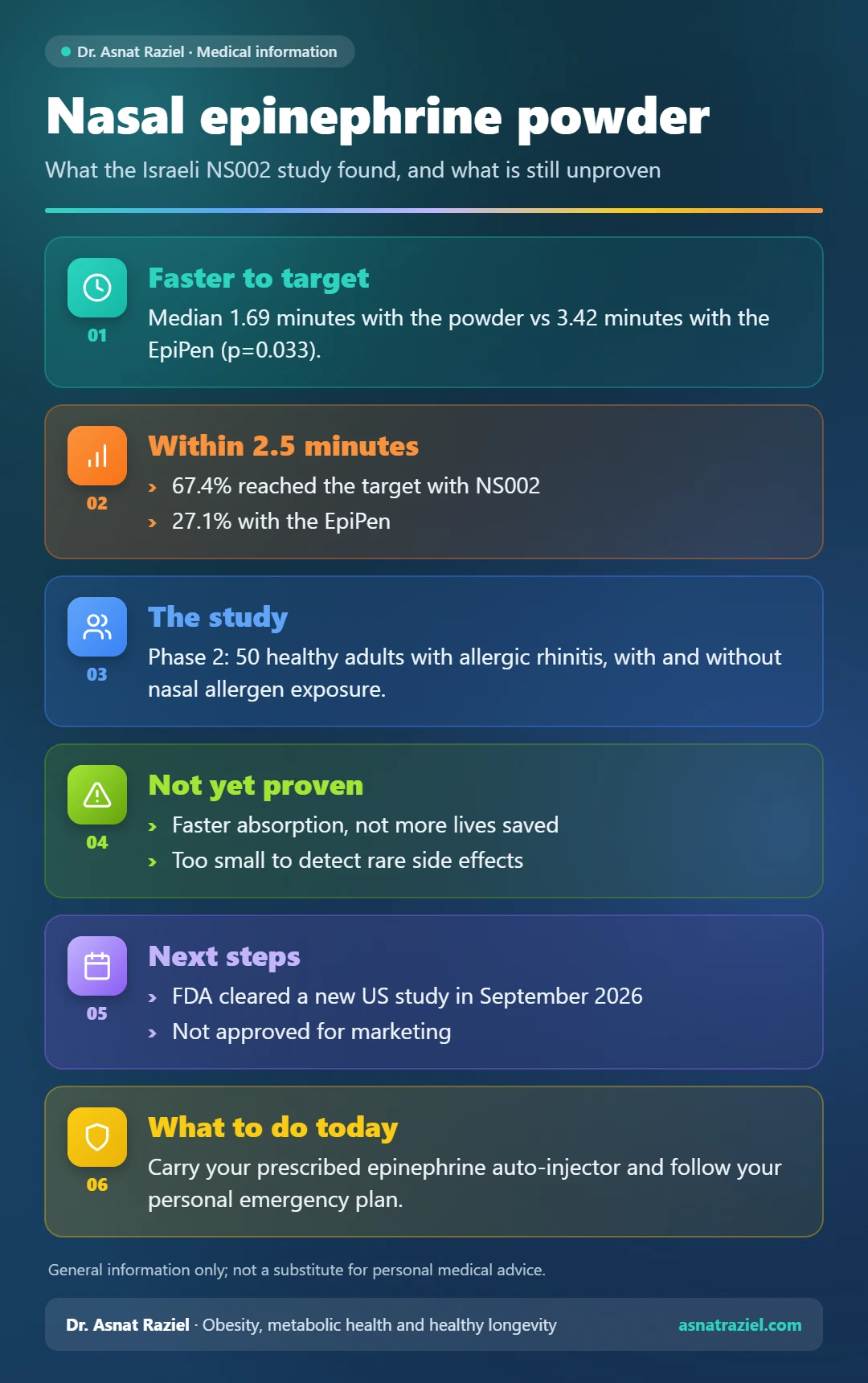
The median time to the target level was 1.69 minutes with the powder and 3.42 minutes with the EpiPen. In other words, the powder reached the target in about half the time. The difference was statistically significant (p=0.033).
In addition, the researchers checked how many participants reached the target within a short time:
After 2.5 minutes: 67.4% of participants with NS002, compared with 27.1% with the EpiPen (p=0.0001).
After 5 minutes: 88.4% with NS002, compared with 64.6% with the EpiPen (p=0.0081).
Put simply: out of 100 people, after two and a half minutes about 67 reached the target level with the powder, and only about 27 with the auto-injector.
What about safety?
According to the company, participants tolerated the treatment well, and there were no serious adverse events. In addition, the effect on the body, such as heart rate and blood pressure, was similar to that of the EpiPen.
On the other hand, the study was relatively small. A study of this size cannot detect rare side effects. Moreover, the study showed fast absorption of epinephrine, but it did not prove that the powder saves more lives. Nor did it show that the powder stops a real attack faster than the EpiPen.
Why every minute counts in anaphylaxis
In anaphylaxis, time is part of the treatment. The reaction can worsen within minutes and affect breathing or the heart and blood vessels.
A British study published in 2025 looked at deaths of children from food allergy in England from 2019 to 2023. The researchers identified 19 cases. According to the University of Bristol, an average of only 14 minutes passed from the first symptoms to cardiac arrest. In addition, in 74% of the cases, the children did not receive epinephrine from an auto-injector before cardiac arrest, or received only one dose.
These data show how important it is to recognize anaphylaxis quickly and treat it at once. So do not wait for all the symptoms to appear. Give epinephrine according to the personal emergency plan and call for medical help. It is important to know that antihistamines and steroids do not replace epinephrine. That is why an accessible, simple treatment such as nasal epinephrine powder may help people act faster.
Is nasal epinephrine a new idea?
No. In August 2024, the US Food and Drug Administration (FDA) approved a liquid epinephrine nasal spray called neffy. The spray is made by ARS Pharmaceuticals. At first, the approval covered adults and children weighing 30 kg or more.
In March 2025, the FDA expanded the approval to children from age four weighing 15 to 30 kg, at a dose of 1 mg. For the first time, the United States has a treatment for anaphylaxis that does not require an injection.
The Israeli product is slightly different. Neffy is a liquid spray, while NS002 is a dry powder. The Israeli company believes the powder sticks better to the nasal lining, even when the nose is congested. However, there is still no direct comparison between the two products. The advantage the study showed was against the EpiPen, not against neffy.
How a drug is given strongly affects people’s willingness to use it. We have seen this in obesity treatment as well, for example in the study on switching from an injection to the Wegovy pill.
What happens when the nose is congested or inflamed?
This is a central question in developing nasal epinephrine. During an allergic reaction, congestion, a runny nose and swelling may appear. These changes may affect absorption.
An earlier study, published in 2023 and led by Prof. Yuval Tal of Hadassah Medical Center, tested the powder in 12 adults with allergic rhinitis. The researchers exposed the nose to an allergen in a controlled way. Under these conditions, the powder reached the target level in a median time of one minute, compared with three minutes with the EpiPen.
On the other hand, the researchers saw large differences between participants in how much epinephrine was absorbed. The results supported further development. Even so, more studies are needed to understand the effect of nasal disease, polyps, previous surgery or changes in the nasal lining.
The next step for nasal epinephrine powder research
In September 2026, Nasus Pharma announced that the FDA had cleared it to start another clinical study in the United States (an IND, permission to begin studies in humans). The study will compare self-administration of the drug with administration by a healthcare professional. According to the company, the pivotal study is due to start in the last quarter of 2026.
This is an important stage. An emergency drug has to work well not only in the lab. It also has to be simple, reliable and easy to use when a person is frightened, struggling to breathe or standing next to a child in distress.
As of early November 2026, NS002 is still in clinical development and is not approved for marketing. The FDA clearance allows a study to take place, not routine use of the product.
Beyond allergy: a technology for other drugs
The company is also testing its nasal powder technology for other drugs. Among other things, it has developed a naloxone powder, a drug used to treat opioid overdose. In addition, it is testing a nasal powder of ondansetron, an anti-nausea drug.
The principle is similar: in an emergency, a small, simple device may save precious time. However, each such drug needs its own research. Success with epinephrine does not guarantee success with other drugs.
Israel leads medical innovation in many fields. For example, I have written before about the Israeli study that aims to reverse biological age.
Will nasal epinephrine powder replace the EpiPen?
It is too early to say. The results so far are encouraging, but more studies are needed. First, absorption and the drug’s effect on the body must be tested in large, diverse populations, including children. Second, researchers need to understand how different nasal problems affect it and how safe repeat use is. In addition, the company must prove that the device is simple and reliable for self-use in an emergency.
Even after all this, the product will need regulatory approval. It is important to remember that running a controlled trial during a real anaphylactic attack is very hard, both practically and ethically. That is why even the existing sprays were approved mainly on the basis of blood drug levels and effects on the body. In the future, too, the assessment will rely on the full body of evidence.
What is important to know today?
Anyone who has had anaphylaxis, or is at risk of a severe allergic reaction, should keep following their allergist’s instructions.
Anyone who has a prescription for an epinephrine auto-injector should always carry it and know exactly how to use it.
Never replace an approved treatment with an experimental product.
If you suspect anaphylaxis, give epinephrine immediately, call for medical help and follow the personal emergency plan.
Even after giving epinephrine, seek urgent medical care. Symptoms may persist, worsen or come back.
Bottom line: nasal epinephrine powder and the future of emergency medicine
The Nasus Pharma development reflects an important shift in medicine. For decades, research focused on new and more effective drugs. Today it is clear that the way a drug reaches the patient matters just as much.
Epinephrine has been known to medicine for more than a hundred years. The innovation here lies not in the substance itself, but in the way it is given in an emergency. If future studies confirm the findings, nasal epinephrine powder may join the treatment options for anaphylaxis.
Ultimately, in emergency medicine, the best treatment is not only the one that works well in the body. It is also the treatment that can be given correctly and on time. This is also the direction of the medicine of the future: effective, accessible and simple treatment that is within reach.
The information in this article is general and does not replace personal medical advice. Anyone at risk of a severe allergic reaction should consult their allergist or treating physician.
References
Prehospital care in fatal food anaphylaxis: a nationally representative case series
Fatal delays in EpiPen treatment for food anaphylaxis in children, finds research
FDA Approves First Nasal Spray for Treatment of Anaphylaxis
An Israeli Team Is Building the Needle-Free Answer to the EpiPen
The NS002 studies were funded by Nasus Pharma. Prof. Yuval Tal serves as a consultant to the company.




