By Dr. Asnat Raziel, bariatric surgeon specializing in obesity treatment, metabolic health and healthy longevity; Director of the Multidisciplinary Center for Obesity Treatment, Assia Medical, Assuta Ramat HaChayal, Tel Aviv
Can we reverse biological age? Not just living longer, but aging more slowly
Can a personalized health program reverse biological age? That is the question a new Israeli study is trying to answer. For years, medicine has focused on preventing disease and extending life expectancy. Now the Longevity Center at Sheba Medical Center is asking an ambitious and practical question: can a broad medical assessment, combined with targeted behavior change, slow the pace of aging?
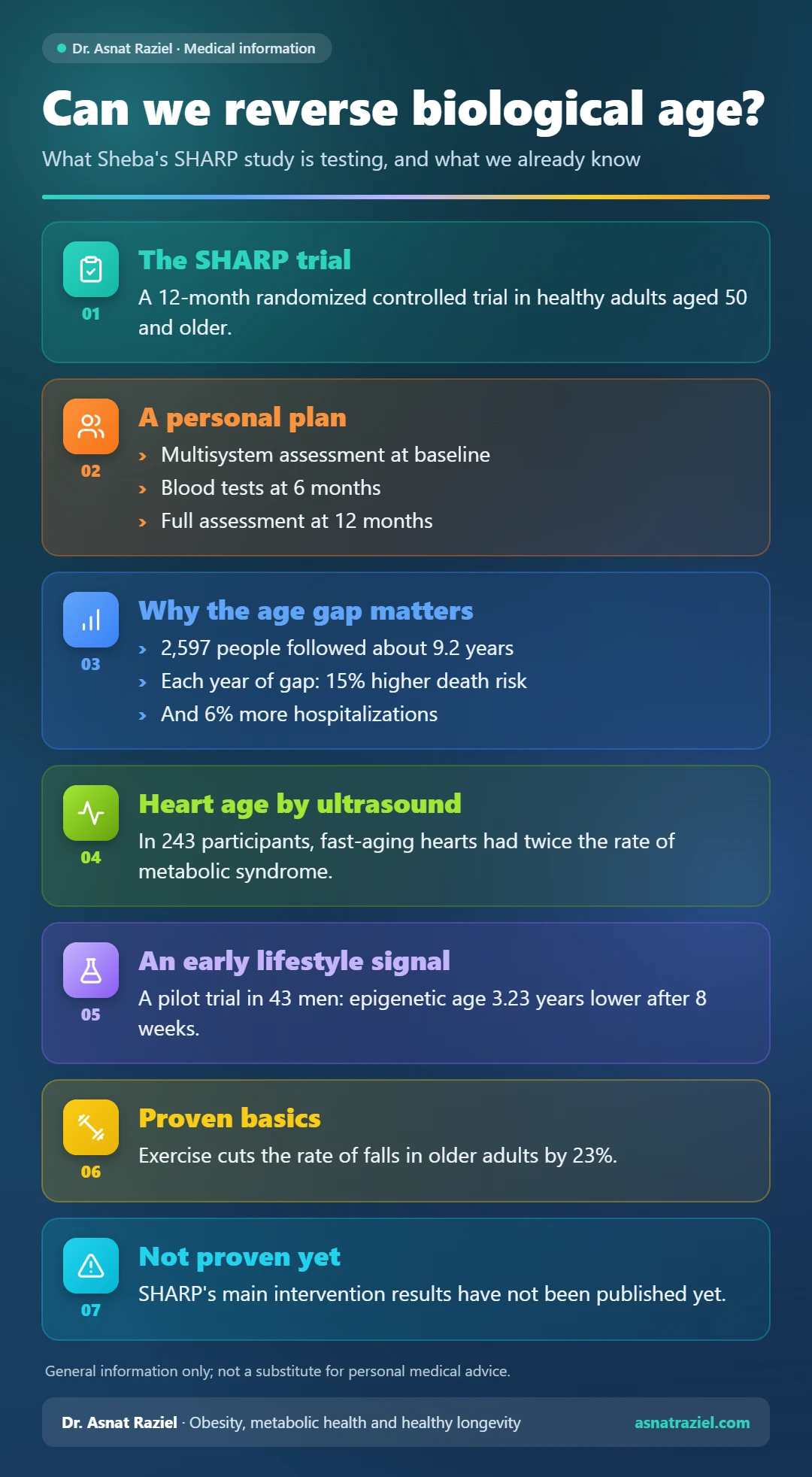
The study is called SHARP, short for Sheba Healthspan Research Population. It is a 12-month randomized controlled trial in healthy adults aged 50 and older. Its goal is not to promise “eternal youth.” Instead, it tests scientifically whether a personalized intervention improves biological, physical and cognitive markers of aging.
What is biological age, anyway?
Chronological age is the number of years since you were born. Biological age, by contrast, tries to describe how well your body’s systems are working for your age.
Two 70-year-olds can be very different. One is active, with good muscle mass, healthy blood pressure, restful sleep and a sharp memory. The other struggles with weakness, frailty, diabetes and declining function. Both are the same age on the calendar, but their bodies are aging at different rates. I explain the concept in more detail in my article on biological age and longevity.
Longevity research measures aging with a range of tools. These include blood tests, inflammatory markers, heart and blood vessel function, body composition, muscle strength and cognitive function. Sometimes researchers also add epigenetic clocks, which are based on changes in DNA methylation.
The SHARP study: an attempt to reverse biological age with a personal plan
What makes SHARP unique is the shift from general advice, such as “eat well and exercise,” to a personalized plan. Each plan is built around the individual participant’s health profile.
At the start of the study, participants undergo a multisystem assessment. The report covers the heart and blood vessels, lifestyle habits, mental health, cognition, sleep and the senses. In addition, it looks at metabolism, strength and endurance, women’s and men’s health, and markers of aging. Next, the intervention group receives a personal set of recommendations. Participants then have blood tests after six months and a full assessment at the end of the year.
The idea is simple but meaningful. For one person, the main driver of faster aging is inactivity and muscle loss. For another, the problem is poor sleep, belly fat, high blood sugar or high blood pressure. And for a third, it may be loneliness, depression, hearing loss or a poor diet. That is why the path to improvement may also differ from person to person.
What are the researchers measuring?
One main outcome is the change in biological age, including epigenetic age. Alongside it, the team tracks function, cognition, general health and intrinsic capacity. That term describes the full set of physical and mental abilities that allow a person to live independently.
What matters is not just a number on a report. If a personal plan improves strength, walking, balance, memory, sleep, blood pressure and body composition, that has clinical meaning. This is true even though “biological age” itself is not yet a perfect measure.
Why does it matter to know your biological age?
Another Sheba study, published in May 2026 in the journal Aging and Disease, looked at exactly this question. The researchers followed 2,597 people in Sheba’s periodic checkup program for an average of about 9.2 years. They calculated biological age from routine blood tests.
According to a report on the study, each year of gap between biological and chronological age was linked to a 15% higher risk of death. It was also linked to a 6% higher rate of hospitalization. These associations held even after adjusting for age, sex, BMI, smoking and high blood pressure. Moreover, a gap of three years or more was linked to especially high mortality.
Still, precision matters here. This is a statistical association, not proof that lowering the number will extend life. The gap may reflect accumulated risks, and it may serve as a tool for spotting people who are aging faster than expected. This is exactly where SHARP comes in. It tests whether an intervention can change biological age, and whether that change comes with a real improvement in health.
Assisted living and nursing homes: a natural setting for longevity
People in assisted living or geriatric care settings may benefit especially from an organized program. Instead of treating disease after it appears, these settings can create an environment that promotes movement, nutrition, sleep, social ties, purpose and mental activity.
In such a setting, staff can regularly measure grip strength, walking speed, rising from a chair and balance. They can also track muscle mass, blood pressure, sleep, hearing, vision, nutritional status and memory. When an early decline shows up, it is possible to step in before a fall, a hospital stay or a loss of independence. The big advantage is that the intervention is not a once-a-year recommendation at a clinic. Instead, it becomes part of daily life.
Muscle, sleep and relationships: the tools to reverse biological age
One of the key messages of longevity medicine is that aging does not happen only in blood tests or in our DNA. It shows up in the ability to climb stairs, get up from a chair, remember names, follow a conversation, sleep well and stay independent. For an encouraging look at when our abilities actually peak, see my article on peak age.
A real program therefore combines aerobic exercise, strength and balance training, and enough protein. In addition, it includes a Mediterranean diet, treatment of metabolic risk factors, good sleep and quitting smoking. Social connection and a sense of purpose are also part of the prescription. Exercise has strong evidence for preventing falls in older adults, cutting the rate of falls by 23%. Today, no single drug can replace all of these. Likewise, even the most advanced technology cannot make up for inactivity, loneliness or poor sleep on its own.
Is it really possible to reverse biological age?
Small studies around the world have found that programs of diet, exercise, sleep and stress reduction may affect epigenetic markers. For example, a randomized pilot trial included 43 healthy men aged 50 to 72. After 8 weeks, epigenetic age in the intervention group was 3.23 years lower than in the control group.
However, many of these studies are small, short or lack a proper control group. That is why we need long, controlled studies like SHARP before concluding that any program “rejuvenates.” What’s more, even when the calculated number drops, we need to check what truly matters. That means fewer diseases, fewer hospital stays, fewer falls, good function and lasting independence. The link between weight loss drugs and aging is another field being studied today with the same caution.
What have we learned from the first data?
An analysis published from the SHARP population examined the biological age of the heart and blood vessels. The researchers used AI-based point-of-care ultrasound. The study included 243 participants with a median age of 62, of whom 54% were women. It compared an ultrasound-based heart clock with clocks based on blood tests and ECG. All three clocks were linked to chronological age. In addition, people whose hearts were “aging fast” had a less healthy metabolic profile, with twice the rate of metabolic syndrome.
The study shows a shift from general measurement to measuring how specific systems age. The heart may age at a different pace than muscle, the brain or metabolism. In the future, a profile like this could help build a precise prevention plan. However, as of November 2026, the main intervention results of SHARP have not yet been published. So it is too early to declare success.
From medicine that treats disease to medicine that manages aging
The importance of the Sheba study is not only whether biological age drops within a year. It reflects a deep change in thinking. We are moving from medicine that waits for disease to medicine that spots decline early, measures it and acts before damage is done.
The vision is that every older adult will receive more than a list of diagnoses and medications. They will also get a map of function and aging: where they stand today, which systems are at risk, what can be improved and what needs to be measured again. If the study succeeds, the program could become a model for Israel’s health funds (HMOs), community services and assisted living.
The bottom line: how to reverse biological age the evidence-based way
The SHARP study tests whether a multisystem assessment and a one-year personal plan can reverse biological age and improve function and cognition from age 50. The study is controlled and measures many domains, but its final results have not yet been published. So this is an important and promising research step, not proof that we have found a recipe for turning back time.
Ultimately, the promise of longevity medicine is not eternal life. It is the ability to measure aging well, spot weaknesses early and act in a personal way. That is how we add more years of health, independence, strength and clarity to our lives.
The information in this article is general and does not replace personal medical advice.
References
Your body’s true age may help predict future illness, scientists say
Cross-sectional evaluation of cardiovascular biological age using point-of-care ultrasound
Exercise for preventing falls in older people living in the community




