By Dr. Asnat Raziel, bariatric surgeon specializing in obesity treatment, metabolic health and healthy longevity; Director of the Multidisciplinary Center for Obesity Treatment, Assia Medical, Assuta Ramat HaChayal, Tel Aviv
Peak age: is it already behind us?
Peak age is a topic I hear about almost every week. “I’m already past my peak,” people in their forties and fifties tell me, and sometimes even people in their thirties. Many believe their best years are gone. In their view, the brain is no longer as sharp as it was, and the body is starting to weaken. From here on, they think, all that is left is to slow the decline.
However, the science of recent years tells a completely different story. A series of studies is changing what we thought about age, performance and aging. Their message is surprising: there is no single age at which a person is at their peak. In fact, life is made up of a series of peaks. Different abilities peak at different ages. Moreover, some important abilities keep improving well into our sixties and seventies.
The big myth about age 25
For many years, the common belief was that people reach their peak in their twenties. There is no doubt that at this stage we are fast and strong, and our reaction time is short. Indeed, Olympic athletes and fighter pilots do benefit from the advantages of a young body.
But is speed the only measure of excellence? As science advanced, it became clear that the answer is no. A person is not just muscle and reaction time. We also have experience, judgment and emotional intelligence. In addition, we have the capacity to learn, remember, create and understand people. Each of these abilities develops at its own pace.
Every ability has its own peak age
One of the most important studies in the field was published in 2015. Psychologists Joshua Hartshorne and Laura Germine analyzed data from 48,537 online participants, along with data from standard intelligence and memory tests. As a result, they built the first life map of cognitive abilities.
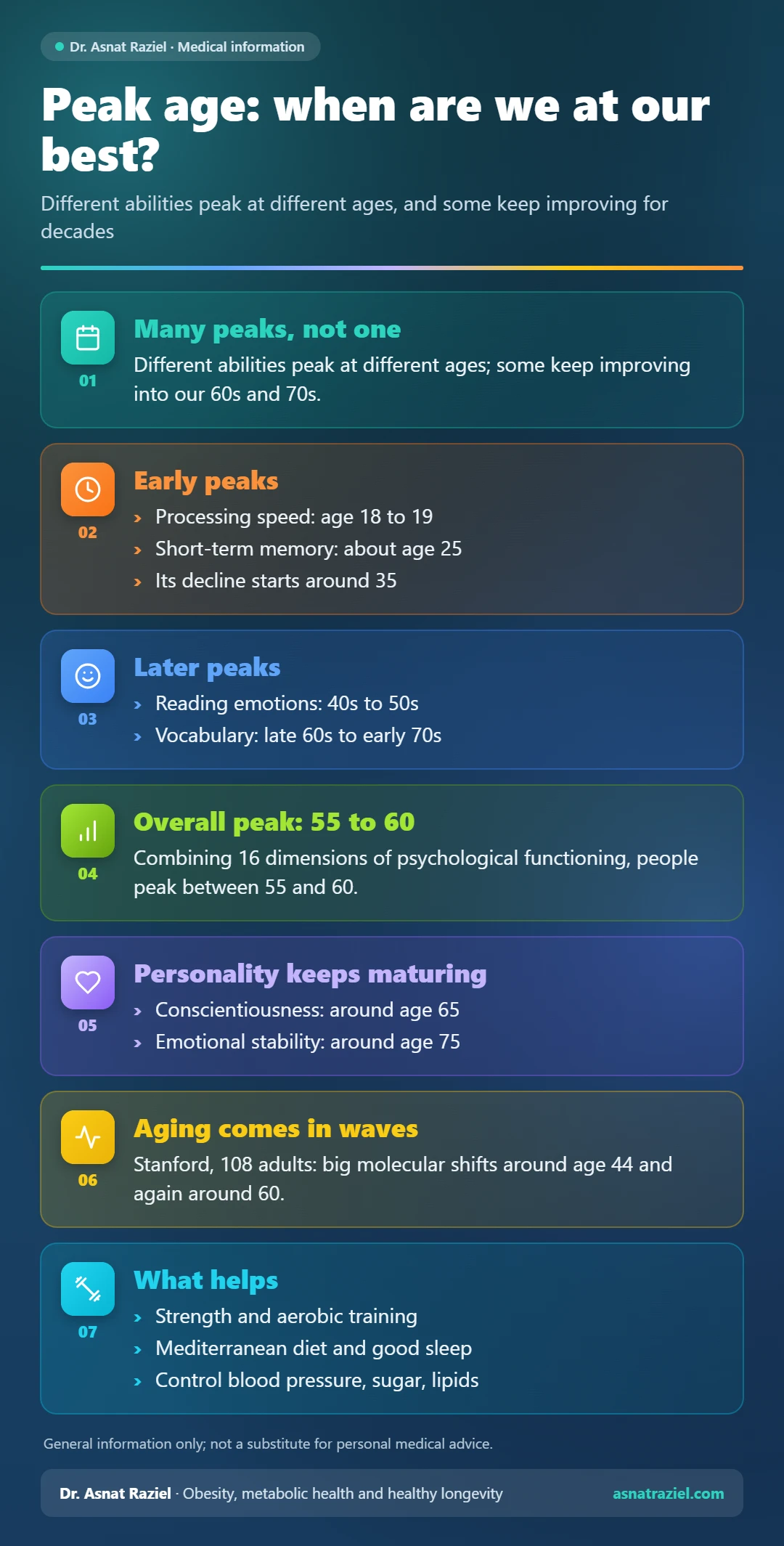
The results were fascinating. According to MIT’s summary, information-processing speed peaks as early as age 18 or 19. Short-term memory keeps improving until about age 25 and starts to decline around age 35. By contrast, the ability to read other people’s emotions peaks only in the forties or fifties. And vocabulary? It keeps growing until the late sixties or even the early seventies. The conclusion is clear: there is no single “intelligence peak.” Instead, there are many peaks, and each one arrives at a different time.
Wisdom doesn’t replace speed, it complements it
When we are young, we react quickly. When we are older, we think more deeply. Accumulated experience allows the brain to recognize patterns quickly. It also helps us avoid repeating mistakes and connect enormous amounts of knowledge within seconds.
That is why veteran doctors sometimes spot a diagnosis at first glance. For a similar reason, experienced managers make good decisions in a crisis. Likewise, veteran judges see the big picture, far beyond the bare facts. This accumulated knowledge is called crystallized intelligence, and it keeps improving for decades.
The study that redefined peak age
In 2025, an innovative study was published in the journal Intelligence. The researchers asked a simple question: what happens if we stop measuring only intelligence? They drew on large existing studies and compared 16 dimensions of psychological functioning. These included not only reasoning and memory, but also emotional intelligence and conscientiousness. In addition, they looked at emotional stability, moral reasoning and resistance to cognitive biases.
When they combined all the components, a surprising result emerged. According to the University of Western Australia, overall psychological functioning peaks between ages 55 and 60. Conscientiousness peaks around age 65, and emotional stability around age 75. In other words, we are not at our peak when we are fastest. Rather, we peak when we combine knowledge, experience, reasoning, emotion and judgment.
Midlife is actually a turning point
If our twenties are the years of speed, our fifties are the years of quality. At this age, many people make calmer, less impulsive decisions. We also see the full picture, understand the people around us well and can tell what matters from what doesn’t. Perhaps that is why many leaders, scientists, judges and senior physicians reach their greatest achievements at exactly these ages.
The body doesn’t age in a straight line
In 2024, another study shook up the field of aging research. Stanford researchers followed 108 healthy participants aged 25 to 75. They measured thousands of molecules: proteins, lipids, metabolites and gut bacteria. The follow-up lasted up to 6.8 years.
The researchers expected to see gradual aging, but that is not what they found. Instead of a slow decline, they discovered two large waves of biological change. The first wave appears around age 44, and the second around age 60. Around 44, the metabolism of fat, caffeine and alcohol changes, along with changes related to the heart, skin and muscle. Around 60, the immune system, kidney function and carbohydrate metabolism change. The implication is profound: aging is not an even slope. Instead, it happens in leaps.
The good news: we can make a difference
Precisely because aging is not continuous, there are windows of time when we can influence it. This is exactly the approach of longevity medicine. Don’t wait for disease and don’t wait for function to decline. Instead, identify the changes in time and intervene.
What helps? Strength training to preserve muscle, regular aerobic activity and a Mediterranean diet rich in protein and fiber. In addition, good sleep, less stress and not smoking. Controlling blood pressure, blood sugar and blood lipids is also very important. All of these can slow biological aging and help maintain a high level of function for years. I wrote about the connection between sleep and the brain in my article on sleep and brain health.
In recent years, new treatments for metabolic health and obesity have also joined the picture. Researchers are studying them not only for their effect on weight. They are also examining their possible effects on chronic inflammation, heart disease, fatty liver and perhaps even the pace of aging. You can read more in my article on weight-loss drugs and aging.
Biological age matters more than the age on your ID
Two people can both be 60. One struggles to climb a single flight of stairs. The other runs ten kilometers, learns a new language and starts a business. The difference between them is not just genetics. To a large extent, it comes from the lifestyle they have built over the years.
That is why today we talk less about chronological age and more about biological age, that is, how healthy and functional the body really is. New studies even estimate the biological age of each organ separately, such as the Stanford blood protein study published in 2025.
So when is peak age, really?
The answer is that there is no single answer. Speed of thought belongs to the young, and physical strength peaks fairly early. On the other hand, knowledge keeps accumulating for decades. Emotional intelligence improves in midlife, and emotional stability grows stronger with age. And when you put all the pieces together, the complete human picture actually peaks in the late fifties.
The bottom line on peak age
This may be one of the most optimistic discoveries of aging science. Our peak is not determined by age alone. Rather, it is determined by how we live. As science advances, it is becoming clear that aging is not only loss. It is also growth, adaptation, wisdom and development. And if we take care of the body and the brain along the way, we may find that our true peak is still ahead of us. Read more about how to get there in my article on healthy aging.
The information in this article is general and does not replace personal medical advice.
References
It’s Not All Downhill after 20: Cognitive skills peak at different ages
Humans peak in midlife: A combined cognitive and personality trait perspective
Worried about turning 60? Science says that’s when many of us actually peak
Nonlinear dynamics of multi-omics profiles during human aging
Plasma proteomics links brain and immune system aging with healthspan and longevity




