By Dr. Asnat Raziel, bariatric surgeon specializing in obesity treatment, metabolic health and healthy longevity; Director of the Multidisciplinary Center for Obesity Treatment, Assia Medical, Assuta Ramat HaChayal, Tel Aviv
The organ age blood test: is it already here?
An organ age blood test that reveals the biological age of each organ sounds like science fiction. We all know how old we are according to our ID card. But what if your brain is ten years older than you are? And what if your heart is actually younger? Perhaps your liver is aging quickly, and you feel nothing at all.
In 2025, Stanford University researchers published a groundbreaking study in the journal Nature Medicine. The study presents a blood test that estimates the biological age of 11 organs and body systems. This makes it possible to identify the “weak link” before any disease appears. What’s more, the test predicts disease risk years in advance.
We don’t all age at the same pace
One of the most fascinating findings is that the body does not age as a single system. For example, a 60-year-old may have a heart that works like a 45-year-old’s. At the same time, their brain may behave like a 75-year-old’s. In another person, the kidneys may age quickly. And in a third, it may be the immune system. For a related look at how our abilities change with age, see my article on peak age.
In other words, every organ has its own “biological clock.” The implications are huge. Instead of relying only on chronological age, medicine is starting to identify which organs need attention right now. You can read about a different kind of biological clock in my article on aging clocks and how we measure aging.
How does an organ age blood test know how old your brain is?
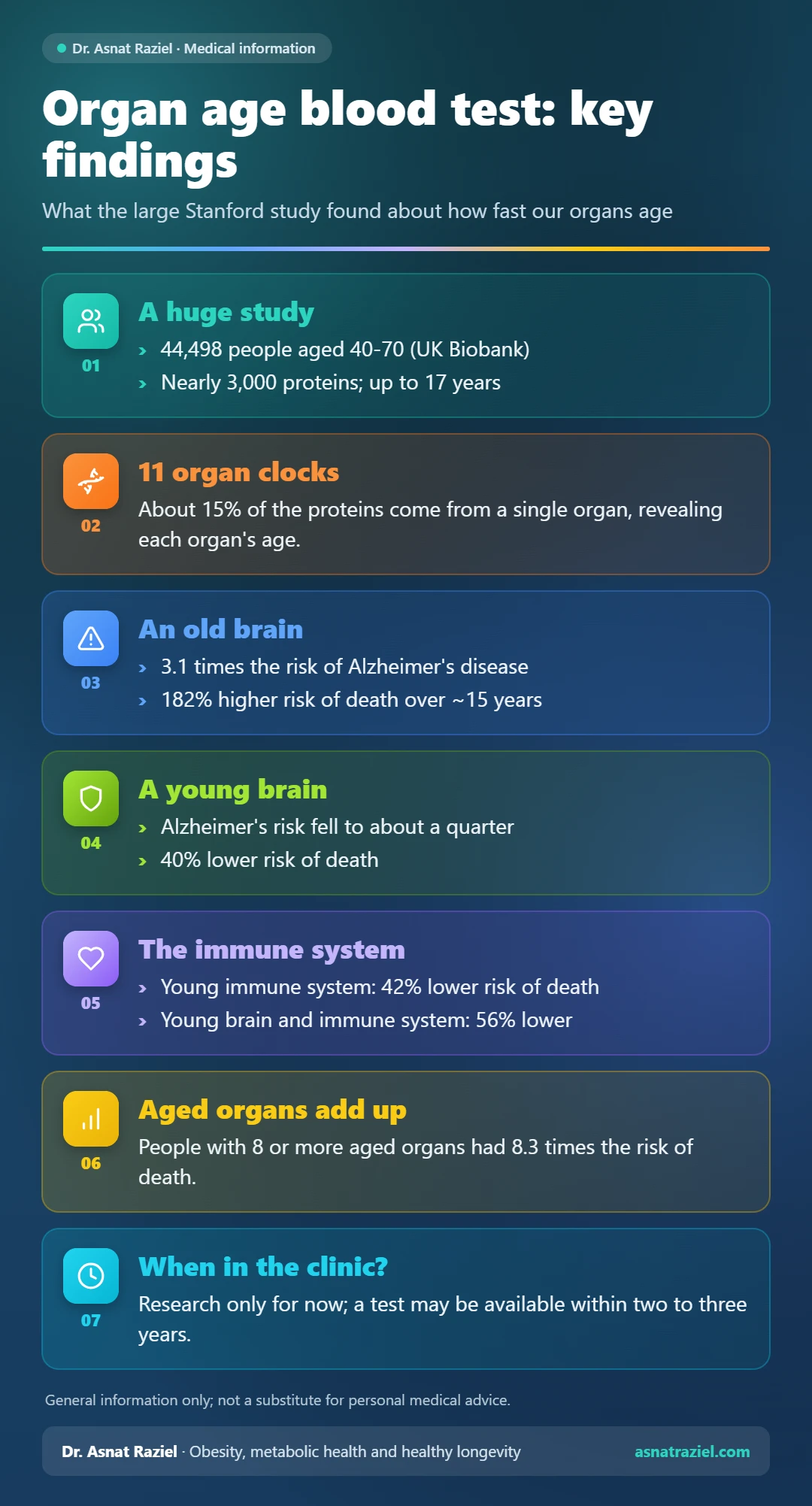
The secret lies in proteomics, a field that measures thousands of proteins in the bloodstream. Each organ releases its own unique proteins into the blood. According to Stanford’s announcement, the researchers measured nearly 3,000 proteins. About 15% of them come from a single organ.
Using artificial intelligence algorithms, the researchers built a “protein signature” for each of 11 organs and systems:
- The brain, heart and blood vessels
- The lungs, liver and kidneys
- The pancreas, muscles and fat tissue
- The digestive system and the immune system
Next, the researchers compared each person’s signature with the values expected for their age. That is how they calculated the biological age of each organ separately.
Nearly 45,000 people and 17 years of follow-up
This is not a small or preliminary study. The researchers analyzed blood samples from 44,498 participants aged 40 to 70 from the UK Biobank database. The researchers followed participants for up to 17 years. During this time, the researchers recorded new diseases and deaths. As a result, they could check whether an “old organ” really predicts future disease. And the answer was yes.
What did the organ age blood test reveal about the brain?
Of all the organs, one stood out in particular: the brain. The biological age of the brain was the best predictor of both death and the risk of neurodegenerative disease. In people with an “especially old” brain, the risk of Alzheimer’s disease was 3.1 times higher than in people whose brains were aging at a normal pace. In addition, their risk of dying during about 15 years of follow-up rose by 182%. Another test looks for dementia itself, as I describe in my article on the dementia blood test.
By contrast, a biologically young brain offered clear protection. The risk of Alzheimer’s fell to only about a quarter, and the risk of death fell by 40%. According to the researchers, the effect is similar to that of major genetic factors. An old brain is similar to carrying one copy of the APOE4 gene, and a young brain is similar to carrying two copies of APOE2. You can read about a closely related line of research in my article on blood tests that detect dementia risk.
The immune system also shapes how long we live
Alongside the brain, the immune system emerged as another key player. A young immune system alone was linked to a 42% lower risk of death. And when both the brain and the immune system were young, the risk fell by 56%. In other words, aging does not happen in a single organ. It reflects constant communication between the body’s systems. Chronic inflammation is one of the bridges between them, as I explained in my article on GLP-1 drugs and chronic inflammation.
How many of us are already aging too fast?
One of the surprises was that a third of the participants had at least one organ with an extreme age relative to their own, either older or younger. In addition, one in four had several such organs. As the number of aged organs rose, so did the risk of death. In people with eight or more aged organs, the risk of death was 8.3 times higher than in those aging at a normal pace.
Can organs be made younger?
This may be the most important question of all. The study did not show that the clock can be turned back, but it does offer real hope. According to the researchers, the biological age of the organs responded to lifestyle and medications. In the early version of the study, the researchers described these links in detail. Smoking, alcohol and processed meat were linked to faster aging. On the other hand, vigorous physical activity and oily fish were linked to younger organs. For a different angle on renewing the body, see my article on organ regeneration research.
However, these findings show an association, not cause and effect. That is why the researchers are planning intervention studies. These studies will test whether lifestyle, medications or other interventions really slow organ aging. Sleep also affects the brain, as I wrote in my article on sleep and brain health.
What about weight-loss medications?
This is one of the most intriguing areas today. GLP-1 medications such as semaglutide (Ozempic/Wegovy) and tirzepatide (Mounjaro/Zepbound) affect much more than weight. They reduce inflammation, protect the heart and improve fatty liver. When it comes to the brain, however, caution is needed. In 2025, the EVOKE and EVOKE+ trials did not show that oral semaglutide slows the progression of Alzheimer’s disease.
In the future, an organ age blood test could measure how these drugs affect each organ. That way, we will know whether they slow aging itself, and not just lower weight or blood sugar. In the meantime, I cover the existing data in my article on weight-loss drugs and their effect on aging.
When will an organ age blood test reach the clinic?
Today, the test serves research purposes only and is not available for clinical use. According to Prof. Tony Wyss-Coray, the lead researcher, such a test could be available within two to three years. In addition, the price is expected to drop if the test focuses on just a few organs, such as the brain, heart and immune system.
Meanwhile, the research keeps moving forward. In June 2026, the same team published a follow-up study in Nature Medicine. This time, the researchers estimated the age of specific cell types, not just whole organs. For example, an “aged” profile of muscle cells was linked to a 12.7 times higher rate of ALS (amyotrophic lateral sclerosis). According to a report on the study, the difference appeared more than three years before diagnosis. However, this finding still needs to be confirmed.
The clinic of the future will start with one blood test
Longevity medicine is changing direction. For decades, we waited for disease to appear and only then treated it. Now we are approaching a new era. In this era, we will identify an organ that is starting to age years before it fails. We will tailor a personal prevention plan for each person. And we will track how nutrition, activity, sleep and medications affect the organs themselves. This is the healthy aging and longevity approach I practice with my patients.
The bottom line on the organ age blood test
An organ age blood test is not yet a routine test, but the science is moving fast. In the near future, the important question will no longer be “How old are you?” Instead, we will ask a different question: “How old are your brain, your heart and your liver, really?” And that is a true revolution in longevity medicine.
The information in this article is general and does not replace personal medical advice.
References
Plasma proteomics links brain and immune system aging with healthspan and longevity
Biological age of our organs and cell types within them predict our disease risk, longevity
Plasma proteomic signatures of cellular aging predict human disease
Blood-based indicator assesses organ age to predict disease risk
Results of EVOKE and EVOKE+ trials show no effect of oral semaglutide on AD progression
The studies were funded by the US National Institutes of Health (NIH) and other research foundations. The lead researcher is a co-founder of companies that have licensed the technology.




