By Dr. Asnat Raziel, bariatric surgeon specializing in obesity treatment, metabolic health and healthy longevity; Director of the Multidisciplinary Center for Obesity Treatment, Assia Medical, Assuta Ramat HaChayal, Tel Aviv
GLP-1 and chronic inflammation: why is everyone talking about it?
The link between GLP-1 and chronic inflammation is one of the most intriguing topics in medicine today. GLP-1 drugs have become a symbol of weight loss and diabetes control. However, behind the headlines lies a much deeper story. An article on Harvard’s health website asked a broad question: could part of these drugs’ benefit come from reducing chronic inflammation throughout the body?
If the answer is yes, it is a real shift in thinking. In other words, these may not be purely metabolic drugs. They may also have a broad effect on the immune system. In this article, I will explain what we know today, what is still open, and what it means for you.
What is chronic inflammation, and why does it matter?
Acute inflammation is a healthy response. It appears after an injury or infection and then fades. In contrast, chronic low-grade inflammation lasts for months and years, quietly and without pain. Modern medicine sees it as a central mechanism in many diseases.
For example, this kind of inflammation is linked to atherosclerosis, heart failure and fatty liver. It is also linked to degenerative brain diseases and to some joint problems. Obesity is not just excess fat. Fat tissue, and especially deep belly (visceral) fat, releases pro-inflammatory substances such as TNF-α and IL-6. These are cytokines, the signaling proteins of the immune system, and they disrupt immune balance. You can read more about this connection in my article on gut bacteria and inflammation.
What a huge study of millions of patients showed
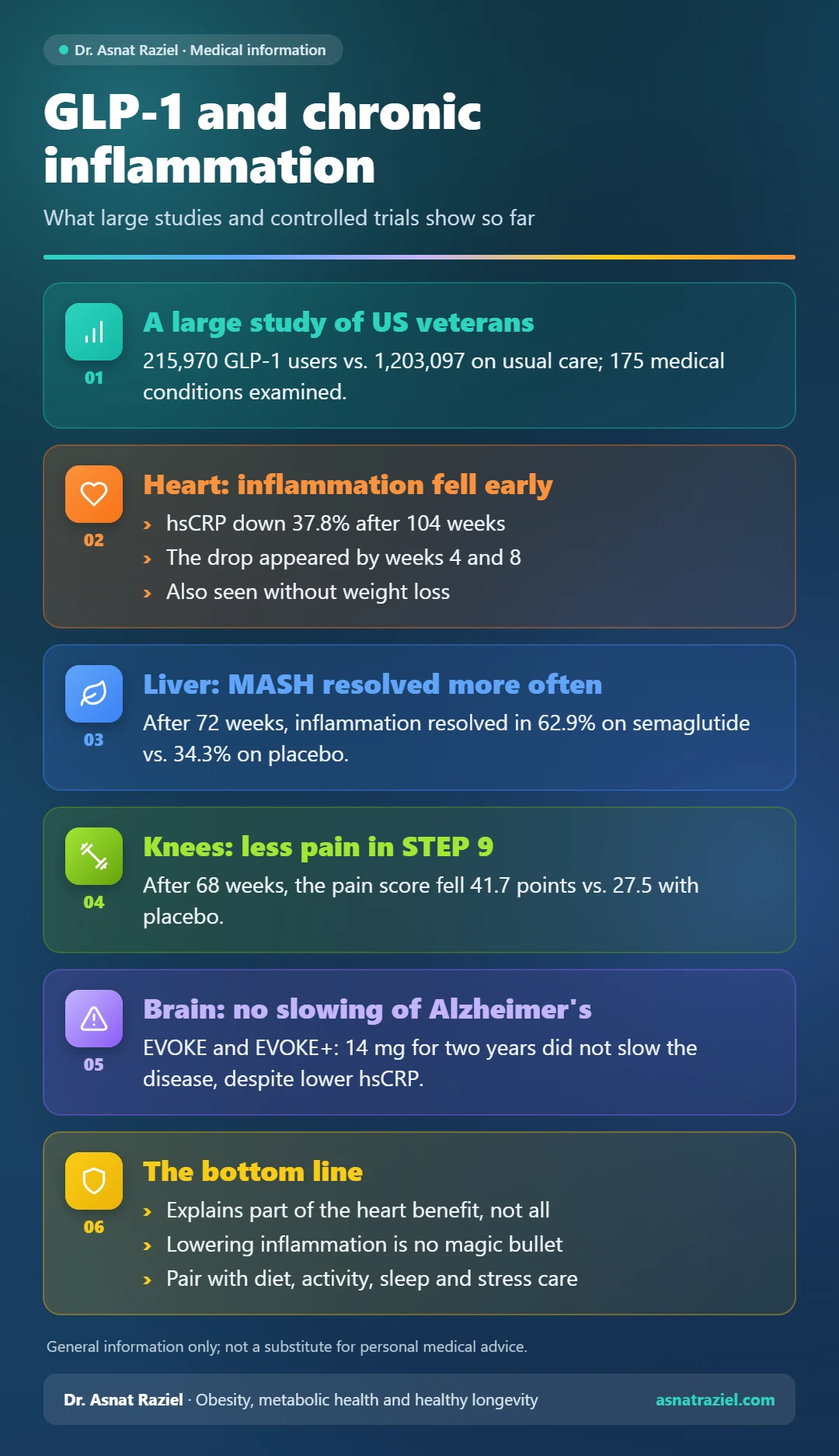
The Harvard article describes large observational studies. One of the most notable was published in Nature Medicine in January 2025. The researchers used health system data from US military veterans. They compared 215,970 people with diabetes who started a GLP-1 drug with 1,203,097 who continued their usual treatment. In total, the researchers examined 175 medical conditions.
Among GLP-1 users, the risk was lower in several areas. These included cognitive disorders such as Alzheimer’s disease and dementia, heart and metabolic diseases, infections, seizures and some lung diseases. On the other hand, the researchers also found risks: digestive problems, low blood pressure, kidney stones and pancreatitis. Keep in mind that this is an observational study. It shows an association, but it does not prove that the drug is the cause.
GLP-1 and chronic inflammation: what happens in the body
The anti-inflammatory effect of drugs such as semaglutide and tirzepatide probably rests on several mechanisms working together. First, weight loss shrinks belly fat and reduces the inflammatory load. Second, better insulin sensitivity balances metabolism and lowers oxidative stress.
What’s more, there is probably an independent effect as well. A 2025 review by Prof. Daniel Drucker and his team describes this in detail. According to the review, in mice the body-wide anti-inflammatory effect depends on GLP-1 receptors in nerve cells in the brain. This is a brain-immune axis: the brain receives the signal and then dampens inflammation throughout the body. In addition, the receptor is active in certain lymphocytes in the gut wall.
Here it is important to be precise. The drugs are sometimes described as acting directly on macrophages in fat tissue. However, according to the review, the receptor is almost absent from macrophages, so the effect on them is mainly indirect. Likewise, the researchers note that it is still unclear whether the mechanism found in mice also works in humans.
The heart: the strongest evidence so far
The strongest data come from controlled trials. The SELECT trial enrolled 17,604 people with heart disease and overweight or obesity, without diabetes. In that trial, semaglutide reduced major cardiovascular events. You can read about the trial itself in my article on the SELECT trial and heart protection.
In August 2026, a secondary analysis of SELECT was published in Circulation. The researchers looked at hsCRP, a blood protein that reflects overall inflammation. Semaglutide lowered its level by 37.8% after 104 weeks. More importantly, the drop appeared as early as 4 and 8 weeks, before significant weight loss. It also appeared in people who did not lose weight. According to the models, reduced inflammation explains part of the heart protection, but not all of it.
The liver and the joints
There are controlled data for the liver, too. The ESSENCE trial enrolled patients with MASH (metabolic dysfunction-associated steatohepatitis, a form of fatty liver inflammation) and stage 2 or 3 fibrosis. After 72 weeks, liver inflammation resolved in 62.9% of patients on semaglutide, compared with 34.3% on placebo. Following the trial, the FDA approved Wegovy for MASH in August 2025. You will find more details in my article on Wegovy and fatty liver.
The picture in the joints is similar. The STEP 9 trial enrolled 407 people with obesity and knee osteoarthritis. After 68 weeks, the pain score fell by 41.7 points with semaglutide, compared with 27.5 with placebo. Even so, it is hard to separate the effect of weight loss from an anti-inflammatory effect here.
GLP-1 and chronic inflammation in the brain: a sobering answer
The observational studies raised great hopes for dementia. For this reason, Novo Nordisk ran two large trials, EVOKE and EVOKE+, of oral semaglutide in people with early-stage Alzheimer’s disease. The results were presented in December 2025, and they were negative. According to a review of the trials, two years of treatment at a dose of 14 mg did not slow the progression of the disease.
At the same time, the drug clearly lowered the inflammatory marker hsCRP in the blood. It also reduced markers of brain inflammation by 7%-10%. But this change did not translate into a clinical benefit. In other words, lowering inflammation in the body alone is probably not enough to stop Alzheimer’s disease.
Scientific caution: what we still don’t know
Despite all the excitement, it is important to keep things in proportion. Much of the data comes from observational studies and animal models. Moreover, the Alzheimer’s trials remind us that observational findings do not always hold up in a controlled trial. Therefore, we need dedicated studies with inflammatory markers, clear clinical outcomes and mechanism testing in humans.
Beyond that, these drugs are not risk-free. In my article on the health benefits beyond weight loss, I also listed their limitations. The decision to start treatment is always personal and requires close medical follow-up. I discuss whether medicine is ready for the GLP-1 revolution in a separate article.
The bottom line on GLP-1 and chronic inflammation
The emerging picture is fascinating. Today, the link between GLP-1 and chronic inflammation is supported by controlled trials in the heart and liver, not just by observational data. On the other hand, the Alzheimer’s trials show that lowering inflammation is not a magic bullet. Ultimately, we are moving from a focus on a single number, such as weight or blood sugar, to broad treatment of a disease that affects many body systems. The medication is one part of the plan, alongside nutrition, physical activity, sleep and stress management.
The information in this article is general and does not replace personal medical advice.
References
Do GLP-1 drugs reduce inflammation?
Mapping the effectiveness and risks of GLP-1 receptor agonists
Antiinflammatory actions of glucagon-like peptide-1-based therapies beyond metabolic benefits
Phase 3 Trial of Semaglutide in Metabolic Dysfunction-Associated Steatohepatitis
Once-Weekly Semaglutide in Persons with Obesity and Knee Osteoarthritis
The SELECT, ESSENCE, STEP 9 and EVOKE trials were funded by Novo Nordisk, the maker of semaglutide.




