By Dr. Asnat Raziel, bariatric surgeon specializing in obesity treatment, metabolic health and healthy longevity; Director of the Multidisciplinary Center for Obesity Treatment, Assia Medical, Assuta Ramat HaChayal, Tel Aviv
The obesity epidemic meets the GLP-1 revolution
The obesity epidemic keeps growing, and at the same time a wave of new medications has arrived. In just a few years, the GLP-1 revolution has turned diabetes drugs into a symbol of medical change. Leading the way are the injections Mounjaro (tirzepatide), Ozempic and Wegovy (semaglutide). They are changing the course of people’s lives and shaking up old beliefs about obesity.
However, behind the excitement and the headlines lies an important question. Are health systems, and the people who work in them, ready for both waves at once? In this article, I will lay out the big picture. In addition, I will explain what a new study reveals about how health professionals themselves feel about these drugs.
The first wave: the obesity epidemic in numbers
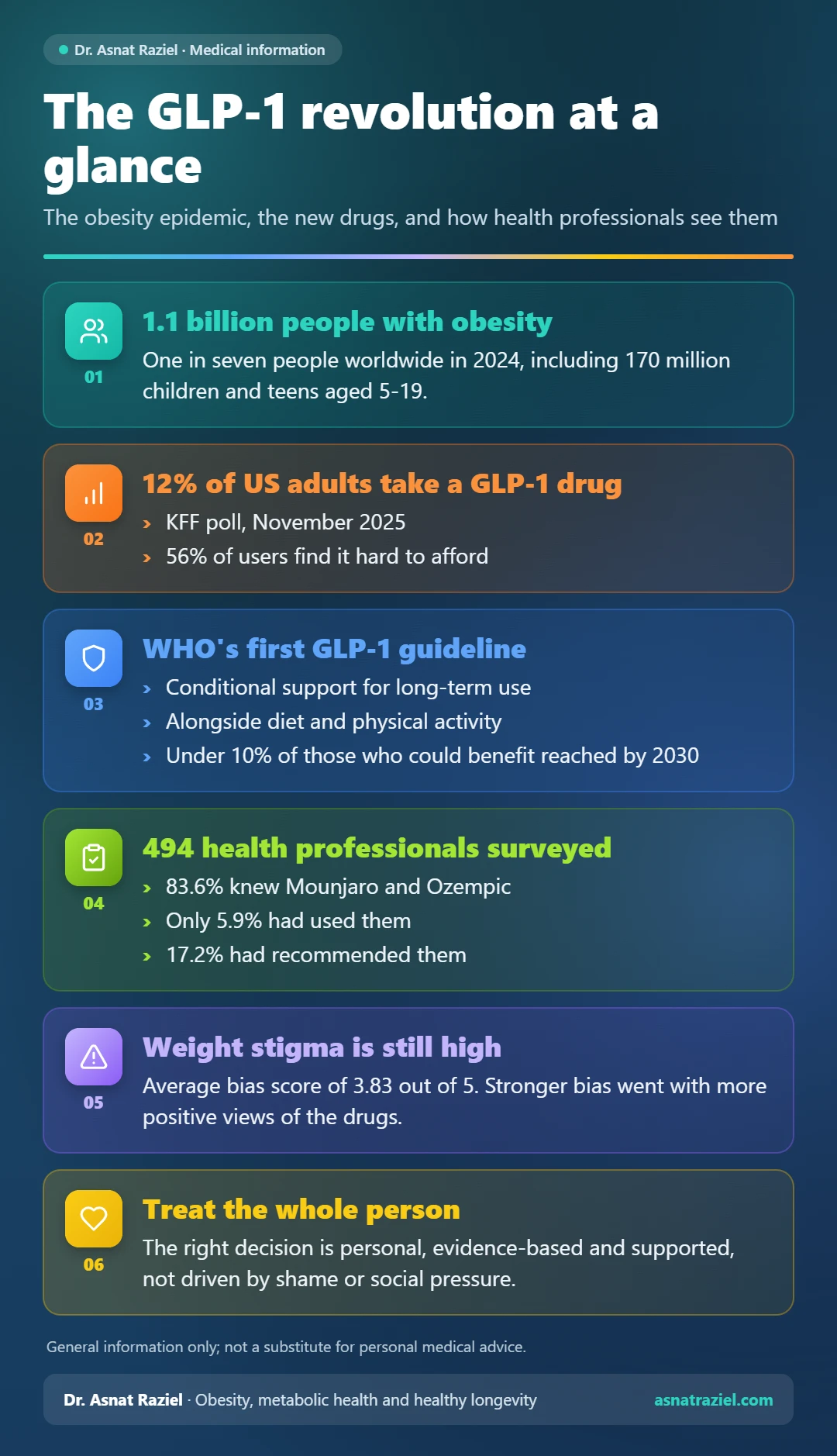
According to the World Health Organization fact sheet, 1.1 billion people worldwide were living with obesity in 2024. In other words, that is one in every seven people. Among adults, 2.6 billion had overweight, and 940 million of them had obesity. Children are part of the picture, too: 170 million children and teens aged 5-19 live with obesity.
These numbers are not just statistics. In fact, the obesity epidemic is one of the greatest challenges facing medicine in our generation. Obesity raises the risk of type 2 diabetes, heart disease, fatty liver disease and many types of cancer. I wrote about the differences between countries and regions in my article on obesity around the world.
The second wave: the GLP-1 revolution in medicine
Meanwhile, the GLP-1 revolution has spread fast. In a KFF poll from November 2025, 12% of US adults said they were currently taking a GLP-1 drug. Even so, 56% of users said the drug was hard to afford.
In December 2025, the World Health Organization published its first global guideline on GLP-1 medicines for obesity. The guideline makes a conditional recommendation for long-term treatment in adults, alongside diet and physical activity. On the other hand, the WHO estimates that by 2030 these drugs will reach fewer than 10% of the people who could benefit. Meanwhile, the wave rolls on. The Wegovy pill (oral semaglutide) won FDA approval in December 2025, and Foundayo (orforglipron) followed in April 2026. You can find a side-by-side comparison in my article on the Wegovy pill and Foundayo.
Health professionals and the obesity epidemic: what the research shows
So what do health professionals themselves think about the GLP-1 revolution? A study published in May 2025 explored this question in four Middle Eastern countries: Kuwait, Egypt, Saudi Arabia and Jordan. The final sample included 494 doctors, pharmacists, and medical and pharmacy students. Most were young, most were women, and most were still in training.
On the one hand, awareness was high: 83.6% knew Mounjaro and Ozempic at least to some degree. On the other hand, only 5.9% had used them personally, and 17.2% had recommended them for weight loss. In short, everyone talks about these drugs, but few feel comfortable using them. A full analysis of the study, with all the data, appears in my article on how professionals view weight loss injections.
The stigma that still follows obesity
One of the study’s most important contributions is its focus on bias against obesity. The researchers asked participants how much they agreed with statements such as “excess weight comes from a lack of self-control” or “people with obesity are less productive.” The average score was 3.83 out of 5. That means a clear tendency to agree.
In addition, men expressed more stigma than women, and pharmacists scored highest of all the professional groups. There were also cultural gaps between countries. This stigma is especially harmful during an obesity epidemic, because it keeps people away from care. Instead of help, it breeds shame. I wrote about the damage stigma does to health in my article on weight stigma.
The surprising link between stigma and the drugs
Here comes the fascinating finding. The stronger the bias against obesity, the more positive the attitude toward the drugs. The correlation was weak, but it was statistically significant. Put simply, people who see obesity as a personal failure tend to favor a strong, fast drug fix. The researchers warn that this support may come for the wrong reasons.
This is a subtle finding, but an important one. It shows how unconscious attitudes and emotions shape medical decisions. On average, attitudes toward the drugs were slightly negative: 2.70 out of 5. The statements that drew the most agreement dealt with the high price and the side effects.
Who supports the drugs and who hesitates
The picture is far from black and white. Doctors and pharmacists, who have broad clinical exposure, held the most positive views. Likewise, people who had tried other weight loss drugs in the past supported treatment. Medical students, by contrast, were the most cautious.
The surprising result concerns people who had already used Mounjaro or Ozempic, or had recommended them. In the simple analysis, they were actually the most positive. However, once the analysis accounted for all the factors together, the link reversed. The researchers suggest that real-world experience reveals more than successes. It also brings side effects, disappointments, trouble sticking with treatment and costs that weigh on patients.
The concerns hanging over the GLP-1 revolution
In their discussion, the researchers reviewed the concerns raised in the medical literature:
- Fear of psychiatric side effects.
- Reports of use without medical supervision.
- Counterfeit drugs.
- High prices and uncertainty about long-term treatment.
Some of these points need an update. In April 2024, the safety committee of the European Medicines Agency concluded that the evidence does not support a causal link between these drugs and suicidal thoughts. I covered this in more depth in my article on GLP-1 drugs and mental health. On the other hand, the fear of fakes is real. In June 2024, the World Health Organization issued a warning about falsified semaglutide. Price also remains a barrier, as I explained in my guide to the cost of obesity medication.
So what’s the takeaway?
The drugs behind the GLP-1 revolution are a real breakthrough, but they are not a magic bullet. The study reminds us that treatment decisions rest not only on science but also on culture, emotions, fears and stigma. Facing the obesity epidemic, we cannot afford to give up an effective tool. At the same time, we have no right to use it without thought. So the message for health professionals is clear:
- Deepen your knowledge instead of relying on headlines.
- Reduce stigma toward obesity.
- Consider medication as part of a broad, personal approach.
- Remember that a patient is not a “problem” but a whole person, with a body, a mind and a life.
Bottom line: the GLP-1 revolution calls for wisdom
The obesity epidemic and the wave of new drugs are already here, and both will keep growing. The real challenge is to manage the GLP-1 revolution wisely and responsibly. Ultimately, a decision to start medication is right when it is personal, evidence-based and supported by a care team. It is not right when it grows out of shame or social pressure. That is how we protect the humanity at the heart of medicine.
This article provides general information and is not a substitute for personal medical advice.
References
WHO issues global guideline on the use of GLP-1 medicines in treating obesity
Meeting highlights from the Pharmacovigilance Risk Assessment Committee (PRAC) 8-11 April 2024
WHO issues warning on falsified medicines used for diabetes treatment and weight loss




