By Dr. Asnat Raziel, bariatric surgeon specializing in obesity treatment, metabolic health and healthy longevity; Director of the Multidisciplinary Center for Obesity Treatment, Assia Medical, Assuta Ramat HaChayal, Tel Aviv
A dementia blood test: can blood reveal risk years ahead?
A dementia blood test that could flag risk years before symptoms appear is one of the great dreams of preventive medicine. A new study brings us one step closer. The researchers found that tiny molecules in the blood, called metabolites, reflect the health of the brain. What’s more, our lifestyle has a major influence on them.
This question is a hot topic in the field of healthy longevity. Can we tell in midlife what the brain will look like twenty or thirty years from now? And does the body leave early clues, long before memory problems or a diagnosis of dementia?
A metabolic fingerprint of the brain
The journal Nature Aging published the study in June 2026. The researchers identified a kind of “metabolic fingerprint” in the blood that is linked to brain health. Moreover, they found that everyday habits shape this pattern.
The possible implications are far-reaching. In the future, we may be able to identify people at risk while the brain is still working well. That would make it possible to offer early, personalized intervention before any damage appears.
The brain leaves traces in the blood
For years, Alzheimer’s researchers focused on proteins that build up in the brain, such as amyloid and tau. Today, however, it is clear that the picture is much broader. Thousands of metabolites, the by-products of metabolism, circulate in our blood.
Metabolites reflect almost every aspect of our lives. For example, they reflect what we eat, how we sleep, whether we exercise or smoke, and which medications we take. Gut bacteria also affect them. That is why they offer a “window” into the state of the body, and now, it turns out, into the state of the brain as well.
What the dementia blood test study examined
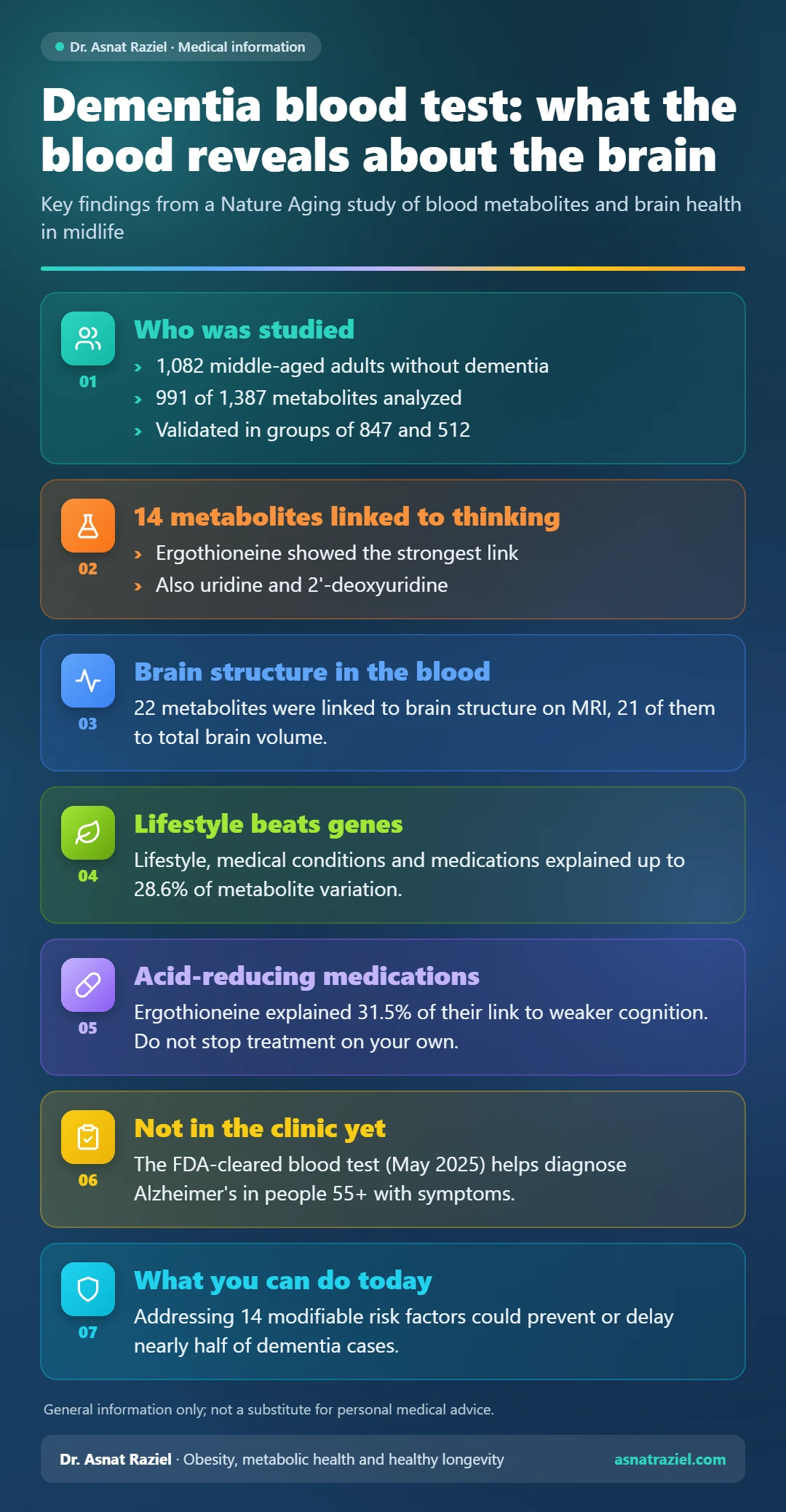
The researchers studied 1,082 middle-aged participants without dementia from the large Rotterdam Study population cohort in the Netherlands. They measured 1,387 metabolites in the blood, and after quality control, 991 remained for analysis. Next, they compared these levels with performance on tests of memory, attention and processing speed. In addition, the participants underwent brain MRI scans.
To make sure the findings were reliable, and as detailed in the full paper, the researchers repeated the analysis in two independent groups of adults. The first included 847 participants from the same Dutch study. The second included 512 participants from an American study on the microbiome and Alzheimer’s disease.
14 metabolites that tell the brain’s story
The researchers identified 14 metabolites linked to thinking abilities, and the link held up in the validation groups as well. Among them, a few stood out:
- Ergothioneine, a natural antioxidant that comes mainly from mushrooms. It showed the strongest link.
- Uridine and 2′-deoxyuridine, molecules involved in building nucleic acids.
Higher levels of these compounds went hand in hand with better scores on thinking tests. In contrast, seven compounds from external sources, which the researchers call xenobiotics, went hand in hand with weaker scores. To be precise, after adjusting for smoking, diabetes and blood pressure, these links weakened and no longer met the strict statistical threshold.
Furthermore, the metabolic signature of good cognition was a mirror image of the signature seen in people who later developed Alzheimer’s disease. This finding strengthens the possibility that these are true biomarkers.
Brain structure was reflected in the blood, too
On the MRI scans, the researchers identified 22 metabolites linked to brain structure. Of these, 21 related to total brain volume. One metabolite showed a link to white matter lesions, an early sign of damage to small blood vessels. On the other hand, no metabolite showed a link to the volume of the hippocampus, the brain’s main memory hub. Perhaps the metabolic changes appear even before this area is affected.
The microbiome and lifestyle enter the picture
One of the surprises was the link to gut bacteria. A total of 22 metabolites tied to cognition and brain structure appeared together with a particular microbiome makeup. For example, high ergothioneine levels appeared together with 12 types of bacteria. I wrote about the connection between the gut and aging in my article on the microbiome and biological age.
The key message: genes do not determine most of the picture. Lifestyle, medical conditions and medications explained up to 28.6% of the variation in metabolites. Lifestyle factors showed links to 13 of the 14 cognition metabolites. For instance, smoking appeared together with high levels of the harmful compounds. Excess weight and alcohol intake also showed links to 20 brain-structure metabolites. Diabetes and diabetes medications showed many links as well. The connection between weight and the brain also comes up in my article on obesity and brain health.
Ergothioneine and acid-reducing medications
Ergothioneine drew most of the attention. It is an antioxidant that scientists have studied in the context of aging, inflammation and protection of the nervous system. In addition, the researchers found a link between the use of acid-reducing medications, weaker cognition and low ergothioneine levels. According to the analysis, ergothioneine explained 31.5% of this negative association.
Still, the researchers stress that this is only a statistical association. We should not conclude that these medications cause dementia, and no one should stop treatment without talking to a doctor. The finding justifies more research, not a change in treatment.
Is there already a dementia blood test?
It is important to separate two things. The metabolite test from this study is not yet available in the clinic. By contrast, in May 2025 the FDA cleared the first blood test that helps diagnose Alzheimer’s disease. The test measures the ratio between the proteins pTau217 and beta-amyloid 42. However, it is intended for people aged 55 and older who already have symptoms, not for screening healthy people.
In other words, a dementia blood test that predicts risk in midlife is still a research goal. Researchers will need long-term studies to turn these findings into a routine medical tool.
What you can do today
The good news is that you don’t need to wait for a test. In 2024, the Lancet Commission on dementia identified fourteen modifiable risk factors. According to a news release from UCL, addressing them could prevent or delay nearly half of dementia cases. They include obesity, diabetes, high blood pressure, smoking, physical inactivity, hearing loss, loneliness and high LDL cholesterol in midlife.
Good sleep also matters a great deal for the brain, as I explained in my article on sleep and brain health. It is also worth knowing the risks of prolonged screen time.
The bottom line on a dementia blood test
The medicine of the future does not wait for disease. Instead, it looks for the first biological changes, while there is still time to change course. Ultimately, a midlife dementia blood test may become part of routine checkups, alongside blood sugar and cholesterol. Until then, our everyday choices are already shaping the chemistry of our blood, and probably the future of our brain as well.
The information in this article is general and does not replace personal medical advice.
References
The blood metabolome of brain health in midlife and influences of genes, microbiome and exposome
FDA Clears First Blood Test Used in Diagnosing Alzheimer’s Disease
Dementia prevention, intervention, and care: 2024 report of the Lancet standing Commission
Nearly half of dementia cases could be prevented or delayed by tackling 14 risk factors




