By Dr. Asnat Raziel, bariatric surgeon specializing in obesity treatment, metabolic health and healthy longevity; Director of the Multidisciplinary Center for Obesity Treatment, Assia Medical, Assuta Ramat HaChayal, Tel Aviv
Organ regeneration: does the body have an electrical blueprint?
Organ regeneration is one of medicine’s greatest dreams. When we think about electricity in the body, we usually think of the brain, the nerves and the heart. Neurons transmit signals, the heart produces activity we can measure on an ECG, and muscles contract in response to stimulation. However, the work of biologist Prof. Michael Levin of Tufts University offers a much broader picture.
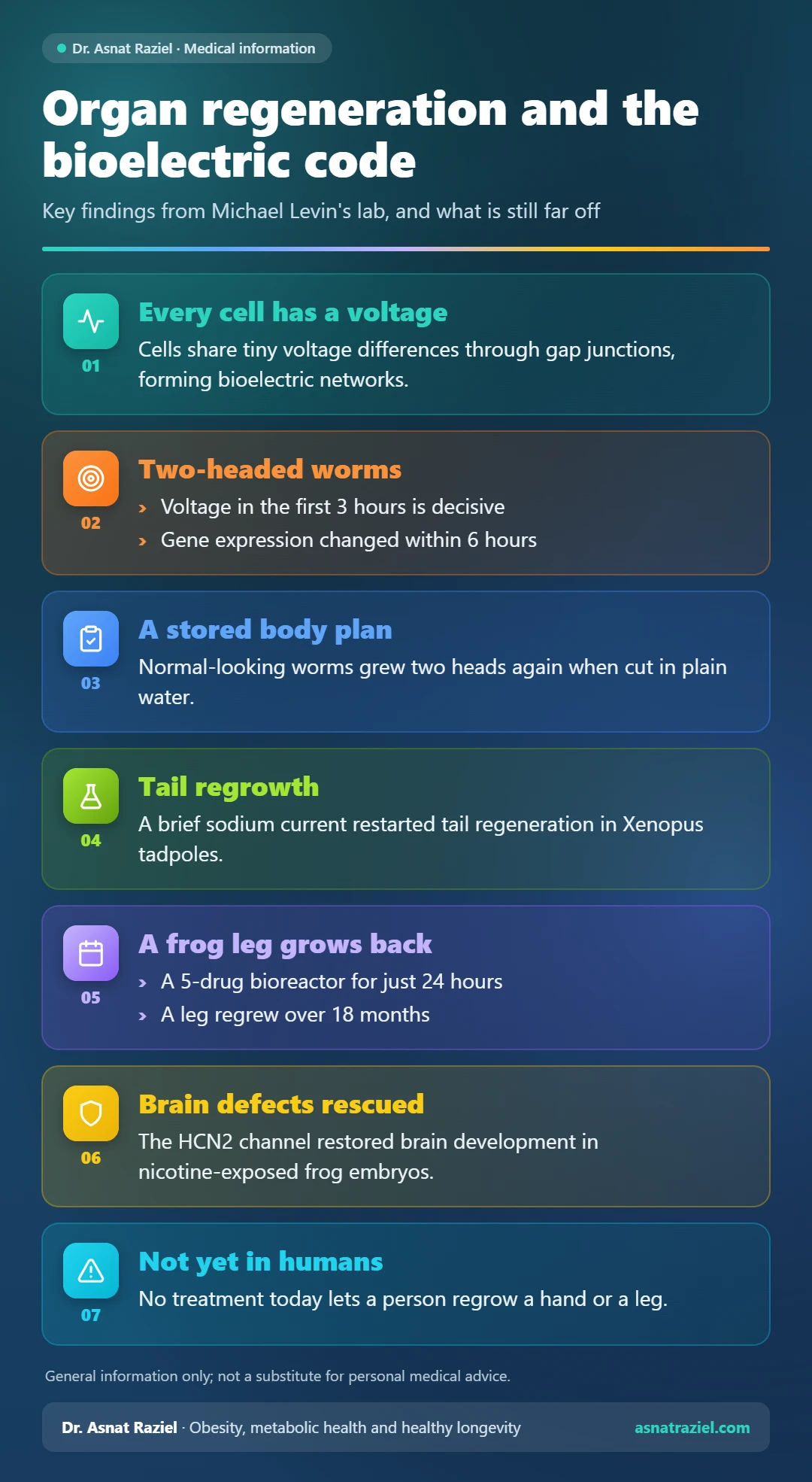
According to Levin, almost every cell in the body holds an electrical voltage across its membrane. In addition, groups of cells form networks of bioelectric communication. These networks help decide where an organ will form, how big it will be, and where the head and tail go. They also take part in repairing tissue after injury. The central idea is fascinating. Perhaps in the future we will not build an organ cell by cell. Instead, we will give the tissue the right instructions, and the body will build it on its own.
Michael Levin: between biology, computers and regenerative medicine
Prof. Levin studies developmental biology and regenerative medicine, that is, medicine that renews tissue. He directs the Allen Discovery Center at Tufts University. His background is unusual: alongside biology and genetics, he also studied computer science. That is why he asks a question that sounds like it comes from a software engineer. How do billions of cells know, together, what shape to build?
DNA is of course essential. Still, genes alone do not simply explain how many cells coordinate to build a hand, an eye or a brain. Nor do they explain how certain creatures know, after an injury, what is missing and when to stop.
Every cell in the body has an electrical voltage
The cell membrane separates the inside of the cell from its surroundings. Charged ions, such as sodium, potassium, chloride, calcium and hydrogen, are spread unevenly on both sides of the membrane. Pumps and ion channels control their movement, and this creates a membrane voltage.
We know this phenomenon from nerve and muscle cells. But this kind of voltage also exists in ordinary cells. Moreover, cells talk to one another through gap junctions, which are direct channels that pass ions and small molecules between cells. In this way, a whole tissue forms a bioelectric network. This electricity is nothing like the current in a household cable. These are tiny voltage differences, yet they may carry a great deal of information.
Electricity as the body’s “software”
Levin uses an analogy from the world of computers. Genes provide a central part of the “hardware.” However, to build a complex structure, the body also needs a system of information and control. According to his review in the journal Cell, voltage patterns affect gene expression, cell division and cell differentiation. In this sense, voltage is not just a by-product. It is an instructive signal that guides morphogenesis, the process by which tissues take on their shape.
The worm that rebuilds itself
One of the most impressive models in the lab is a flatworm called planaria. When you cut one, each piece regrows what is missing. A piece without a head grows a head, and a piece without a tail grows a tail. This raises an astonishing question: how does the wound know whether to build a head or a tail?
The same stem cells are found throughout the body. So the tissue must know what is missing and where it is located. A 2019 study showed that the electrical state during the first three hours after cutting is decisive. When researchers briefly changed the voltage in the injured tissue, gene expression changed within six hours. By the end of regeneration, the worms had grown two heads.
What happens when you change the “electrical instructions”?
The DNA of these worms did not change. The researchers did not rewrite the genome; instead, they changed the state of the communication network between the cells. What’s more, in a 2017 experiment, the change persisted through later cuts. Worms that looked completely normal grew two heads again when they were cut in plain water. That is why the researchers suggest that the electrical network stores a kind of memory of the target shape. This does not mean the body holds a simple “electrical picture” of itself. Even so, the finding supports the idea that anatomical information is not written in DNA alone.
Organ regeneration without building organs cell by cell
This may be the most important part for the medicine of the future. To build a hand, you would seemingly need to design bones, muscles, blood vessels, nerves, skin and tendons. In addition, every component would have to sit in exactly the right place. That is an almost impossible engineering task.
Levin’s approach offers another path: rather than building the hand, give the tissue the signal that switches on its building program. For example, in Xenopus frog tadpoles, a brief sodium current restarted tail regeneration. This happened even under conditions in which the tail normally does not regrow. The implications are huge: a relatively simple signal can trigger a complex chain of events that the tissue already “knows” how to carry out.
Organ regeneration in limbs: the frog experiment
Adult frogs, like humans, almost never regrow an amputated leg. In a study published in 2022, researchers fitted a wearable “bioreactor” over the stump. The device delivered a mix of five drugs for just 24 hours. Over 18 months of follow-up, a leg grew back with skin, bone, blood vessels and nerves, and the frogs used it to swim and respond to touch.
The long-term goal is clear: to move tissue from a scarring mode to a regenerating mode. But it is important to separate the vision from reality. As of November 2026, there is no treatment that lets a person regrow a hand or a leg. Most of the work is still done in worms, amphibians and other animals, and the road to humans is long.
Fixing birth defects in the lab
This is another fascinating area. Nicotine, for example, harms brain development in frog embryos. In a study in the journal Nature Communications, researchers introduced an ion channel called HCN2 into the embryos. The channel restored the natural voltage pattern, and the brain developed almost normally. In addition, the tadpoles’ learning ability returned to near normal.
The idea is almost revolutionary: damage to a developmental pathway is not always the end of the story. It may be possible to intervene downstream, further along the chain of events, and get a much better outcome. Still, it must be emphasized that this is basic research in animals. Today, birth defects in humans cannot be treated this way.
Eyes in unexpected places
In an experiment in Xenopus embryos, researchers changed the voltage of cells that were not eye cells. As a result, complete eyes grew in unusual places, even far from the head region. Structurally, these eyes resembled normal eyes. The finding illustrates a deep principle: cells are not passive bricks. They respond to signals at the tissue level and carry out complex building programs.
And what about cancer?
A cancer cell is not just a cell that divides quickly. In a sense, it stops cooperating with the tissue and goes it alone. Levin is exploring the possibility that the electrical network keeps cells inside the body’s “shared project.” In animal models, changes in membrane voltage affected tumor-like behavior. This is still a research field, not a cancer treatment. Nevertheless, it raises an interesting direction: perhaps one day we will also try to bring cells back under the tissue’s control, not only kill them. I wrote about weight and cancer, among other conditions, in my article on obesity-related diseases.
The body as a collective intelligence of cells
This brings us to Levin’s broadest idea. Each cell senses its surroundings, processes information and responds. When billions of cells connect, they form a system that solves problems on a large scale. A wound, for example, is a problem: “something is missing here.” The system has to figure out what is missing, how much to grow, what structure to build and when to stop. A planarian does not grow heads endlessly, and a salamander does not grow a leg two meters long. Levin calls this collective intelligence, a shared intelligence of cells.
Organ regeneration and longevity
Today’s longevity medicine focuses mainly on slowing damage. It protects muscle, metabolic health and the heart through movement, sleep and nutrition. I discussed these tools in my article on what longevity medicine offers today. In the future, a far more ambitious goal may be added: giving tissues back the ability to repair themselves.
Aging brings a decline in regenerative capacity, changes in stem cells and inflammation. If we understand the control system that guides cells, regenerative medicine could become deeply integrated with longevity medicine. The goal is not to live forever, but to preserve and restore function. Related topics appear in my articles on peptides in medicine and on epigenetic aging clocks.
The bottom line on organ regeneration
Bioelectric research changes the central question of regenerative medicine. Instead of asking “How do we build an organ?”, we can ask “What information does the body need to build it on its own?” In the future, ion channel drugs, wound devices, tissue engineering and perhaps AI tools may all work together. Even so, we are still far from regrowing a new hand or fixing a complex birth defect in humans. Ultimately, the experiments in planaria and frogs show that organ regeneration is no longer pure science fiction. The question is how well we will learn to speak the language that cells already use.
The information in this article is general and does not replace personal medical advice.
References
Bioelectric signaling: Reprogrammable circuits underlying embryogenesis, regeneration, and cancer
The Role of Early Bioelectric Signals in the Regeneration of Planarian Anterior/Posterior Polarity
Long-Term, Stochastic Editing of Regenerative Anatomy via Targeting Endogenous Bioelectric Gradients
Induction of vertebrate regeneration by a transient sodium current
HCN2 Rescues brain defects by enforcing endogenous voltage pre-patterns
Transmembrane voltage potential controls embryonic eye patterning in Xenopus laevis




