By Dr. Asnat Raziel, bariatric surgeon specializing in obesity treatment, metabolic health and healthy longevity; Director of the Multidisciplinary Center for Obesity Treatment, Assia Medical, Assuta Ramat HaChayal, Tel Aviv
Peptides in medicine: why is everyone talking about them?
Peptides in medicine have become one of the hottest buzzwords in the United States in recent years. They come up in conversations about weight loss, diabetes, fatty liver and sleep apnea. In addition, people talk about them in the context of muscle recovery, younger-looking skin, inflammation, libido and even longevity.
But it is worth pausing here for a moment. Not everything called a “peptide” is a proven medical treatment. Some peptides are approved, life-changing drugs. Others are experimental substances that are very popular in wellness clinics and biohacking communities, where people try to upgrade their bodies with unconventional methods. Most of them have no FDA approval and not enough human research. That is exactly what makes this field fascinating, and also dangerous.
What exactly is a peptide?
A peptide is a short chain of amino acids. You can think of it as a “short sentence” in the body’s biological language. Proteins are like whole books, whereas peptides are short, precise instructions.
In fact, the body uses peptides all the time. Insulin, GLP-1, glucagon, oxytocin and melanocortins are all examples. So it is easy to understand why the drug world fell in love with them. After all, they talk directly to receptors and switch on biological pathways. In this way, they affect hunger, fullness, blood sugar, inflammation, the liver, muscle and the brain. You can read about how fullness works in my article on the physiology of satiety.
Peptides in medicine that have already changed obesity care
The most important group today is the incretin family. These are not “wellness supplements.” They are prescription drugs that researchers have tested in large studies.
Semaglutide
Semaglutide, known as Ozempic, Wegovy and Rybelsus, mimics the hormone GLP-1, which the gut releases after eating. It increases fullness, slows stomach emptying, improves blood sugar and leads to significant weight loss. In the United States, regulators have approved it for diabetes, obesity and reducing cardiovascular risk. In 2025, it also received approval for treating metabolic fatty liver disease. Common side effects include nausea, constipation, diarrhea, vomiting and heartburn.
Tirzepatide
Tirzepatide, known as Mounjaro and Zepbound, acts on two receptors: GIP and GLP-1. Clinically, it is one of the most effective drugs for weight loss and type 2 diabetes. The FDA has also approved it for moderate to severe obstructive sleep apnea in people with obesity.
Liraglutide and dulaglutide
Liraglutide, known as Saxenda and Victoza, was one of the first-generation GLP-1 drugs for obesity. Patients inject it daily, so it is less convenient. Doctors use dulaglutide, known as Trulicity, mainly for type 2 diabetes, and it has a modest effect on weight.
Peptides in medicine: the next generation of obesity drugs
The future is already moving beyond GLP-1 alone. For example, retatrutide acts on three receptors: GLP-1, GIP and glucagon. The idea is to reduce hunger and also affect energy expenditure, the liver and belly fat. As of October 2026, it is still experimental, and no regulator has approved it. I write more about it in my article on retatrutide.
In addition, survodutide combines GLP-1 and glucagon activity. In the SYNCHRONIZE-1 trial, participants without diabetes lost up to 16.6% of their body weight after 76 weeks, compared with 3.2% on placebo. Mazdutide also acts on GLP-1 and glucagon. China approved it in June 2025, but the United States has not. In other words, the field is moving toward multi-receptor drugs that affect fullness, blood sugar, the liver and belly fat.
Other medical peptides already in use
Tesamorelin is an FDA-approved peptide for reducing belly fat in people with HIV and lipodystrophy. Specifically, it works by stimulating the release of growth hormone. This is a defined medical treatment, not general “anti-aging.”
Setmelanotide acts on the melanocortin pathway in the brain. The FDA has approved it for rare genetic forms of severe obesity, such as POMC, PCSK1 or LEPR deficiency and Bardet-Biedl syndrome. In March 2026, the FDA expanded its approval to acquired hypothalamic obesity from age 4. This peptide reminds us that obesity is not a “lack of willpower.” Sometimes it is a deep biological fault in the hunger and fullness pathways.
Peptides in medicine vs. the wellness world
This is where the gray zone begins. In the United States, names like BPC-157, TB-500, CJC-1295, ipamorelin, MOTS-c, Epitalon, KPV and Semax are common. Private clinics sell them, as do websites offering “research chemicals,” substances labeled “for research only.” The promises are big: healing tendons, building muscle, better sleep, sharper memory and anti-aging.
However, the FDA has not approved any of them as a drug. Some have interesting animal or cell studies, but large, controlled human studies are missing. This year, the regulatory picture changed. In July 2026, the FDA’s pharmacy compounding advisory committee recommended allowing pharmacies to compound six peptides, including BPC-157, TB-500, KPV and MOTS-c. The vote on the first three was close: 8 in favor and 6 against. Even so, the recommendation is not a drug approval, and it says nothing about effectiveness. According to an October 2026 legal review, the FDA has not yet completed the process.
What we know about the popular peptides
Sellers promote BPC-157 for injury recovery and for the digestive system. However, the human evidence is very limited. There are also safety questions, including a possible effect on angiogenesis, the formation of new blood vessels. That is why special caution is needed when it comes to cancer. TB-500 comes with claims of tissue healing, and here too the gap between marketing and evidence is wide.
CJC-1295 and ipamorelin stimulate growth hormone release. Yet stimulating this axis is not a harmless game. It may affect blood sugar and cause swelling, joint pain and carpal tunnel syndrome. MOTS-c is a peptide of mitochondrial origin that researchers are studying in relation to metabolism and aging. The idea is beautiful, but the excitement is running ahead of the evidence. Likewise, Epitalon, promoted as telomere-related, still has no strong clinical basis.
Peptides in medicine and the problem of sourcing
One of the biggest dangers is not only the substance itself, but its quality. For peptides in medicine, quality is everything. Some online sellers label peptides “Research Use Only,” but in practice buyers inject them into themselves. For example, in March 2026 the FDA sent a warning letter to a company that sold retatrutide and tirzepatide under such a label. According to the FDA, the label does not change the fact that the company intended the products for human use.
When a company does not manufacture a substance as an approved drug, there is no certainty about its purity, dose, sterility, stability or contamination. With injections, this is an especially serious problem, because the substance goes directly into the body.
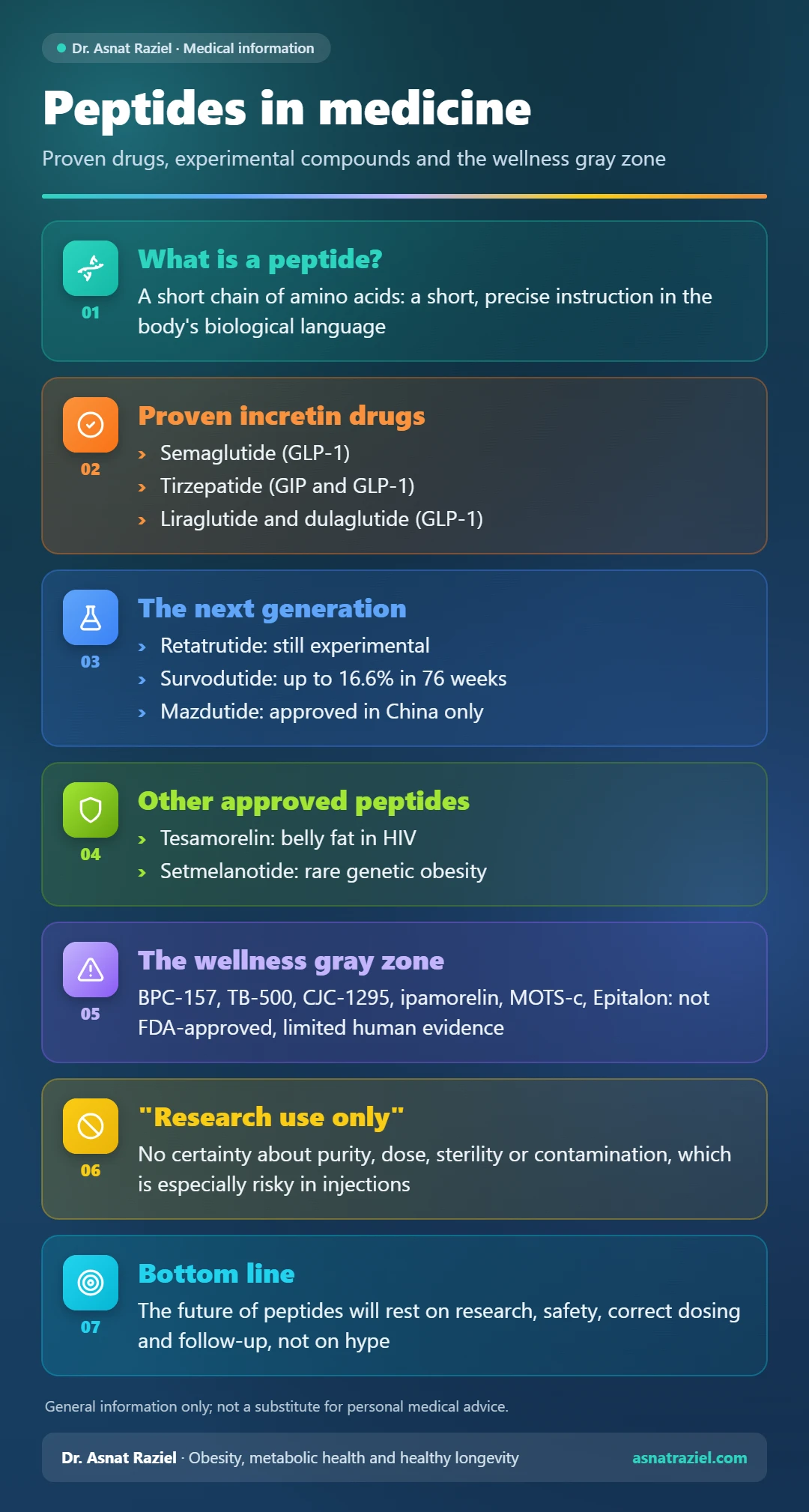
Quick summary: the key names
- Semaglutide – GLP-1: diabetes, obesity, heart protection and metabolic fatty liver disease.
- Tirzepatide – GIP/GLP-1: diabetes, obesity and sleep apnea in obesity.
- Liraglutide – GLP-1: diabetes and obesity, as a daily injection.
- Dulaglutide – GLP-1: type 2 diabetes, with a modest effect on weight.
- Tesamorelin – GHRH analog: reducing belly fat in HIV.
- Setmelanotide – MC4R agonist: rare genetic obesity and hypothalamic obesity.
- Retatrutide – GLP-1/GIP/glucagon: experimental.
- Survodutide – GLP-1/glucagon: experimental, for obesity and fatty liver.
- BPC-157 and TB-500: not approved, limited human evidence.
- CJC-1295 and ipamorelin: growth hormone stimulation, not approved for anti-aging.
- MOTS-c and Epitalon: an intriguing research area, not a proven treatment.
Bottom line on peptides in medicine
An approved peptide, tested in large studies, with a clear dose, regulated manufacturing and medical follow-up, is a drug. In contrast, a peptide from the internet, in an unclear syringe and with promises of healing and longevity, is not necessarily medicine. Sometimes it is an uncontrolled experiment on your own body.
Ultimately, peptides in medicine are an old-new biological language. The body has always spoken it, and medicine is only now learning to use it precisely. The future probably belongs to peptides. But we will build it on research, safety, correct dosing and responsible follow-up, not on hype. For a broad review of the drugs on the way, see my article on new weight loss injections.
The information in this article is general and does not replace personal medical advice.
References
Bulk-list bound? PCAC backs majority of peptides in two-day public meeting
Peptides at a Crossroads: What Wellness Providers Need to Know About HHS and FDA Actions
FDA Warning Letter: Gram Peptides (March 31, 2026)
Survodutide delivers 16.6% weight loss in major phase 3 obesity trial
FDA approves setmelanotide for acquired hypothalamic obesity in ages 4 years and older