By Dr. Asnat Raziel, bariatric surgeon specializing in obesity treatment, metabolic health and healthy longevity; Director of the Multidisciplinary Center for Obesity Treatment, Assia Medical, Assuta Ramat HaChayal, Tel Aviv
Accelerated aging in young adults: what has changed?
Accelerated aging in young adults is a topic science barely discussed a decade ago. We used to think aging began only in the later decades of life. Today the picture is completely different. New studies show that the biological clock starts to change at a young age, and sometimes faster than in previous generations. The good news is that aging is not just a matter of chronological age. To a large extent, it depends on how we live.
The age on your ID card is no longer what matters most
Two 40-year-olds can be far apart biologically. In one, the blood vessels, muscles and brain work like those of someone a decade younger. The other, by contrast, already shows early signs of chronic disease.
That is exactly why “biological age” has become one of the most intriguing areas of longevity medicine. Today we can estimate the pace of aging with biomarkers. Examples include epigenetic changes, chronic inflammation, mitochondrial function, muscle mass, the immune system and blood vessel health.
What studies show about accelerated aging in young adults
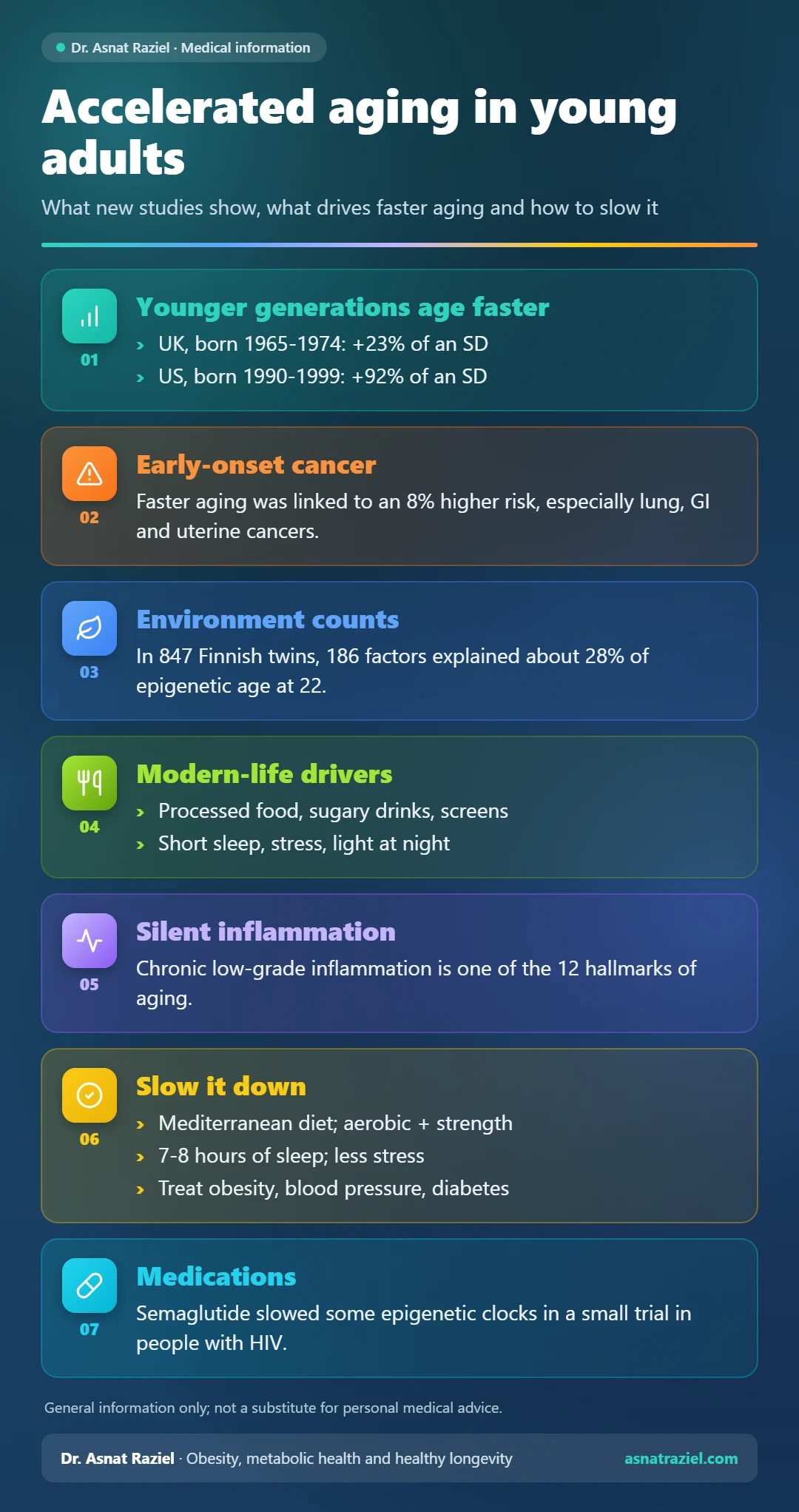
In June 2026, Nature Medicine published a study on biological aging and generational shifts. The researchers examined 154,169 young adults in the UK Biobank database and another 10,262 participants in the American All of Us program. They estimated biological age from routine blood tests. In the UK, people born in 1965-1974 showed accelerated aging of 23% of a standard deviation compared with those born in 1950-1954. In the US, people born in 1990-1999 showed accelerated aging of 92% of a standard deviation compared with those born in 1965-1969.
What’s more, according to a summary of the findings, accelerated aging was linked to an 8% higher risk of early-onset cancer. The link stood out for lung, gastrointestinal and uterine cancers. However, this is an observational study. It shows an association, but it does not prove cause and effect.
Another study from Finland reached a similar conclusion. In a twin study published in Environment International, researchers followed 847 young people from age 12 to age 22. They examined 186 lifestyle and environmental factors. Together, these factors explained about 28% of the differences in epigenetic age at 22. Smoking, alcohol and higher youth unemployment in the neighborhood were linked to faster aging. On the other hand, tree cover and greenery in the residential area were linked to slower aging.
Why is the younger generation aging faster than before?
There is no single cause. Instead, several dramatic lifestyle changes come together. First, a Western diet rich in processed foods and sugary drinks creates an ongoing metabolic burden. You can read about this in my article on ultra-processed food and the brain. Second, long hours in front of screens reduce daily activity and muscle mass.
On top of that come chronic sleep deprivation, stress, exposure to artificial light at night, fewer social connections and rising obesity rates. Each factor affects aging on its own. But when they appear together, they may cause real acceleration. You can read about the damage of short nights in my article on the effects of sleep deprivation.
The silent inflammation that ages with us
One of the key mechanisms is chronic low-grade inflammation. In this state, the immune system is always switched on, even without an infection or acute illness. In the well-known review of the hallmarks of aging in the journal Cell, chronic inflammation is one of the 12 hallmarks.
This inflammation goes hand in hand with abdominal obesity, insulin resistance, fatty liver and damage to blood vessels. Over time, it contributes to heart disease, diabetes, dementia and some types of cancer. That is why the link between inflammation, the microbiome and obesity is now at the center of research.
Obesity is not just a weight problem
Today it is clear that obesity is a metabolic disease that affects almost every system in the body. Fat tissue, and especially the visceral fat that builds up around the abdominal organs, releases substances that promote inflammation. It also disrupts hormonal balance and speeds up aging. So treating obesity is not about appearance. It is a central part of preventing disease and protecting healthy years.
Can accelerated aging be slowed in young adults?
Fortunately, the answer is yes. Even after years of unhealthy habits, you can influence the pace of aging. The foundation is a combination of healthy habits:
- A Mediterranean diet rich in vegetables, legumes, fish and olive oil.
- Aerobic activity alongside strength training to preserve muscle mass.
- Quality sleep of seven to eight hours a night.
- Lower stress and strong social connections.
- Treating risk factors: obesity, high blood pressure, diabetes and smoking.
Keep in mind that you do not need to change everything at once. For example, a daily walk, an early dinner and a regular bedtime are a good first step. Later, you can add strength training and periodic blood tests. That way, the new habits last over time.
As for the type of exercise, it is worth reading my comparison of aerobic and strength training.
In recent years, innovative obesity medications have also joined the picture, including drugs that act on the hormones GLP-1 and GIP. Beyond weight loss, they reduce inflammation and protect the heart, liver and kidneys. Researchers are now also examining their effect on biological age. For example, in a randomized trial of semaglutide (Ozempic/Wegovy) published in May 2026, the drug slowed several epigenetic clocks in people with HIV. However, this was a small trial in a specific population. I discuss this further in my article on weight-loss drugs and biological age.
The bottom line on accelerated aging
The medicine of the future does not only treat diseases that have already appeared. Instead, it detects aging processes early and tries to slow them down. Soon we may ask, “What is your biological age, and what can you do to improve it?” This is no longer a theoretical idea. For one research direction, see my article on anti-aging drug screening.
Ultimately, accelerated aging in young adults is a challenge for the current generation. The goal is not only to live many years, but to make sure those years are healthy and active. This is the difference between lifespan, how long we live, and healthspan, the number of years we live in good health and function well. This will most likely be one of the most important measures in medicine in the coming decades.
The information in this article is general and does not replace personal medical advice.
References
Biological aging and generational shifts in early-onset cancer risk
Faster biological aging may explain rising early-onset cancers
Hallmarks of aging: An expanding universe
Semaglutide slows epigenetic aging in a randomized trial of HIV-associated lipohypertrophy




