By Dr. Asnat Raziel, bariatric surgeon specializing in obesity treatment, metabolic health and healthy longevity; Director of the Multidisciplinary Center for Obesity Treatment, Assia Medical, Assuta Ramat HaChayal, Tel Aviv
Aging clocks and weight-loss drugs: what’s new?
Weight-loss drugs such as Wegovy and Mounjaro have made headlines thanks to new data from aging clocks. Novo Nordisk and Eli Lilly report that the biological age of patients on the drugs advanced more slowly than expected. Novo Nordisk speaks of a gap of about two to three years compared with placebo. Keep in mind, however, that this gap was measured with molecular aging clocks, not with actual life expectancy. So what exactly do aging clocks measure, and how far can we trust them? In this article, I focus on the clocks themselves. What do they measure, what do the new data prove, and what will it take to show that aging has truly slowed? For a summary of the data themselves, see my article on what the drugmakers’ new data show.
The conference where the companies presented the data
Both companies unveiled the findings at the ARDD conference (Aging Research & Drug Discovery). The 13th meeting took place on October 1–3, 2026 at Harvard University in Boston. It was the first time the conference was held in the United States, after more than a decade in Europe. MIT Technology Review reported on the data on October 6. According to the report, the size of the effect varied widely from clock to clock and from organ to organ.
What are aging clocks?
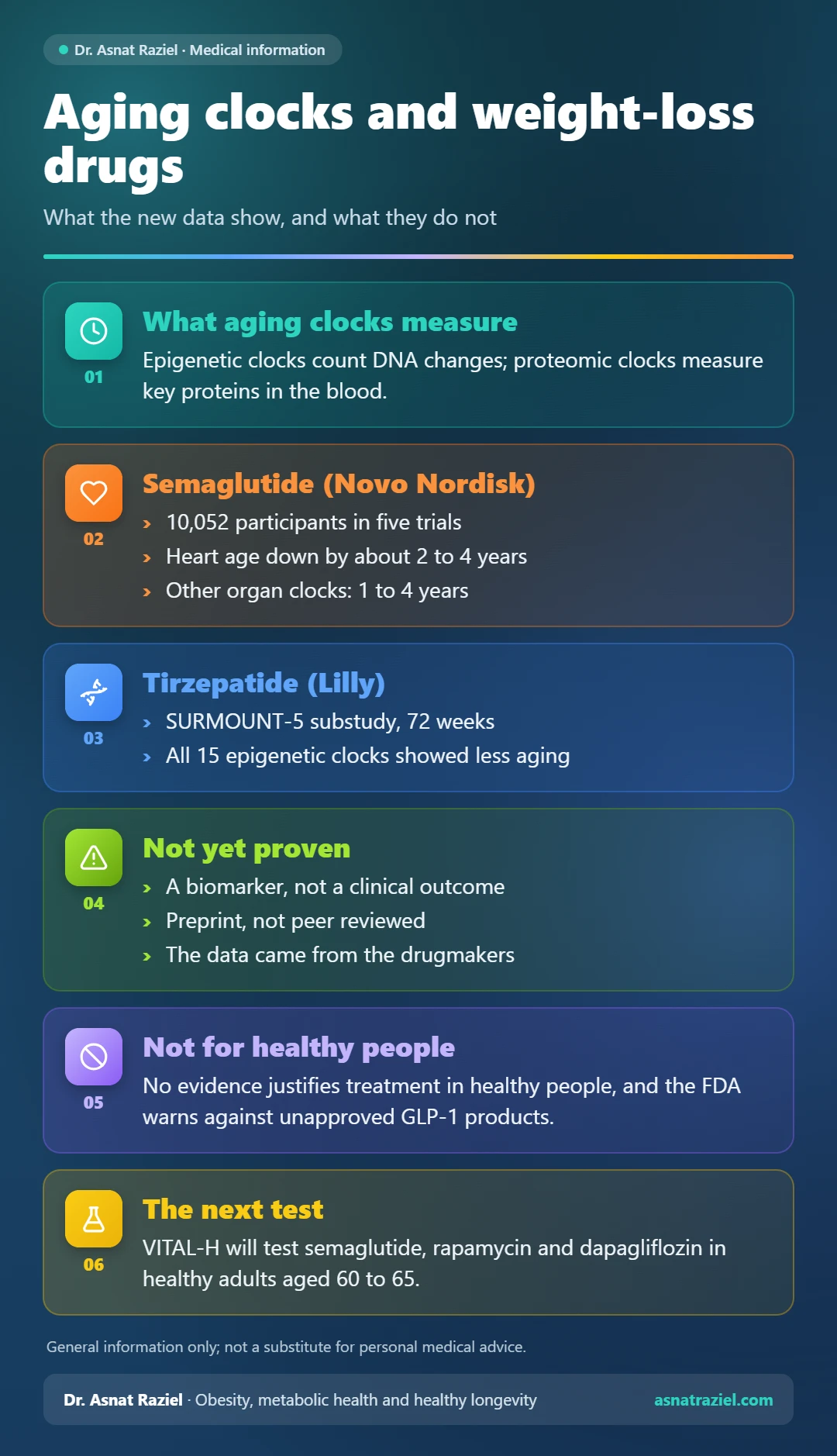
Chronological age is the age on your ID card. Biological age, by contrast, describes the state of the body itself. Aging clocks estimate it from a blood sample. Epigenetic clocks count chemical changes that build up on DNA over the years. Proteomic clocks are a newer generation: they measure the levels of key proteins in the blood.
For example, a large study in the journal Nature Medicine showed that a protein clock predicts mortality and the risk of common age-related diseases. In addition, some clocks estimate the age of each organ separately, such as the heart, the kidneys or the brain.
Novo Nordisk’s study of aging clocks and weight-loss drugs
Novo Nordisk researchers examined semaglutide, the active ingredient in Ozempic and Wegovy. They analyzed blood samples from 10,052 participants in five placebo-controlled trials. Half of the participants received the drug, and the other half received a placebo. The team published the results in a preprint, meaning a draft study that has not yet gone through peer review.
What did the organ clocks show?
First, the biological age of the heart fell by about two to four years compared with placebo. Second, in the kidney, brain, pancreas and lung clocks, and in a multi-organ clock, the decrease was one to four years. In addition, frailty measures and cardiometabolic risk measures improved. Follow-up lasted up to 156 weeks.
Another finding is especially interesting. The researchers looked at three measures: weight, HbA1c (glycated hemoglobin, a measure of blood sugar control over about three months) and CRP (C-reactive protein, a marker of inflammation). However, none of them explained the full change in the clocks.
Nikolaj Roed, Novo Nordisk’s global project leader for research and development, also presented a model based on the SELECT trial at the conference. The model predicted an average gain of 1.9 years of life for patients on semaglutide. However, this is a model’s prediction, not an outcome the researchers actually measured.
Epigenetic aging clocks: what Lilly showed on tirzepatide
Eli Lilly scientists ran a similar analysis of tirzepatide, the active ingredient in Mounjaro and Zepbound. They used epigenetic clocks, and their study was smaller than Novo’s. According to a conference summary on Longevity.Technology, Kevin Duffin of Lilly presented a substudy of the SURMOUNT-5 trial. Participants took tirzepatide for 72 weeks, or 1.38 years. All 15 epigenetic clocks measured less aging than the time that had actually passed. Moreover, two independent labs produced the data, and the results held up.
Duffin, Lilly’s vice president for aging research, said that all the clocks tell a consistent story of a drop in age. He added that no one will become 30 years younger, but the drop is meaningful. According to another report from the conference, the slowdown stood out mainly in the heart, brain, liver and kidneys. However, Lilly presented the data only at the conference and has not yet published them in a paper.
The findings add to an earlier randomized trial of semaglutide. In that trial, one of the epigenetic clocks showed a slowdown of about 9% in the pace of aging.
Not just Novo and Lilly: the drug giants join in
The conference marked a broad shift in the industry. Executives from Pfizer, GSK, AstraZeneca, Novartis and Eli Lilly discussed longevity drugs there. According to the organizers, the program also featured representatives of Takeda, Menarini and other companies. In this way, aging clocks and weight-loss drugs are becoming a matter for the entire industry. Thomas Marron, Lilly’s associate vice president of healthy aging, explained the logic. In his words, this is an important field because that is where the patients will ultimately be.
There is an economic logic as well. Bankers at TD Securities estimate the current longevity market at more than $250 billion. The US government is also investing in the field. ARPA-H (Advanced Research Projects Agency for Health) runs the PROSPR program (Proactive Solutions for Prolonging Resilience). The program allocates $144 million over five years to develop treatments that preserve function in older age.
What does the FDA say about drugs to slow aging?
For the first time, the FDA’s leadership also took part in the conference. The agency’s chief scientist, Steven Kozlowski, announced that aging and longevity will be included in the upcoming update of its scientific priority areas. Jeffrey Siegel of the FDA described two possible paths to approval. In the first, a company shows that one treatment helps with several diseases of aging. In the second, it shows a slower decline in function in a defined population.
Even so, the regulators stressed that the road is long. To date, the FDA has not approved any treatment to slow aging. Justin Penzenstadler, another FDA official, expects the first trials to focus on high-risk older adults and to look at illness and death. George Daley, dean of Harvard Medical School, also called for restraint at the opening of the conference. In his words, the promises in the field are running ahead of what biology can prove today.
How do experts explain the findings?
The drugs act on the receptor for GLP-1 (glucagon-like peptide-1, a gut hormone that signals fullness to the brain). Yet their benefits go beyond weight loss. Real-world studies have shown better kidney function, lower blood pressure and a sharp drop in the risk of death. That is why many researchers suspect that the drugs touch the root causes of aging.
Steve Horvath of the University of California, Los Angeles, is the inventor of aging clocks. In his view, two years is a fairly strong effect. He believes the data may suggest that the drugs are geroprotectors, drugs that slow biological aging and perhaps even reverse it. Vadim Gladyshev, a Harvard biologist who helped Novo with the measurements, is more cautious. In an unhealthy population, he says, this is an anti-aging drug. In a healthy population, however, nobody knows.
Aging clocks and weight-loss drugs: the caveats
First, aging clocks are biomarkers, not clinical outcomes. The authors of the preprint say so themselves. According to them, the findings do not prove biological rejuvenation or a causal link. Nor do they prove that the clock can replace a clinical outcome such as a heart attack or death.
Second, the participants were people with overweight or diabetes, at high health risk. Therefore, we cannot draw conclusions from them about lean, healthy people. Third, most of the paper’s authors are Novo Nordisk employees and hold shares in the company. Lilly’s data also came from the company itself.
Finally, the drugs have side effects, including loss of muscle mass. Horvath said he has not yet seen enough evidence of benefit in lean people. For this reason, he does not take the drugs himself, although he has considered it.
Microdoses for healthy people?
Alex Zhavoronkov, founder of Insilico Medicine and organizer of the conference, said he takes “microdoses” of both drugs, even though he is not overweight. In front of a packed hall, he asked the Novo scientist whether a reasonable person should start taking semaglutide. The scientist replied that he is not a physician and therefore could not answer.
It is important to stress that today there is no evidence to justify such treatment in healthy people. Moreover, the FDA warns against unapproved GLP-1 products, whether compounded or counterfeit. By May 31, 2026, the agency had received 990 reports of adverse events with compounded semaglutide. It had also received more than 730 reports involving compounded tirzepatide.
Five questions to ask about aging clocks and weight-loss drugs
When a patient asks me about new results from aging clocks and weight-loss drugs, I suggest five questions. First, which clock was used? The size of the effect varied widely from clock to clock and from organ to organ. Second, was the result measured or modeled? The gain of 1.9 years of life, for example, is only a model’s prediction. Third, has it been peer reviewed? Novo’s paper is a preprint, and Lilly has presented its data only at a conference. Fourth, who took part? These were people with overweight or diabetes, not lean, healthy people. Finally, who funded and analyzed the study? Here, the data came from the drugmakers themselves.
The trial that will test healthy people
The answer may come from Texas. Under the PROSPR program, ARPA-H is funding a trial called VITAL-H with up to $38 million. The trial will test three approved drugs: rapamycin, dapagliflozin and semaglutide. Its participants will be generally healthy adults aged 60 to 65.
The researchers will track intrinsic capacity (a measure that includes cognition, mobility, vitality, mental state and sensory function). According to MIT Technology Review, first answers may arrive within a year or two.
Aging clocks and weight-loss drugs: what does it mean for patients?
For people who already take weight-loss drugs for obesity or diabetes, the aging clocks data are encouraging news. These data add to the benefits we already knew about for the heart, the kidneys and blood pressure. In addition, it is worth preserving muscle during treatment, with protein and strength training.
On the other hand, the data are not a reason to start treatment just to “get younger.” The decision to treat therefore remains medical and personal, based on your health and not on a clock. It is also important to get the drug only with a prescription and under medical supervision.
The bottom line on aging clocks and weight-loss drugs
The new data from aging clocks suggest a link between weight-loss drugs and biological age. Semaglutide moved protein clocks by one to four years, and tirzepatide slowed epigenetic clocks. Other drug giants and the FDA are also entering the field. But a clock is not life itself. Only trials in healthy people will reveal whether we have a true longevity drug.
The information in this article is general and does not constitute personal medical advice. Before any change in treatment, consult your treating physician.
Sources
Weight-loss drugs show signs of slowing biological aging, say drugmakers
Semaglutide reduces proteomic organ-specific biological age across randomized clinical trials
Major pharmaceutical companies embrace longevity drugs at the 2026 ARDD Conference in Boston
ARDD 2026 brings global pharma, FDA leaders and longevity science pioneers to Harvard October 1–3
FDA to Highlight Aging, Longevity Medicine in Planned FARS Updates
FDA Leaders Name Longevity a Priority at ARDD
FDA’s Concerns with Unapproved GLP-1 Drugs Used for Weight Loss
Disclosure: most of the authors of the preprint are Novo Nordisk employees and shareholders in the company. The paper has not yet undergone peer review.




