By Dr. Asnat Raziel, bariatric surgeon specializing in obesity treatment, metabolic health and healthy longevity; Director of the Multidisciplinary Center for Obesity Treatment, Assia Medical, Assuta Ramat HaChayal, Tel Aviv
Slowing biological aging: what the new studies found
Slowing biological aging has become the big headline in the world of weight-loss injections. For the first time, the two largest drugmakers in the field have presented data of their own. According to them, these drugs may do more than help people lose weight; they might also slow the pace of aging. However, experts remind us that these findings are still very early. I discuss what aging clocks can and cannot prove in a separate article.
What did Novo Nordisk look at?
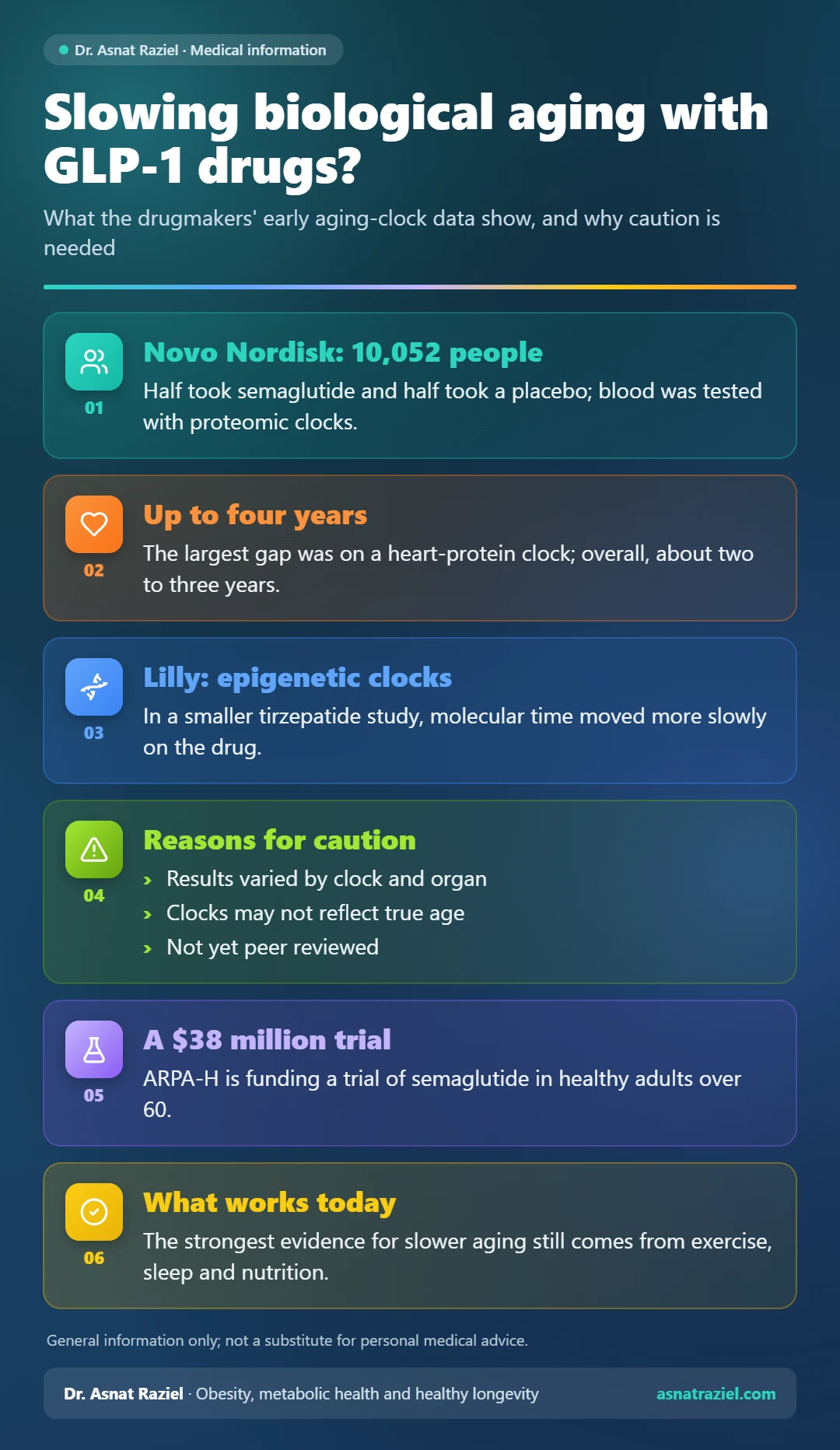
The company followed semaglutide, the active ingredient in Ozempic and Wegovy. The analysis included 10,052 people: half received the drug and half received a placebo. Researchers then tested their blood samples with “proteomic clocks,” tools that estimate age from protein levels. The result was a difference of up to four years on a clock based on heart proteins. Meanwhile, the company’s project leader estimated the overall difference at about two to three years.
Aging clocks and slowing biological aging
Eli Lilly has also entered the picture. The company studied tirzepatide, the active ingredient in Mounjaro, using epigenetic clocks. These are measures that count the changes that build up in our DNA over time. Lilly’s study was smaller, but here too “molecular time” moved more slowly in people taking the drug. The companies presented both sets of findings at the Aging Research & Drug Discovery meeting, a major forum for the development of anti-aging drugs.
Why doctors urge caution about slowing biological aging
Some perspective is needed here. First, the results varied widely between types of clocks and between the organs examined. In addition, it is still unclear whether aging clocks reliably reflect true biological age. A senior researcher who advised Novo said the drug may well help people who are unhealthy, but for healthy people, “no one knows.”
On the other hand, a Lilly representative stressed that this is a slowdown, not a reversal of aging by decades. Moreover, there is a concern about losing muscle mass during treatment. It is also worth remembering that the data come from the manufacturers’ own analyses of trials that were not designed to study aging, and no one has peer reviewed them yet.
What does this mean for you?
This research points in an exciting direction, but it is not a recommendation to take a drug to extend your life. For now, the strongest evidence for slower aging still comes from exercise, sleep and nutrition. If you are considering medication for obesity, choose it based on your health profile and with medical guidance, as I explain in my guide to obesity medication and in my article on choosing the right treatment. For the broader context, you can also read about weight-loss injections as anti-aging drugs and about a study in which semaglutide extended the lives of female mice.
The bottom line
To sum up, this is the first time the drugmakers themselves have presented data on slowing biological aging. Still, it is an early stage, the measuring tools are controversial and the populations studied are limited. Notably, the US research agency ARPA-H has already invested $38 million in a trial that will test semaglutide in healthy adults over the age of 60. Until those results come out, it is worth following this story with curiosity and caution alike.
The information in this article is general and does not constitute personal medical advice. Consult your physician before making any change to your treatment.
References
Weight-loss drugs show signs of slowing biological aging, say drugmakers
The Ozempic fountain of youth? Doctors wary of GLP-1 drugs’ anti-aging claims




