By Dr. Asnat Raziel, bariatric surgeon specializing in obesity treatment, metabolic health and healthy longevity; Director of the Multidisciplinary Center for Obesity Treatment, Assia Medical, Assuta Ramat HaChayal, Tel Aviv
AI and aging: a new step in research
AI and aging come together in a new study in the journal Cell, published on September 17, 2026. The researchers developed an open evaluation system called LongevityBench. Their goal was to test whether artificial intelligence models can do more than summarize papers. In other words, can they read complex biological data and draw conclusions from it about age and aging?
The main result is surprising. Relatively small models trained on aging data matched giant general-purpose models, and sometimes even outperformed them. This does not mean that a computer knows how to stop aging. Rather, it means that specialization and data quality matter as much as model size.
Why does aging research need artificial intelligence?
Aging is the main risk factor for heart disease, cancer, diabetes, neurodegenerative brain diseases and muscle loss. However, it does not stem from a single mechanism. Instead, it involves cumulative changes in many systems:
- DNA methylation and other epigenetic changes.
- Gene expression and protein levels in blood and tissues.
- Chronic inflammation, mitochondrial function and cellular aging.
- Metabolic and hormonal changes.
- Links between genetics, environment and lifestyle.
Modern research generates enormous amounts of “omics” data. The term covers genomics, epigenomics, transcriptomics and proteomics, meaning broad measurements of genes, gene expression and proteins. The challenge is to connect these data and turn them into insights. This is where the potential of artificial intelligence lies: it spots patterns that even an entire research team struggles to see.
A test on real biological data
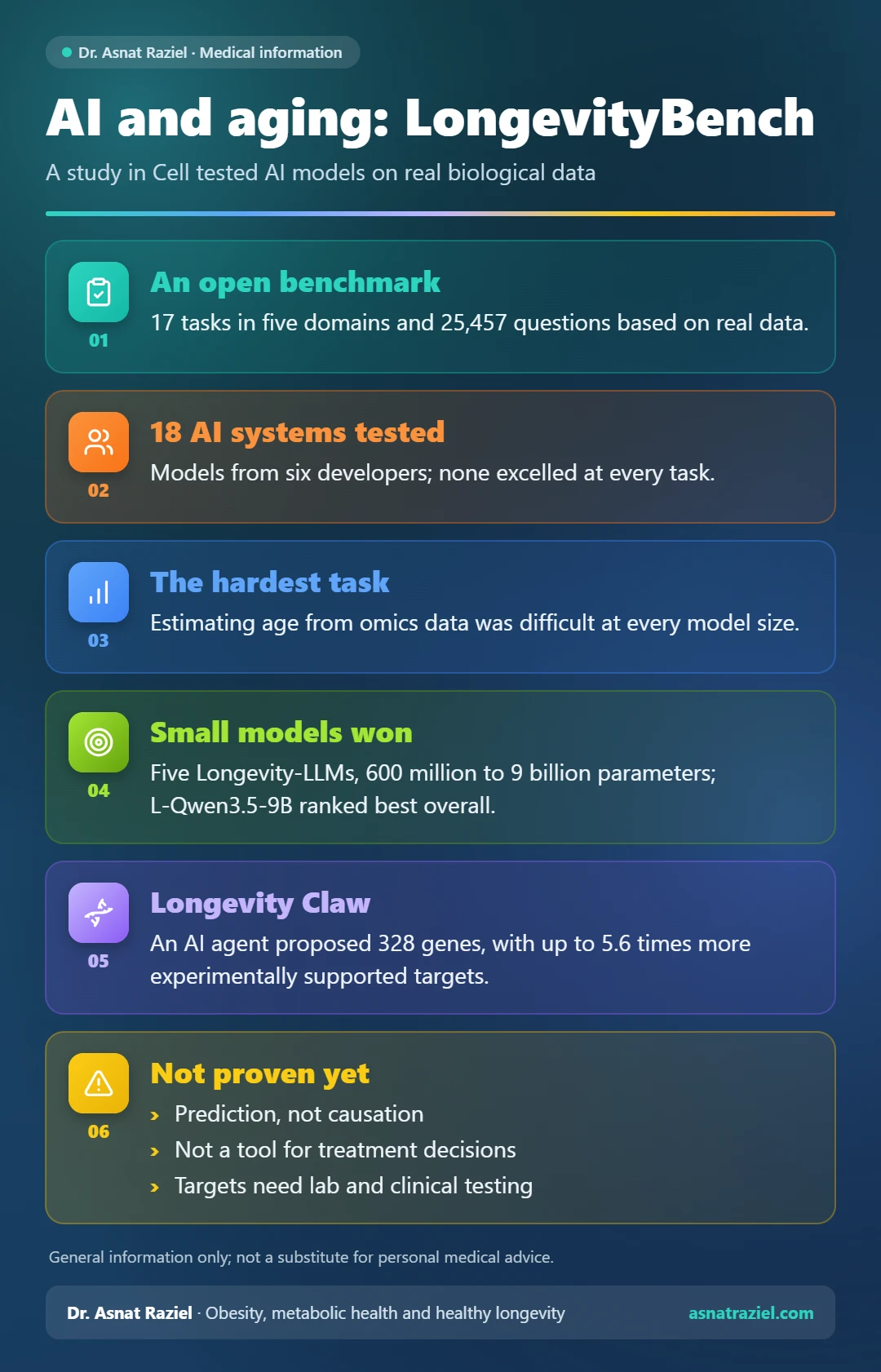
Most tests of AI in medicine check whether a model knows facts that have already been published. However, that kind of success does not prove that a model can analyze a new experiment. So the researchers built LongevityBench, an open system with 17 tasks across five domains:
- Clinical data: blood tests, body measurements and survival data from the NHANES database.
- Epigenomics: DNA methylation profiles from the GEO database.
- Transcriptomics: gene expression patterns in tissues from the GTEx database.
- Proteomics: plasma protein levels on the Olink platform.
- Longevity genetics: genes and the effect of genetic variants on lifespan.
In total, the system included 25,457 questions. For example, the models had to decide which of two people was older. In addition, they estimated age from a molecular profile and tried to predict which genetic intervention would extend life. To succeed, a model has to read the measurements themselves rather than retrieve a familiar fact.
The giant models showed no consistent advantage
The researchers tested 18 advanced AI systems from six developers. Among them were models from OpenAI, Google, Anthropic, xAI, DeepSeek and Moonshot AI. The results were uneven, and no model excelled at every task. In addition, the models were sensitive to how a question was phrased. The same information produced different performance when the task appeared as a comparison, a classification or a numerical age estimate.
The general models did relatively well on clinical tasks with familiar data such as blood tests. By contrast, the hardest task was estimating age from omics data. According to the researchers, this difficulty appeared at every model size.
AI and aging: the small models won
The researchers trained five specialized models called Longevity-LLMs. They ranged from 600 million to 9 billion parameters, far below the giant commercial models. Training included structured biological data, not just scientific texts. That way, the models learned the statistical and biological structure of omics data.
The L-Qwen3.5-9B model achieved the best overall ranking of all the systems. Moreover, according to the company’s announcement, even the smallest model, with about 600 million parameters, beat most of the giant models. Liquid AI, a partner in the study, also reported that its small models beat all the giant models on one protein task. The conclusion is clear: size isn’t everything.
From biological clocks to a system that explains
Epigenetic aging clocks have existed for years. They estimate biological age from DNA methylation, blood proteins or gene expression. However, a traditional clock has limitations. Usually it takes one type of data and returns a single number. To switch to another type of data, you need to build and validate a new model.
In the future, a specialized language model may be far more flexible. It could combine different types of data, hold a conversation with the researcher and explain its conclusions. That said, the study does not prove that the models accurately estimate the biological age of a specific person. Nor do they recommend treatment. If you are interested in the tests available today, you can read about blood tests for biological age.
Longevity Claw: an AI agent that searches for drug targets
The researchers built the leading model into a system called Longevity Claw. This is an agentic system, meaning a system that carries out tasks on its own. It connects a language model to bioinformatics tools, aging clocks and databases.
In a demonstration, the team asked the system to suggest genes that could serve as targets for anti-aging treatments. It examined 14 categories, including the hallmarks of aging. At the end of the process, it proposed 328 genes. Compared with a reference list, the list contained up to 5.6 times more targets already supported by experiments. One of the genes, KDM1A, is linked to both aging and cancer. In an experiment in worms, changing its activity extended lifespan.
These are interesting results, but they are not proof of safety or effectiveness in humans. Targets that AI suggests must first be validated in the lab and in animals, and only then in clinical trials. Likewise, the longevity drugs under study today still have a long road ahead.
AI and aging in longevity medicine
The future potential is broad. A reliable system could help combine clinical tests with genetic and molecular information. In addition, it could identify early markers of risk, suggest research hypotheses and track the response to interventions. Another advantage of the small models is that they can run inside a medical institution. As a result, less sensitive information needs to travel to cloud services. I have written about AI in preventive medicine in a separate article.
What does the study not yet prove?
We should read these findings with enthusiasm, but also with caution. The system tested prediction and pattern recognition. It did not prove that the models understand biological mechanisms or can tell a statistical association from causation. For example, a model may detect that a certain marker is linked to age. However, we cannot conclude from this that changing the marker will slow aging.
In addition, the databases are public, so commercial models may have seen some of them in advance. The researchers also did not test performance by sex, age or ancestry. Therefore, AI is a tool that supports research, not an independent source for treatment decisions. The judgment of researchers and physicians remains central, as I also described in my article on longevity technologies.
The bottom line on AI and aging
The study marks an important shift in the field of AI and aging. We are moving from AI that reads the literature to AI that is starting to read the biology itself. The road to clinical use is still long. Even so, bringing clinical, genetic and protein data together in one system may become a central tool in research on healthy aging.
The information in this article is general and does not replace personal medical advice.
References
An open benchmark and language models for AI in aging biology
Setting the Frontier of Aging Biology with Liquid Foundation Models
Insilico Medicine Opens AI Longevity Discovery Toolkit to Researchers Worldwide in Cell Cover Study
Hallmarks of aging: An expanding universe
Disclosure: some of the study’s researchers are employees of Insilico Medicine and hold options or shares in the company. Some are employees and founders of Liquid AI, which developed some of the models tested. The tools released as part of the study are Insilico Medicine products.




