By Dr. Asnat Raziel, bariatric surgeon specializing in obesity treatment, metabolic health and healthy longevity; Director of the Multidisciplinary Center for Obesity Treatment, Assia Medical, Assuta Ramat HaChayal, Tel Aviv
A diet to slow aging: what did the new study find?
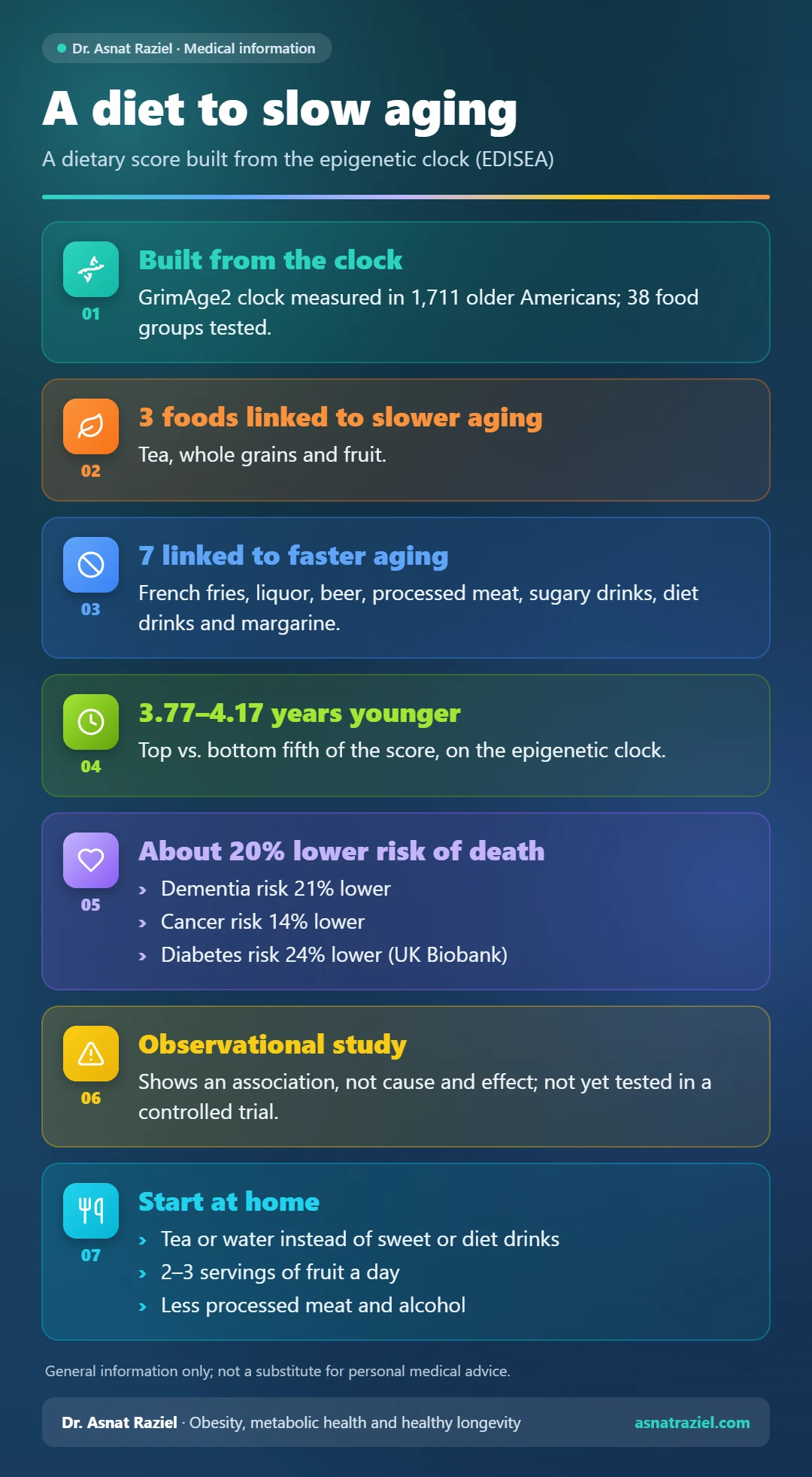
A diet to slow aging is no longer just a marketing slogan. A new study in the journal Nature Communications, published in September 2026, built a dietary score directly from the body’s epigenetic clock. The result is intriguing. People whose eating was closest to this pattern were 3.77 to 4.17 years younger by the clock than those whose eating was furthest from it. In addition, their risk of death during follow-up was about 20% lower. Still, this is an observational study, so it shows an association, not cause and effect.
The findings quickly reached fashion magazines too, and Vogue Adria devoted an article to them. So it is worth pausing to look at what the study really shows, and what is still open.
What is an epigenetic clock, and how do we measure biological age?
The age on your ID card doesn’t tell the whole story. Each of us also has a biological age, which reflects the state of our cells and tissues. One way to measure it is with an epigenetic clock. The clock looks at chemical marks on DNA, the genetic material in our cells. These marks are called methylation, and they change over the years in a predictable pattern. For a look at the same idea in pets, see my article on dog aging.
The researchers chose the GrimAge2 clock, a second-generation epigenetic clock that predicts disease and death. When epigenetic age is higher than chronological age, scientists call it “acceleration.” In contrast, a lower epigenetic age points to slower aging. I describe even newer tools in my article on new epigenetic clocks.
How did the researchers build a diet to slow aging?
Most well-known diets started from a hypothesis. For example, the Mediterranean diet grew out of knowledge about heart disease. This time, a team from Zhejiang University in China, together with partners from China and Harvard, reversed the order. First, the researchers measured the epigenetic clock of 1,711 older Americans. Then they checked which of 38 food groups predicted a slower clock.
That is how they created EDISEA, the Empirical Dietary Index for Slower Epigenetic Aging. Next, the team tested it in an independent sample of 2,311 people. Overall, the study drew on four large databases from the United States and the United Kingdom, with about 223,000 participants. The largest of these is the UK Biobank, a British biomedical database that contributed data on 187,035 people.
What to add to your plate and what to cut back
The statistical model selected ten food groups. Three of them went hand in hand with slower aging, and seven with faster aging.
The three foods that slow the clock
On the positive side were tea, whole grains and fruit. For example, people in the top fifth of the score drank a median of 0.87 servings of tea a day, compared with 0.12 in the bottom fifth. They also ate 2.38 servings of fruit a day versus 0.90. The gap was clear for whole grains, which are rich in dietary fiber, as well: 1.96 servings versus 0.84. Legumes were also linked to a slower clock, but they did not make it into the final score.
The seven food groups that speed it up
On the other hand, seven groups appeared on the negative side: French fries, liquor, beer, processed meat, sugar-sweetened drinks, diet drinks and margarine. In other words, the story isn’t only about sugar. Drinks with artificial sweeteners were also linked to a faster clock. However, the actual gaps were modest. For example, people in the top fifth ate 0.16 servings of processed meat a day, compared with 0.50 in the bottom fifth.
How many years do you “gain”? The results in numbers
In the first sample, the gap between the top and bottom fifths was 4.17 years on the epigenetic clock. In the independent sample, the gap was 3.77 years. It is important to understand that these are “biological” years based on a blood test, not actual years of life. Moreover, the new score was more strongly linked to the clock than any other well-known dietary score the researchers checked.
A diet to slow aging, mortality and disease
A slower clock is a lab marker. That is why the researchers also looked at clinical outcomes. In the two American databases, a high score went hand in hand with a 20% lower risk of death. The hazard ratio was 0.80, with a confidence interval of 0.76 to 0.85. The comparison was between the 90th and the 10th percentile of the score. What’s more, in a joint model with other well-known dietary scores, only the new score stayed linked to lower mortality. Still, the researchers warn that the scores are similar to each other, so the comparison calls for caution.
In addition, in an American database and an English database of older adults, the risk of dementia was 21% lower, and the risk of cancer 14% lower. Difficulties with daily activities, such as bathing and dressing, were also 25% less common. In contrast, the link with heart disease and stroke did not reach statistical significance in these databases.
In the large British database, the picture became sharper. There, 46 of 59 health outcomes were significantly linked to the score. Among other things, the risk was 24% lower for diabetes, 19% lower for high blood pressure, 18% lower for heart failure and 30% lower for liver disease.
What happens in the brain and the blood?
Does this way of eating leave a mark on the brain as well? A total of 39,507 participants had a brain MRI (magnetic resonance imaging). In people with a high score, the cerebral cortex was thicker in 40 of 68 regions. The most notable were in the frontal and temporal lobes, which tend to shrink with age. In addition, blood tests showed a lower inflammatory profile, including CRP, a protein that signals inflammation.
But be careful: these measurements reflect a single point in time. So we can’t say that diet “made the brain younger,” as some headlines promise.
Study limitations: what we still don’t know
First, this is an observational study. People who drink tea and eat fruit also tend to exercise more and smoke less. The researchers adjusted for these factors, but residual confounding is always possible. Second, participants reported what they ate themselves. Third, most of them were older adults of European descent. As a result, it isn’t clear whether the findings apply to younger people and other populations. I discuss aging at a younger age in my article on accelerated aging in young adults.
Furthermore, the GrimAge2 clock includes markers of smoking, inflammation and metabolism. Thus part of the link to mortality is expected from the start, as the researchers themselves note. Also, not every biological clock detects a true slowing of aging. Finally, no one has yet tested this menu in a controlled trial. In other words, we don’t know whether switching to this pattern actually slows the clock. On the other hand, a small intervention study has already hinted that a short dietary change reduces markers of aging.
A diet to slow aging: how to put it into practice at home
The good news is that there are no exotic foods or expensive supplements here. The pattern is very similar to familiar recommendations. For example, a large study in Nature Medicine linked fruit, whole grains and legumes to healthy aging. So you can safely adopt these principles, step by step.
Swap your drink. Instead of a sweetened or diet drink, have tea or water.
Add whole fruit. Two to three servings of fruit a day are close to the intake in the top fifth.
Choose whole grains. For example, oatmeal, whole wheat bread or brown rice.
Cut back on processed meat. Cold cuts, hot dogs and pastrami belong to the occasional event, not your routine.
Drink less alcohol. In particular, beer and liquor, which appeared on the negative side of the score.
Save French fries for special occasions. The same goes for margarine.
Of course, your plate is only part of the picture. Other everyday factors also affect how fast you age.
The bottom line: a diet to slow aging starts on your plate
The study doesn’t prove that tea and fruit turn back the clock. Even so, it adds strong evidence in favor of simple eating. A menu rich in fruit and whole grains, and low in processed food and alcohol, goes hand in hand with slower aging. So it is worth starting with one small step this week.
This article provides general information and is not a substitute for personal medical or nutritional advice.
References
DNA methylation GrimAge version 2
Optimal dietary patterns for healthy aging
A new study reveals the only longevity routine you need
Funding and conflicts of interest: the study was funded by public research foundations in China. The researchers declared no conflicts of interest.




