By Dr. Asnat Raziel, bariatric surgeon specializing in obesity treatment, metabolic health and healthy longevity; Director of the Multidisciplinary Center for Obesity Treatment, Assia Medical, Assuta Ramat HaChayal, Tel Aviv
Dog aging: what the study found
Dog aging fascinates scientists just as much as human aging does. A new study, published in the journal Science, has built an accurate biological clock for dogs. Using it, the researchers figured out why large dogs age so quickly. First, they analyzed hundreds of dogs from many different breeds. In addition, they found a surprising link to “jumping genes” in the genome. That is why the finding is also relevant to understanding how we ourselves age.
An accurate epigenetic clock for dogs
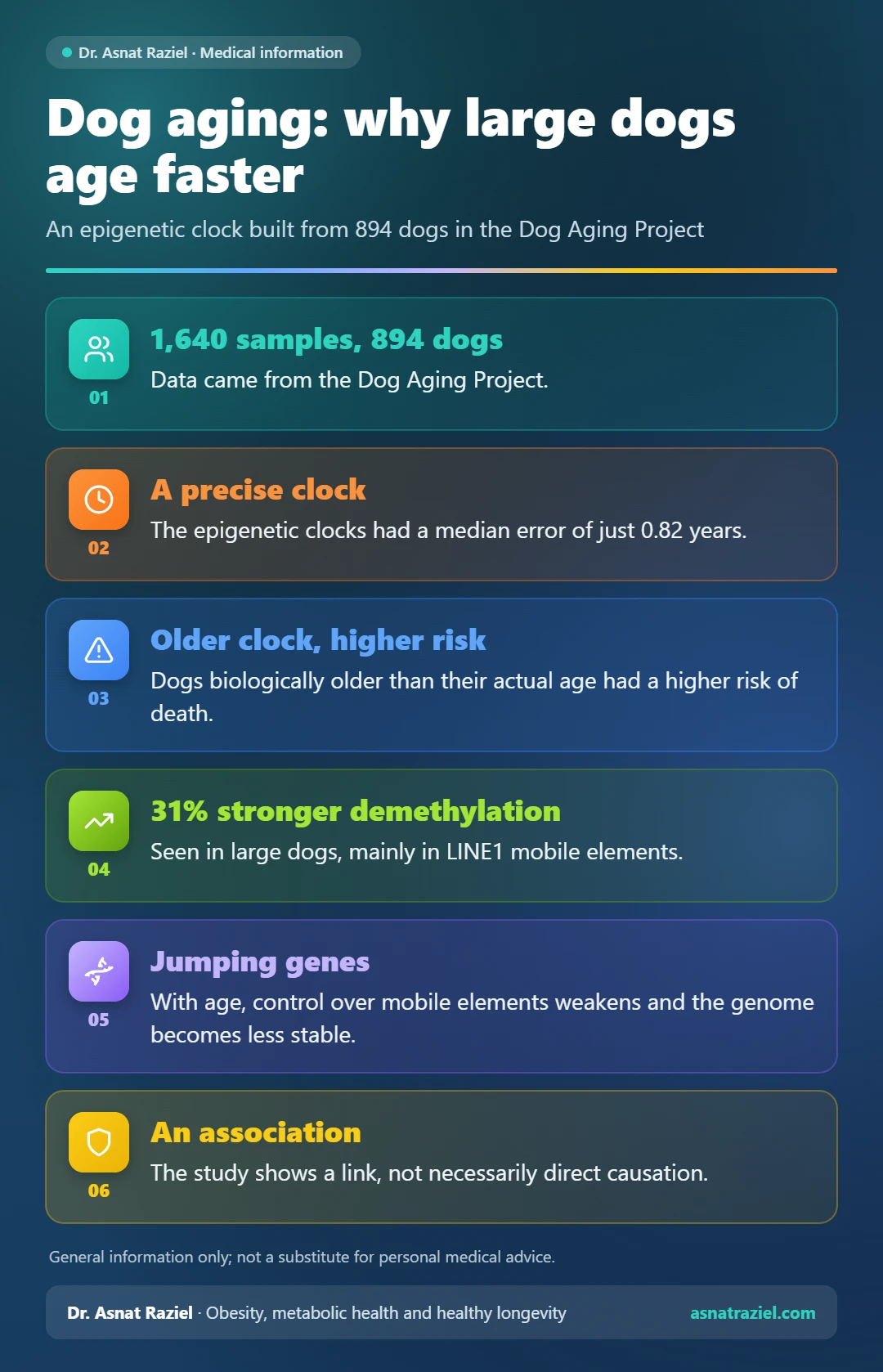
The researchers analyzed 1,640 samples from 894 dogs as part of the Dog Aging Project. From these data, they developed accurate epigenetic clocks, with a median error of just 0.82 years. What is more, dogs whose biological age ran ahead of their actual age had a higher risk of death. In other words, the clock predicted health, not just age.
Dog aging: why large dogs age faster
We all know that large dogs live fewer years. Now there is a molecular clue as to why. In large dogs, the researchers measured 31% stronger demethylation in certain regions of the genome. Scientists call these regions mobile elements, mainly sequences of the LINE1 type. In fact, this is a measurable difference in the pace of biological age.
“Jumping genes” and the link to aging
Mobile elements are stretches of DNA that can “jump” and change their location in the genome. Normally, the body silences them and keeps them from acting. With age, however, this control weakens. As a result, they can destabilize the genome. Therefore, their activation is linked to faster aging.
What dog aging teaches us
Dogs are a natural and excellent model for studying aging. First, they share our living environment. In addition, they age relatively quickly, so researchers can follow them throughout their lives. Moreover, the finding shows a link between body size, genome stability and the pace of aging. This direction may also shed light on longevity in the animal world and in humans.
The bottom line
Dog aging is not just a veterinary curiosity. It opens a window onto aging mechanisms shared by mammals. That said, the study describes an association, not necessarily direct causation. Ultimately, every animal that grows old alongside us may teach us something about ourselves. It is important to emphasize that the information in this article is general only and does not constitute personal veterinary or medical advice.
Sources
Why big dogs die younger: DNA study points to changes around jumping genes




