By Dr. Asnat Raziel, bariatric surgeon specializing in obesity treatment, metabolic health and healthy longevity; Director of the Multidisciplinary Center for Obesity Treatment, Assia Medical, Assuta Ramat HaChayal, Tel Aviv
Jonathan the tortoise and the secret hidden in his cells
Jonathan the tortoise, the world’s oldest known tortoise, is now about 194 years old. For the first time, researchers have decoded his genome, the full set of his hereditary information. They found that certain regulatory regions of his DNA remain remarkably “young” and orderly. Many of these regions control genes of the mitochondria, the powerhouses of the cell. However, the researchers stress that this is a clue, not proof.
Who is Jonathan?
Jonathan is an Aldabra giant tortoise (Aldabrachelys gigantea). Scientists consider him the oldest known living land animal. He hatched around 1832 in the Seychelles. In 1882 he arrived on St. Helena, a remote island in the South Atlantic Ocean. Since then, he has lived on the grounds of the governor’s residence. Today Jonathan is blind from cataracts, but his hearing is excellent.
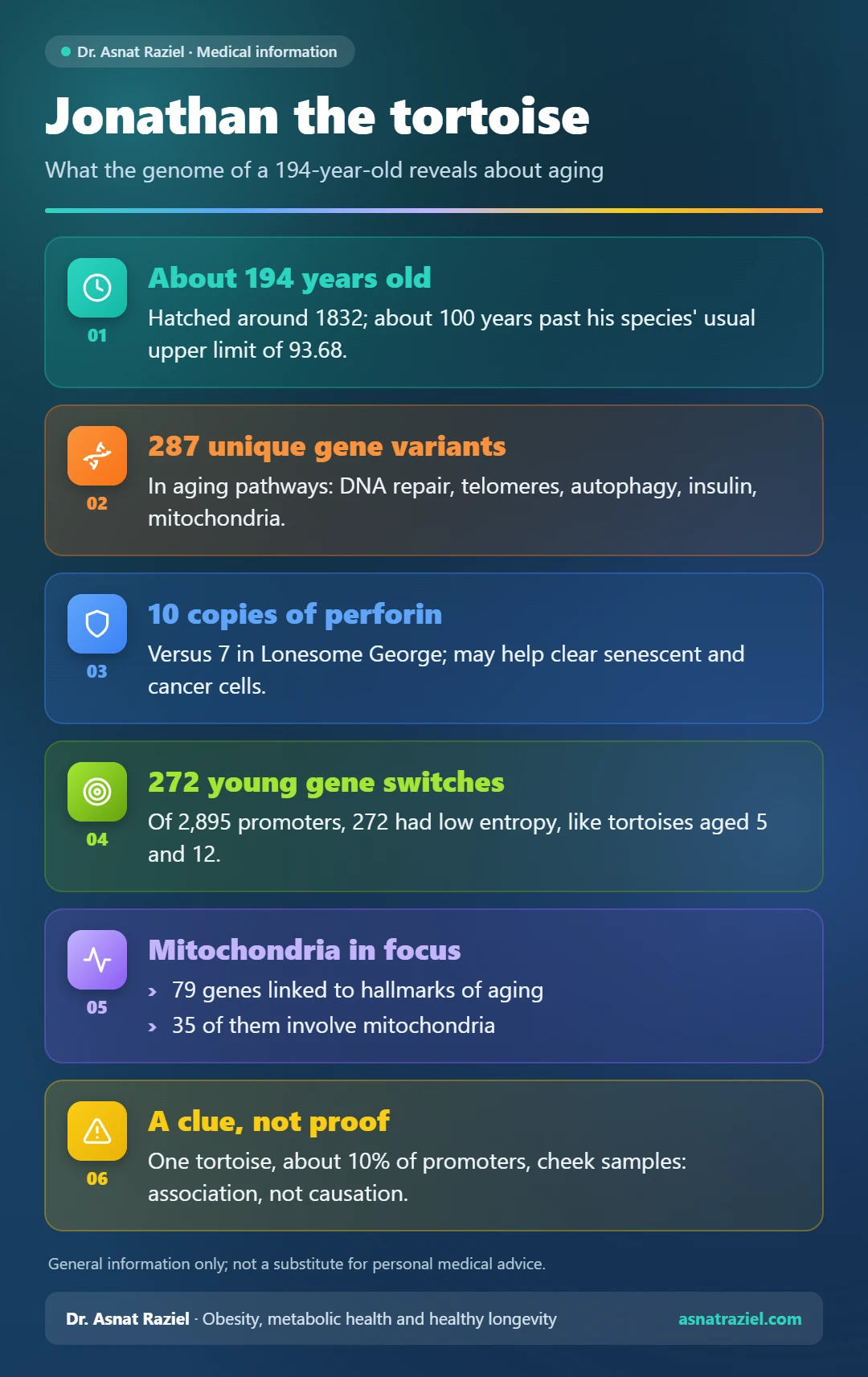
According to the researchers, the average lifespan of Aldabra tortoises is 80.47 years. The upper limit is 93.68 years. In other words, Jonathan is about 100 years older than the usual upper limit for his species. That is why he fascinates anyone who studies the link between genetics and longevity.
What did the study of Jonathan the tortoise examine?
The study was published in October 2026 in the journal Science Advances. Researchers from the Kallel Foundation in Nashville led it, together with partners from several countries. The island authorities did not allow a blood draw from Jonathan, for fear of infection. So his veterinarian collected small samples from the lining of his mouth.
At the same time, the researchers built a reference genome from the blood of Tank, a 36-year-old Aldabra tortoise. They also compared Jonathan with Lonesome George, a Galápagos giant tortoise. Finally, they examined four more Aldabra tortoises: a 5-year-old, a 12-year-old and two adult males. The exact age of those two is unknown, but both were already adults in 1969.
What did the genes of Jonathan the tortoise reveal?
The researchers identified 287 genes with variants, meaning small changes in the gene sequence, that appear only in Jonathan. They are absent in Tank, in Lonesome George and in humans. These genes belong to well-known aging pathways. Among them are DNA repair, telomere maintenance, autophagy, insulin regulation, mitochondrial function and tumor suppression.
Telomeres are the “caps” that protect the ends of chromosomes. Autophagy, on the other hand, is the cell’s cleanup and recycling system.
In addition, Jonathan has 10 copies of the perforin gene, compared with 7 in Lonesome George. Perforin is a protein that immune cells use to destroy damaged cells. According to the researchers, extra copies may improve the removal of senescent cells and cancer cells.
Methylation entropy: a measure of disorder that builds up with age
The study’s main novelty lies in the epigenome. This is the system of chemical tags that determines which genes are active, and when. One of these tags is methylation, the attachment of a small chemical group to DNA. Methylation patterns are also the basis of epigenetic aging clocks.
With age, methylation patterns become randomly disrupted. Scientists call this methylation entropy, a measure of disorder. Benjamin Vaisvil, one of the study’s leaders, compared the genome to a cookbook. The epigenome, he explained, is like the handwritten notes in the margins. Over the years, those notes become harder to read.
Where does Jonathan the tortoise stay young?
Across most of his genome, Jonathan looks old, as expected. His entropy is higher than that of the young tortoises. However, the researchers focused on promoters, the on-switches of genes. They examined 2,895 promoters for which they had reliable data in all five tortoises.
In 272 of them, a surprising pattern emerged. In Jonathan and in the two young tortoises, entropy was low. By contrast, in the two adult males it was high. In other words, at these switches, Jonathan, the world’s oldest tortoise, resembles tortoises aged 5 and 12.
Which genes are these? Almost 30% of them, 79 genes, are linked to the “hallmarks of aging.” Of these, 35 genes involve the mitochondria. Another 25 genes deal with RNA processing and protein production, and 15 with maintenance of the genome and telomeres.
Why the mitochondria?
Mitochondria produce the cell’s energy, so many see them as a key to healthy aging. Mitochondrial dysfunction is one of the hallmarks of aging. The researchers propose a positive feedback loop. Orderly switches keep energy production efficient. That energy fuels the DNA repair machinery. Repair, in turn, keeps the switches orderly.
A similar finding exists in humans. A comprehensive 2025 study examined a woman who lived to 117. According to the researchers, her mitochondria worked especially efficiently compared with other older adults. I wrote about her in my article on Maria Branyas and biological age.
What we still don’t know about Jonathan the tortoise
It is important to read these findings with caution. First, this is a single tortoise, so it is hard to generalize. Second, the researchers could examine only about 10% of the tortoise’s promoters. In addition, cheek-lining samples are limited compared with a blood sample. They did not allow a direct test of gene activity.
Therefore, the study points to an association, not causation. The researchers themselves write that the data are not enough to establish cause and effect. Prof. Vincent Lynch of the University at Buffalo, who was not involved in the study, also expressed skepticism. In an interview with Live Science, he questioned whether entropy is a useful way to describe these changes. As he put it, “Maybe Jonathan is just really good at being old.”
What does it mean for us?
None of us will live like a giant tortoise. Still, the pathways highlighted in the study also operate in the human body: cellular energy, DNA repair and gene regulation. The researchers’ goal is to extend healthspan, the number of years we live in good health and good function.
According to a Vanderbilt Health news release, animal studies have hinted that old generic drugs may slow aging. One example is rapamycin. The Kallel Foundation hopes to test such drugs in clinical trials in humans. I wrote about the gap between promise and evidence in my article on rapamycin and longevity.
For now, the study does not offer a treatment, a supplement or a test. So the proven tools remain the same: regular physical activity, good sleep, a high-quality diet and protecting your metabolic health. And what about the upper limit of human life? I wrote about that in my article on whether humans could live to 194.
The bottom line
Jonathan the tortoise does not reveal a magic formula. Even so, he shows that a 194-year-old body can keep a “young” order in critical systems. So the key to longevity may not be good genes alone. Maintaining gene regulation over the years may matter just as much. Follow-up studies, using blood samples and more animals, will test this hypothesis.
The information in this article is general only and does not constitute personal medical advice.
References
Epigenetic insights into extreme longevity in the world’s oldest terrestrial animal, Jonathan
An extremely old giant tortoise named Jonathan may hold the secret to a long, healthy life: Study
The multiomics blueprint of the individual with the most extreme lifespan
Jonathan the tortoise has lived to 194 years old – now scientists think they know why
Funding: According to Vanderbilt Health, the Stephen Voland Research Fund provided $50,000 to fund the study.




