By Dr. Asnat Raziel, bariatric surgeon specializing in obesity treatment, metabolic health and healthy longevity; Director of the Multidisciplinary Center for Obesity Treatment, Assia Medical, Assuta Ramat HaChayal, Tel Aviv
Muscle aging: what is new in the research?
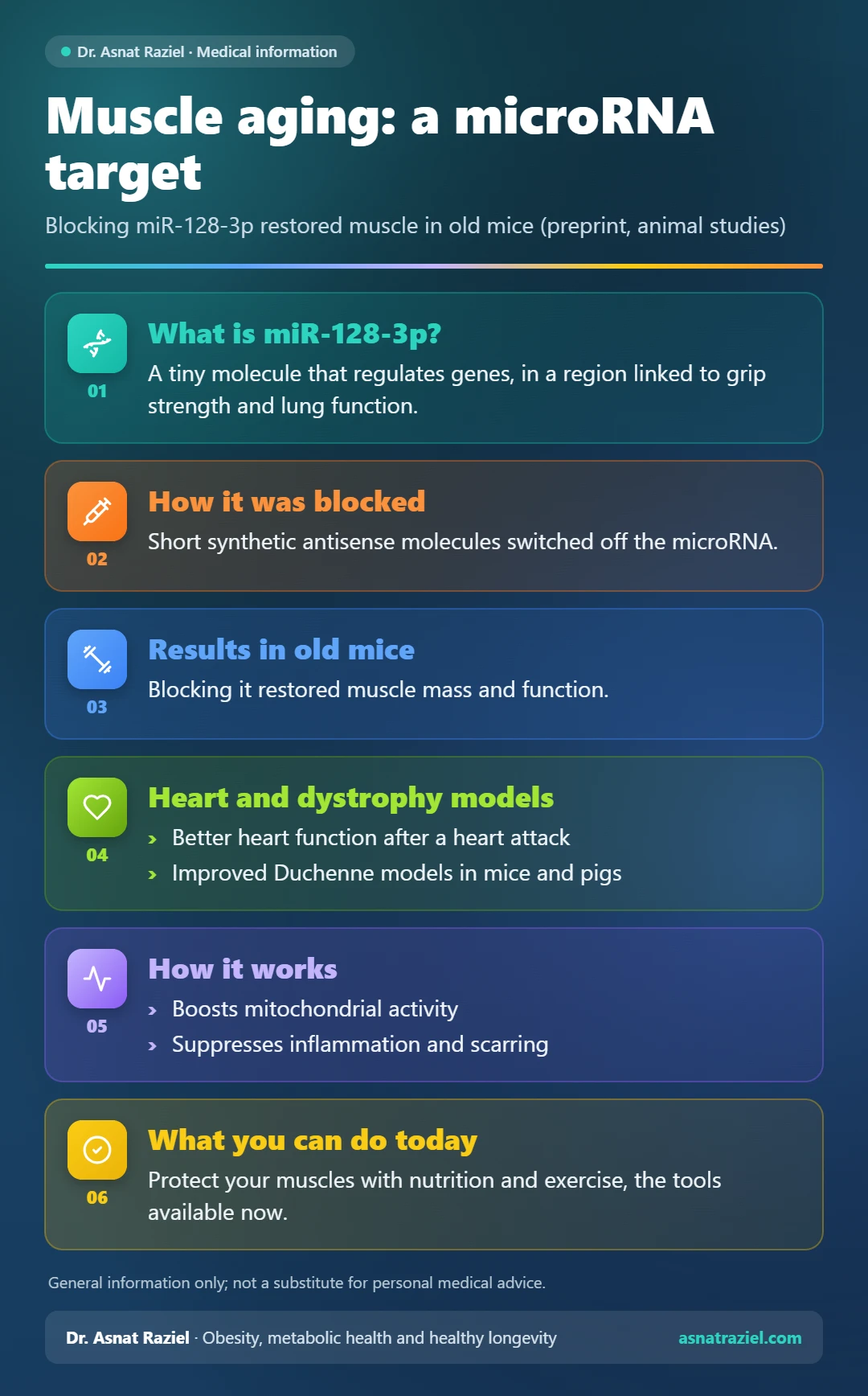
Muscle aging erodes independence and quality of life in older age. Now a new study has found a surprising molecular target. Blocking a tiny molecule called miR-128-3p restored muscle in old mice. That makes it an intriguing direction for future treatment.
Elenae Therapeutics developed the technology. For now, the researchers have released their findings as a preprint. In other words, the work has not yet undergone full peer review.
What is miR-128-3p?
A microRNA is a tiny molecule that regulates how genes are expressed. Interestingly, miR-128-3p sits in a notable region of the genome. Earlier studies linked this region to hand grip strength and lung function. This led to the hypothesis that it plays a role in muscle aging.
To test the idea, the researchers blocked the molecule with short synthetic molecules. Scientists call this method antisense, and it switches off specific targeted genes. In this way, they could see what happens to muscle without this molecule.
Muscle aging: what did the experiments show?
Blocking the molecule restored muscle mass and function in old mice. What is more, in a heart attack model it improved heart function. It also curbed harmful changes in the heart tissue after the injury. The effect appeared in both skeletal muscle and heart muscle.
The benefit was not limited to aging mice, either. In fact, the treatment also improved models of Duchenne muscular dystrophy. These models included both mice and pigs. As a result, the researchers see this as a broad target.
How does it work?
Blocking the molecule switched on a consistent gene pattern across different tissues, one that works against muscle aging. First, it boosted the activity of the mitochondria, the “power plants” of the cell. Second, it suppressed signals of inflammation and scarring. According to the researchers, this pattern resembles the effect of known lifespan-extending interventions.
Muscle aging and the link to weight-loss drugs
Muscle loss is a known side effect of GLP-1 weight-loss drugs. For this reason, research on preserving muscle is attracting new interest and new funding. The same tools may also help address declining muscle mass. Meanwhile, physical activity remains central, as I explain in my article on aerobic versus strength training. In a separate article, I also explain how working out rejuvenates muscle.
The concern has reached professional societies too. As Ynetnews reported on the hidden cost of weight-loss drugs, a World Obesity Federation position paper from April 2026 urges clinicians to weigh muscle and bone risks alongside weight reduction.
Meanwhile, the National Institute on Aging notes that exercise may protect against age-related loss of muscle mass, strength and function.
The bottom line
Muscle aging undermines function and independence as we get older. Blocking miR-128-3p produced impressive muscle recovery in animals. This is a promising but early treatment direction. Even so, protecting your muscles through nutrition and exercise remains the tool available today.
The information in this article is general and does not constitute personal medical advice. These findings come from animal studies and do not guarantee a similar result in humans.
Sources
A positively selected microRNA controls a reversible aging program in striated muscle
miR-128-3p Inhibition Improves Muscle Mass and Function in Aged Mice