By Dr. Asnat Raziel, bariatric surgeon specializing in obesity treatment, metabolic health and healthy longevity; Director of the Multidisciplinary Center for Obesity Treatment, Assia Medical, Assuta Ramat HaChayal, Tel Aviv
Exercise and muscle aging: what the researchers found
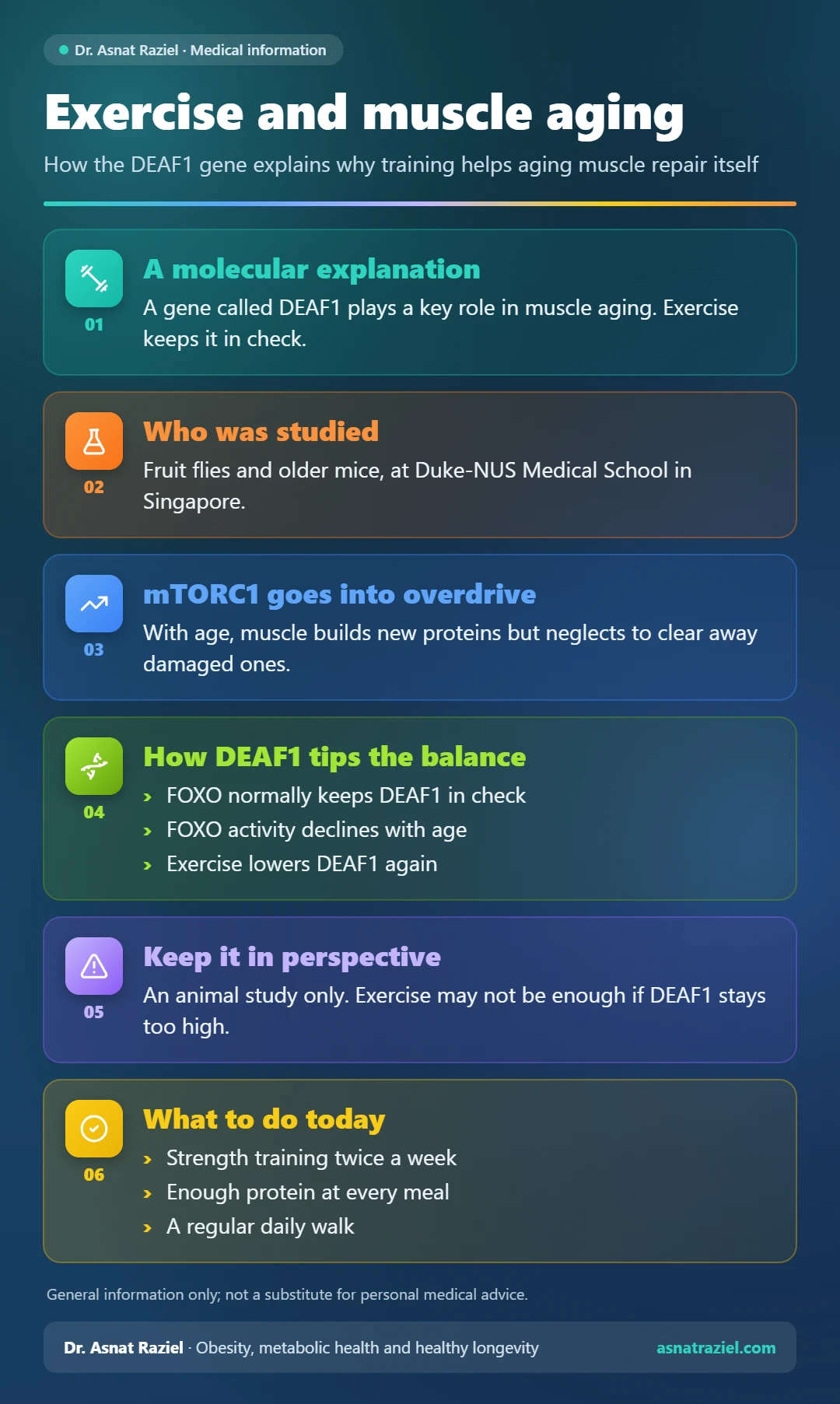
The link between exercise and muscle aging is well known, but now it has a molecular explanation. Specifically, researchers have identified a gene called DEAF1 that plays a key role in muscle aging. When it is overactive, muscle struggles to repair itself. Exercise, it turns out, keeps it in check.
What happens to muscle as we age?
Researchers at Duke-NUS Medical School in Singapore studied fruit flies and older mice. They found that a growth pathway called mTORC1 becomes overactive with age. As a result, muscle keeps building new proteins but neglects to clear away damaged ones. Damage therefore builds up, and the muscle weakens.
The DEAF1 gene, exercise and muscle aging
This is where DEAF1 comes in. In particular, high levels of it push mTORC1 into overdrive. Normally, proteins from the FOXO family keep DEAF1 in check. However, FOXO activity declines with age, so DEAF1 runs unchecked. Exercise lowers DEAF1 levels and restores the balance. In this way, the muscle regains its ability to repair itself.
Exercise and muscle aging: what it means
Of course, it is important to keep this in perspective. First, the study was done in animals, not humans. Second, exercise is sometimes not enough if DEAF1 stays too high. Even so, the finding helps explain why some older adults get less benefit from training. In the future, regulating DEAF1 might mimic some of the effects of exercise.
What can you do today?
For now, the most powerful tool remains simple: movement. First, include strength training twice a week. In addition, make sure you get enough protein at every meal. Also, add a regular daily walk. Finally, progress gradually and avoid injuries. That way, you will preserve your muscle for years to come.
Muscle strength may even predict how long we live. According to a Ynetnews report on two simple strength tests, a study of about 5,000 older women linked stronger grip and faster chair stands to a lower risk of death.
The World Health Organization’s physical activity guidelines call for at least 150 minutes of moderate activity a week and note that muscle strengthening benefits everyone.
The bottom line
In short, preserving muscle mass is one of the most important tools for longevity. Science only reinforces what we already know: it pays to move. To learn more, read about strength training and preserving muscle, about building muscle after 60, and about grip strength as a marker of aging. In the end, every step and every lift counts.
The information in this article is general and does not constitute personal medical advice.
References
Scientists discover why exercise reverses muscle aging
Duke-NUS scientists uncover how exercise helps ageing muscles repair themselves