By Dr. Asnat Raziel, bariatric surgeon specializing in obesity treatment, metabolic health and healthy longevity; Director of the Multidisciplinary Center for Obesity Treatment, Assia Medical, Assuta Ramat HaChayal, Tel Aviv
Mental health monitoring on weight-loss injections: why it still matters
Mental health monitoring remains an important part of treatment with weight-loss injections, even after the FDA removed the suicidality warning. This article is a practical guide: what monitoring looks like before and during treatment, who needs closer follow-up and when to call your doctor. For the full story of the regulatory decision, see my article on why the FDA removed the GLP-1 suicide warning.
Emotional readiness also matters before you start, so I wrote about mental preparation for lifestyle change.
GLP-1 drugs have changed the treatment of obesity and type 2 diabetes. Beyond substantial weight loss, studies have also shown significant metabolic and cardiovascular benefits. However, alongside this success, concerns have also emerged. One of the main ones was a possible link to suicidal thoughts or behavior.
Now the picture is clear. In this article, I will explain what has changed and, above all, what good mood monitoring during treatment looks like.
What the FDA decided, and what it was based on
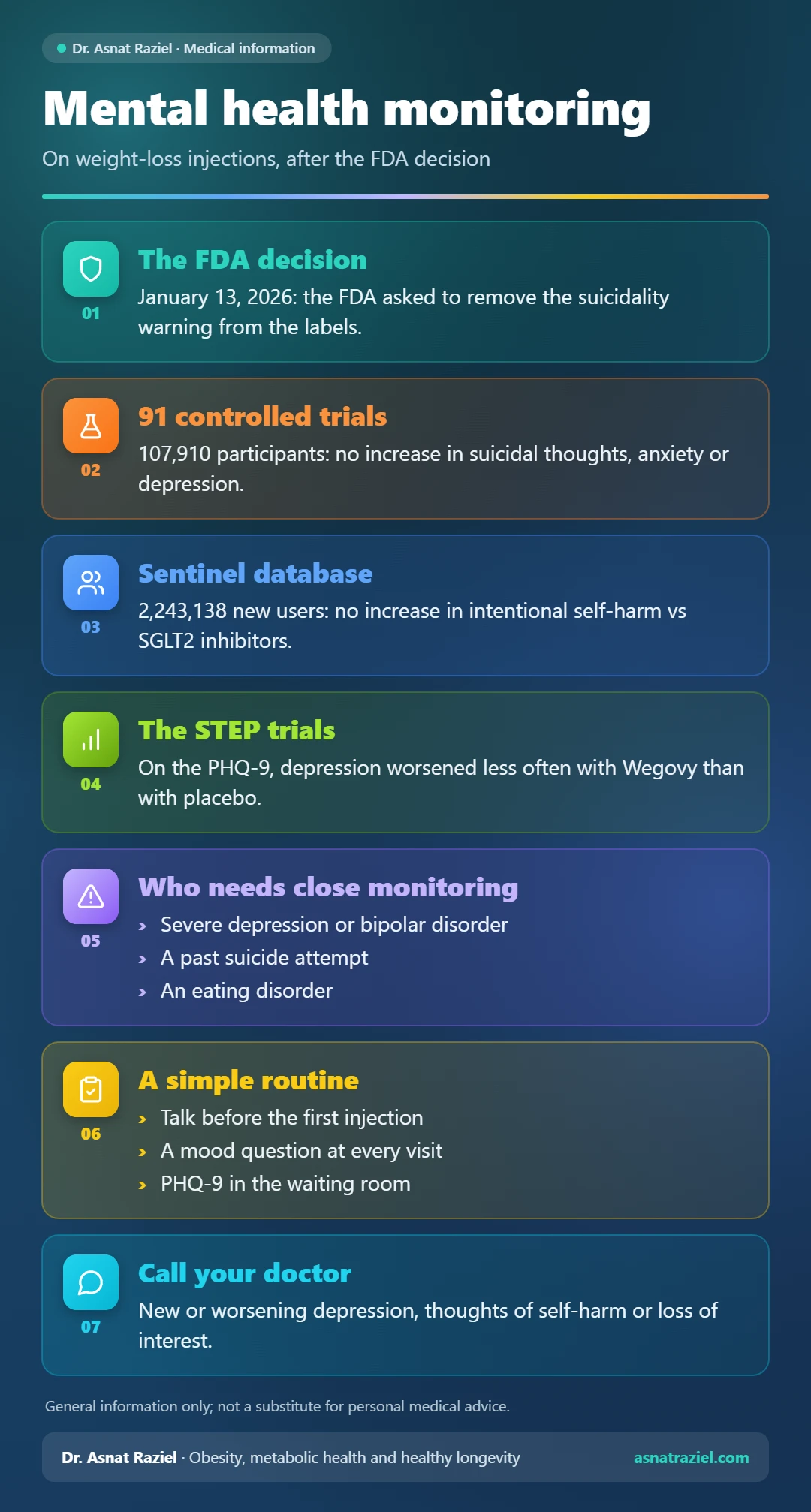
On January 13, 2026, the US Food and Drug Administration (FDA) asked to remove the warning from the labels of obesity drugs. The decision rests on a broad analysis of high-quality data, not on impressions or isolated reports.
In total, the FDA reviewed 91 randomized controlled trials with 107,910 participants. The analysis compared patients on GLP-1 drugs with patients who received a placebo. Specifically, the researchers looked at suicidal thoughts, suicidal behavior and psychiatric effects such as anxiety and depression. The finding was clear: there was no increase in these effects in the treatment groups.
In addition, the FDA examined its Sentinel database, its system for monitoring drugs after they reach the market. The database included 2,243,138 new users. The researchers compared GLP-1 users with users of SGLT2 inhibitors, a different class of diabetes drugs. Here, too, there was no increase in intentional self-harm. Therefore, the FDA concluded that the overall evidence does not support a causal link.
Where the warning came from
The warning appeared on the labels of drugs approved for weight loss: Saxenda, Wegovy and Zepbound, the US brand name of tirzepatide (sold as Mounjaro) for obesity. It stemmed from regulatory caution and from reliance on spontaneous reports. However, such reports do not prove cause and effect. They are influenced by public awareness and headlines. In addition, they mix in existing risk factors, such as obesity itself, depression and other conditions.
As early as January 2024, the FDA reported that it had found no evidence of a link. Still, the number of events was small, so it could not rule out a small risk. Since then, researchers have collected far broader and more precise data. In February 2026, the section was already removed from the US label of Zepbound and from the Wegovy label. This created consistency with GLP-1 drugs for diabetes, which never carried a similar warning.
What else we know about mood during treatment
The data go beyond the absence of harm. A pooled analysis of the STEP trials tracked mood using the PHQ-9 questionnaire, a standard tool for detecting depression. In the Wegovy group, depression worsened at a lower rate than in the placebo group. Suicidal thoughts were reported in 1% of participants or fewer, with no difference between the groups.
On the other hand, we also need to know the limits. A 2025 cohort study found no increased risk with semaglutide for weight loss. However, the researchers noted that the data do not rule out a very small increase. In addition, the STEP trials did not include people with a known serious mental illness. That is why mental health monitoring on weight-loss injections is especially important in this group.
Mental health monitoring in practice: what it looks like
Removing the warning does not free us from the need to assess mental health, to ask, to listen and to support. Obesity is a chronic disease, and it is itself linked to depression and anxiety. In our clinic, monitoring includes several stages:
- Before treatment: questions about mood, past mental health treatment and eating patterns.
- In the first months: a routine question at every visit about sleep, energy and mood.
- At every stage: attention to changes in body image and in the relationship with food.
- In case of distress: a fast referral to a psychologist or psychiatrist.
Patients who take antidepressants continue them as usual, in coordination with their treating doctor. Some psychiatric medications even cause weight gain. I wrote about this in my article on psychiatric medications and weight gain.
A 2025 study I described for Camoni found that weight-loss injections also helped people taking antipsychotic medications (in Hebrew), although the benefit was smaller with high-risk drugs such as olanzapine and clozapine.
Who needs especially close monitoring?
Close monitoring is right for anyone with a history of severe depression, bipolar disorder or a suicide attempt. It is also important for people living with an eating disorder, such as binge eating disorder. For these patients, it is best to involve their mental health provider from the very start.
A simple mental health monitoring routine, step by step
Good monitoring does not need to be complicated. First, before the first injection, talk openly about your mood, past mental health care and eating patterns. Next, during the first months, expect a short question at every visit about sleep, energy and mood. In addition, the PHQ-9 questionnaire takes only a few minutes, and you can fill it in while you wait. If you take antidepressants, keep taking them as usual, in coordination with your doctor. Throughout treatment, notice changes in body image and in your relationship with food. Finally, if distress appears, a fast referral to a psychologist or psychiatrist is part of the plan, not a failure.
What you can do
The FDA recommends continuing treatment as prescribed and sharing any concern with your doctor. You should contact your doctor in any of the following situations:
- New or worsening depression.
- Thoughts of self-harm.
- An unusual change in mood or behavior.
- Loss of interest in things that used to make you happy.
It is important to remember that weight loss also stirs up strong emotions. Sometimes food served as a source of comfort, and when hunger fades, a void remains. You can read more about this in my article on emotional coping with obesity.
The message for health professionals
There are three messages here for doctors and other professionals. First, the decision strengthens the mental health safety profile of these drugs. It reduces a fear that deterred patients and care teams from effective treatment. Second, it reminds us to rely on controlled data, not headlines. Finally, it highlights the need for monitoring that is holistic, sensitive and personalized. A patient who reports suicidal thoughts needs an immediate referral for assessment by a mental health professional.
In practice, a simple tool like the PHQ-9 questionnaire helps a great deal. It is short, and patients can fill it in in the waiting room. This way, we detect a change in mood early, before it becomes a crisis.
The bottom line on mental health monitoring
The fear is fading, and the data speak for themselves: obesity drugs do not raise the risk of suicide. Even so, mental health monitoring on weight-loss injections remains part of good care. Ultimately, the decision allows us to support patients with up-to-date, balanced knowledge. It is another step toward obesity medicine that is precise, responsible and less stigmatizing. You will find more on this topic in my article on GLP-1 drugs and depression.
The information in this article is general and does not replace personal medical advice. If you are in distress in Israel, call ERAN, the national emotional first aid hotline, on 1201, at any hour.