By Dr. Asnat Raziel, bariatric surgeon specializing in obesity treatment, metabolic health and healthy longevity; Director of the Multidisciplinary Center for Obesity Treatment, Assia Medical, Assuta Ramat HaChayal, Tel Aviv
Binge eating disorder: the disorder that stays invisible
Binge eating disorder (BED) is the most common eating disorder in the world. Yet it is also one of the least diagnosed and least treated. Unlike anorexia or bulimia, it involves no vomiting and no extreme food avoidance. Precisely because of this, others often label people who live with it as “emotional eaters” or “undisciplined.” As a result, the disorder itself usually goes undiagnosed.
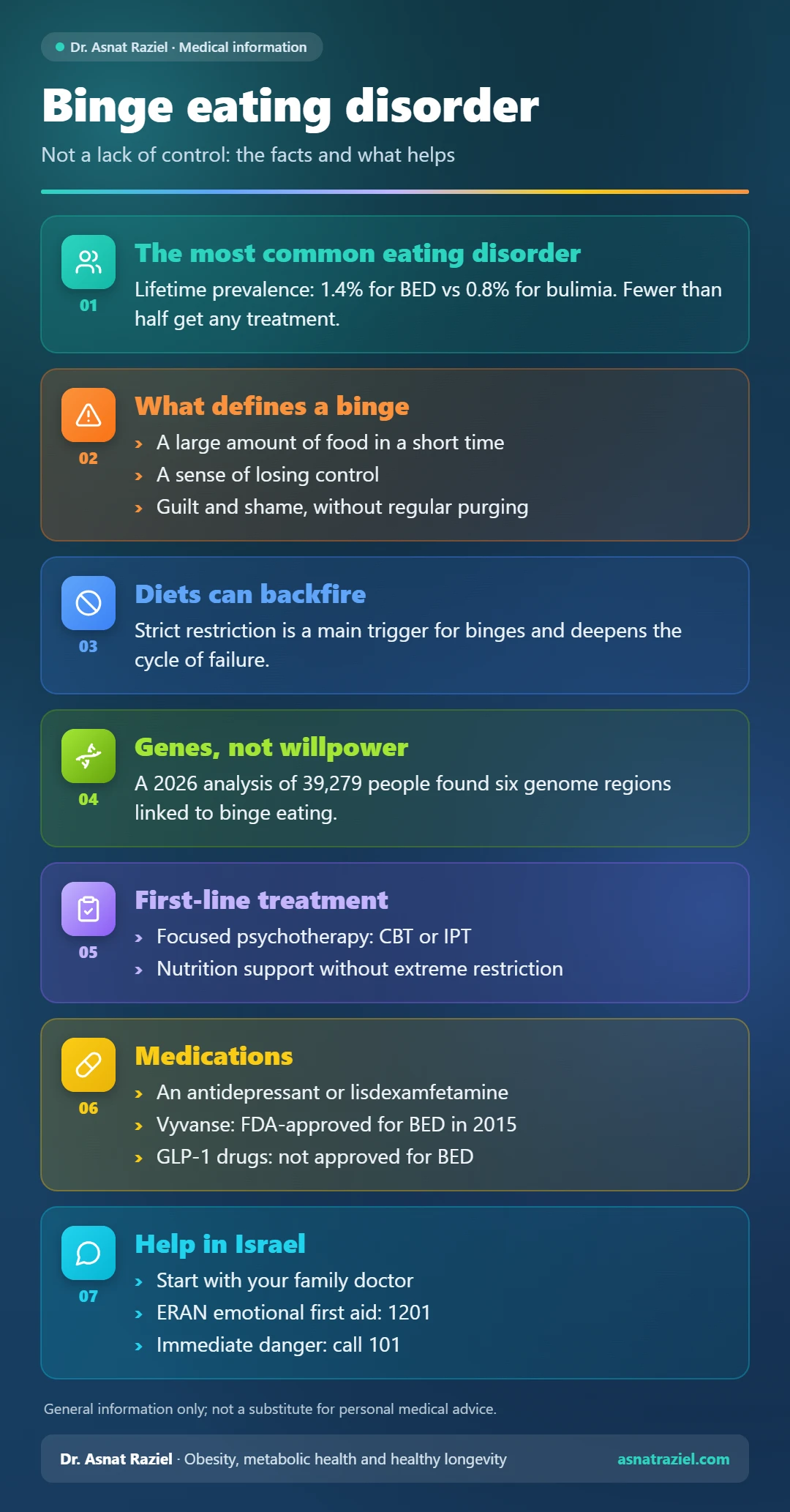
These numbers show the gap. The World Health Organization World Mental Health Surveys examined 24,124 adults in 14 countries. The lifetime prevalence of BED was 1.4%, compared with 0.8% for bulimia. In addition, fewer than half of those affected received any treatment at all.
What defines a binge
A binge is not simply eating a lot. It is a recurring episode of eating a large amount of food in a short time, with a feeling of losing control. Often the eating is fast, without attention to fullness signals, and sometimes it happens in secret. After the binge come guilt, shame and frustration. However, unlike bulimia, there are no regular compensatory behaviors such as vomiting or fasting.
The diagnosis relies on an ongoing pattern, not a single event. In other words, it requires listening and an open conversation, not just a look at the scale. By the way, eating disorders occur at any weight, and the diagnostic process should reflect that.
A few signs are worth noticing. For example, eating when you are not hungry, eating until you feel uncomfortably full, or hiding food from others. In addition, frequent thoughts about the next binge and a sense of shame afterward. If these signs sound familiar, it may be binge eating disorder, and it is worth seeking an evaluation.
Binge eating disorder and obesity
Many people with binge eating disorder live with overweight or obesity. On the other hand, not everyone with obesity has BED. This overlap creates confusion in diagnosis. Quite often, treatment focuses only on weight loss through repeated diets. But such diets actually increase binges and deepen the cycle of failure.
That is why treatment that ignores the disorder itself can lead to weight regain and harm self-image. The urges to eat may also get worse. For this reason, I believe in obesity treatment without extreme diets, which starts by understanding eating patterns.
The brain, genes and the urge to eat
The disorder involves changes in the brain’s reward pathways, mainly the dopamine system. Some patients have a strong response to food cues, together with difficulty regulating impulses. In some ways, the mechanism resembles behavioral addictions. In addition, studies have found links between BED and ADHD, anxiety and depression.
Genetics is also starting to speak. A large genetic analysis published in August 2026 included 39,279 people with binge eating behavior. The researchers identified six regions of the genome linked to binges, some of them also linked to impulse control. Moreover, most of the genetic signal was not shared with body mass index (BMI). In other words, binge eating disorder is not just “the other side” of obesity.
Why binges are not solved by dieting
Strict dietary restriction is one of the main triggers for binges. When the body and brain experience deprivation, the urge to eat grows stronger and control weakens. So trying to “hold on tight” or “be disciplined” usually backfires. This link is also familiar from food noise, the constant, intrusive thoughts about food.
Treatment starts with nutritional stability: regular meals, no fasting and no sweeping bans. At the same time, the work focuses on emotional regulation and on the binge patterns themselves.
What good treatment for binge eating disorder looks like
Treatment is multidisciplinary. The 2023 American Psychiatric Association guideline recommends focused psychotherapy first. The leading approaches are cognitive behavioral therapy (CBT) or interpersonal therapy (IPT), individually or in a group. In addition, professional nutritional support that is not based on extreme restriction is part of the plan.
For adults who prefer medication, or who did not improve with psychotherapy alone, the guideline suggests an antidepressant or lisdexamfetamine. In January 2015, the FDA approved Vyvanse as the first medication for moderate to severe BED in adults. It is important to know that this drug is not intended for weight loss.
What we know about GLP-1 medications
A question I hear a lot concerns medications in the GLP-1 family. A 2026 systematic review and meta-analysis pooled 25 randomized controlled trials. The medications moderately reduced binge eating and emotional eating. On the other hand, they increased dietary restraint, and the researchers do not yet know whether this is always healthy. Therefore, they are currently not approved for treating BED. Their use is appropriate only as part of personalized drug treatment with close follow-up.
Where to get help in Israel
The first step is a conversation with your family doctor. Israel’s national health basket covers treatment for eating disorders. For example, at Maccabi (in Hebrew), members aged 12 and over can receive an evaluation and a course of treatment at mental health clinics. Also, the Israeli Association for the Prevention, Treatment and Research of Eating Disorders (in Hebrew) publishes a directory of treatment centers by region and health fund (HMO).
If you are in emotional distress, you can contact ERAN, emotional first aid (in Hebrew), at 1201, around the clock and anonymously. In immediate danger, call Magen David Adom (Israel’s emergency medical service) at 101 or go to an emergency room.
The bottom line: stop blaming, start diagnosing
Binges are not a personal failure. They are a symptom of a recognized medical disorder that doctors can diagnose and treat. With the right diagnosis and treatment, we see improvement in eating patterns, in the relationship with the body and in overall health. For more on the field as a whole, see what modern medicine knows about eating disorders, as well as my articles on coping with emotional eating and on the biological basis of eating disorders.
This article provides general information and is not a substitute for personal medical advice.
References
The Israeli Association for the Prevention, Treatment and Research of Eating Disorders (in Hebrew)
ERAN: emotional first aid by phone and online (Kol Zchut, in Hebrew)