By Dr. Asnat Raziel, bariatric surgeon specializing in obesity treatment, metabolic health and healthy longevity; Director of the Multidisciplinary Center for Obesity Treatment, Assia Medical, Assuta Ramat HaChayal, Tel Aviv
Obesity treatment without extreme diets: why it is the right direction
Obesity treatment without extreme diets starts with a simple understanding: obesity is a chronic disease, not a failure of willpower. Therefore, its treatment should also be long term, personalized and sustainable. Crash diets bring fast weight loss, but most of the weight comes back. By contrast, gradual habit change, along with medication when needed, allows weight loss that lasts for years.
According to the World Health Organization, about 940 million adults worldwide were living with obesity in 2024, or 16% of all adults. Behind these numbers are people who have tried diet after diet. In this article, I explain why the extreme approach fails, and what does work.
Why extreme diets do not last
Our body does not “know” that we want to lose weight. As far as it is concerned, severe food restriction is an emergency. So it responds with two defense mechanisms: metabolism slows down, and hunger grows stronger.
A slowing metabolism
A well-known study followed contestants from the TV show “The Biggest Loser.” On average, they lost 58.3 kg in 30 weeks. However, six years later they had regained an average of 41.0 kg. Moreover, their resting metabolic rate was 704 calories a day lower than before the competition. This is an extreme case, but it shows clearly how strongly the body reacts.
Hunger hormones wake up
In another study, 50 participants followed a very low-calorie diet for 10 weeks and lost an average of 13.5 kg. Yet even a year after the weight loss, their levels of fullness hormones stayed low. At the same time, ghrelin, the hunger hormone, stayed high, and participants reported more hunger. The result is familiar to many people: yo-yo dieting, frustration and guilt.
One point needs to be precise. An Australian study compared rapid and gradual weight loss, and found that in both groups about 71% of the weight came back within about three years. In other words, the problem is not only the pace. Rather, the problem is that a program that ends does not change the mechanisms that push the weight back up.
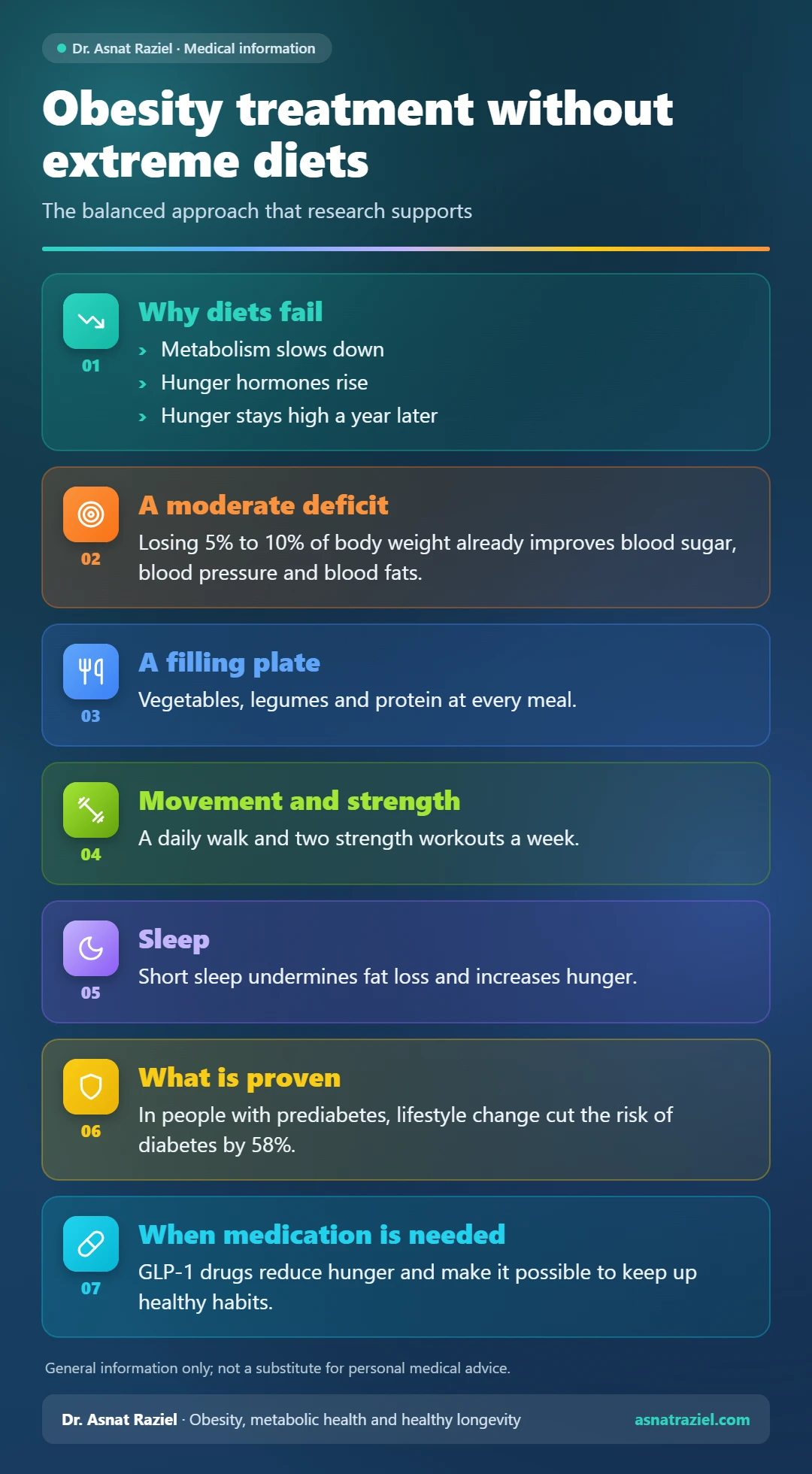
Obesity treatment without extreme diets: the principles
Treating obesity without extreme diets does not promise miracles. Instead, it builds habits you can live with. Here are the principles I recommend in my clinic.
A moderate calorie deficit
First, there is no need to starve. A moderate deficit, such as giving up a sugary drink and an evening snack, is enough to get started. In addition, losing 5% to 10% of your weight already improves blood sugar, blood pressure and blood fats.
A balanced, filling plate
Second, build every meal around vegetables, legumes and a protein source. Protein preserves muscle mass and increases fullness, so it is worth including at every meal. For example, an omelet with salad and a slice of whole-grain bread will keep you full far longer than a cookie and coffee.
Daily movement and strength training
In addition, exercise is not only about “burning calories.” It preserves muscle, improves the body’s sensitivity to insulin and helps you keep the weight off after you lose it. A daily walk and two strength workouts a week are an excellent foundation.
Sleep, stress and emotional eating without extreme diets
Sleep habits affect weight directly. In a small experiment, ten participants followed a moderate diet for two weeks. When they slept only 5.5 hours instead of 8.5, they lost less fat and more lean body mass, and they felt much hungrier. I discuss this link further in my article on sleep and brain health.
Stress and emotions also affect what we eat. That is why part of treatment is learning to notice when we eat from hunger, and when from fatigue, boredom or stress. Simple tools, such as a food diary and a short pause before opening the fridge, help a lot. Some patients also experience food noise, meaning constant thoughts about food, which makes every attempt much harder.
Without extreme diets: what the research shows
The strongest evidence comes from the US Diabetes Prevention Program. The trial included 3,234 people with prediabetes. The lifestyle group aimed to lose at least 7% of body weight and to get at least 150 minutes of activity a week. As a result, the risk of diabetes fell by 58% compared with placebo, a much stronger effect than that of the drug metformin.
Put simply, you do not need dramatic weight loss to gain health. Moderate weight loss that lasts is better than a large loss that comes back. Even so, a balanced approach also has periods when the weight stalls. If that happens, read about the weight loss plateau, and do not give up.
When treatment without extreme diets includes medication
Sometimes habit change alone is not enough. This does not reflect a lack of effort, but rather the disease of obesity itself and the biology that defends body weight. If you have tried everything, it is worth reading what to do when a diet does not work.
In such cases, medication from the GLP-1 family can help. These drugs mimic fullness hormones, reduce hunger and quiet food noise. Moreover, new oral drugs, such as Foundayo (orforglipron), are expanding the options. It is important to stress that the medication does not replace healthy habits. Instead, it makes them possible to keep.
The bottom line
Obesity treatment without extreme diets is not a compromise; it is the approach the research supports. The body defends its weight, so severe restriction tends to fail. On the other hand, a moderate deficit, filling food, movement, good sleep and emotional support build change that stays. When needed, medication joins the plan. At our clinic, led by Dr. Asnat Raziel, we build a personal plan like this for every patient.
This article provides general information and is not a substitute for personal medical advice.
Questions and answers
How much weight do you lose per week without extreme diets?
Usually half a kilo to one kilo a week. However, the pace varies from person to person, and the most important goal is to keep the weight off.
Can I eat carbohydrates?
Yes. Choose whole grains, legumes and fruit, and combine them with protein and vegetables.
What should I do when my weight gets stuck?
A plateau is a natural part of the process. In that case, review your sleep, protein intake and activity, and talk to a doctor.
When should I seek medical treatment?
When obesity comes with related conditions, or when habit change has not been enough. A specialist will check whether medication or surgery is right for you.
Sources
World Health Organization: Obesity and overweight
Persistent metabolic adaptation 6 years after “The Biggest Loser” competition
Long-term persistence of hormonal adaptations to weight loss
The effect of rate of weight loss on long-term weight management: a randomised controlled trial
Insufficient sleep undermines dietary efforts to reduce adiposity
Reduction in the incidence of type 2 diabetes with lifestyle intervention or metformin