By Dr. Asnat Raziel, bariatric surgeon specializing in obesity treatment, metabolic health and healthy longevity; Director of the Multidisciplinary Center for Obesity Treatment, Assia Medical, Assuta Ramat HaChayal, Tel Aviv
Obesity and ADHD: a two-way link
Obesity and ADHD (attention-deficit/hyperactivity disorder) are not separate phenomena. What many once saw as coincidence or a behavioral problem is now emerging as a complex biological and clinical link. This link affects eating patterns, adherence to treatment and metabolic risk. That’s why anyone who treats obesity needs to be familiar with it.
More common than you might expect
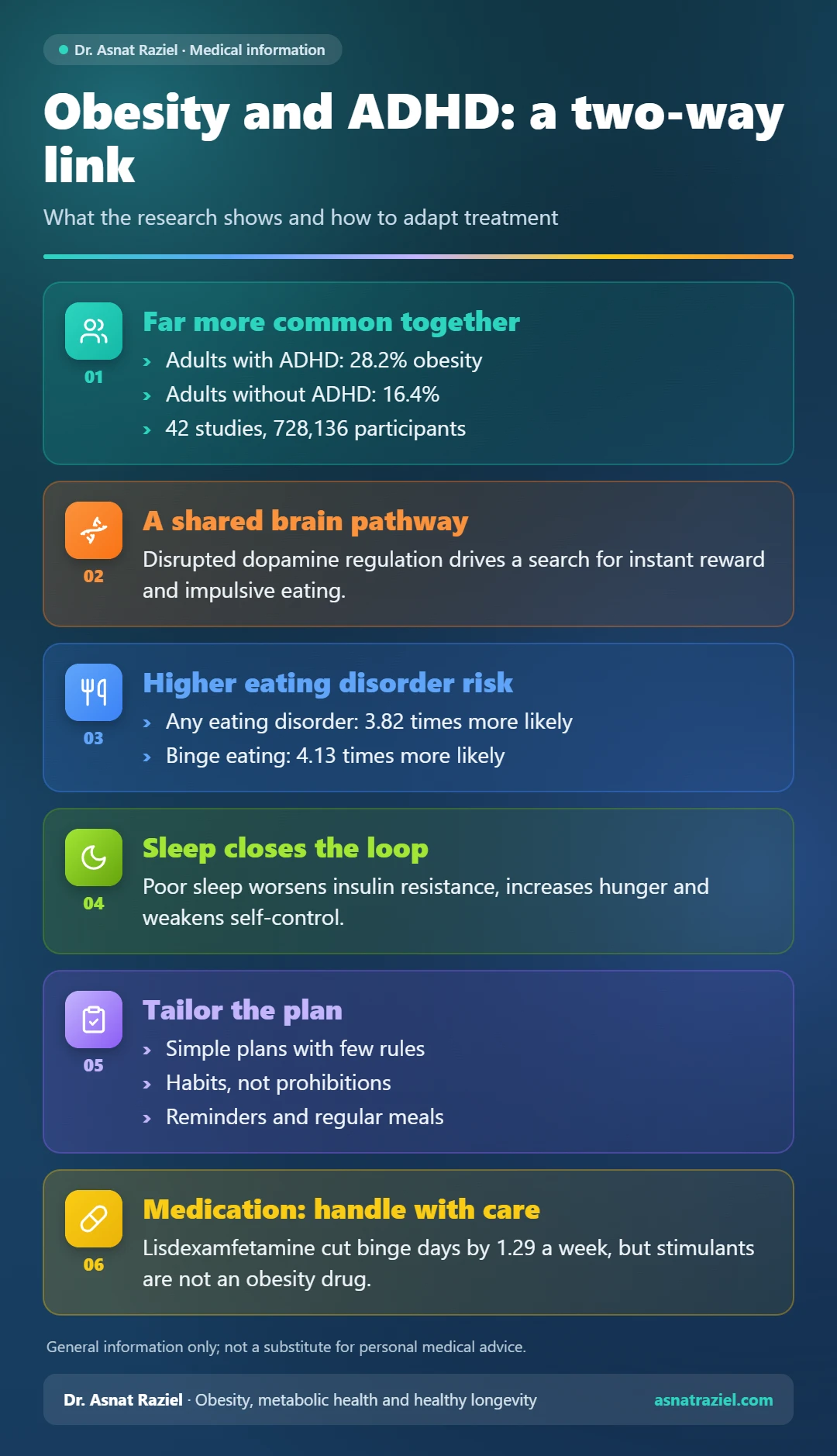
A meta-analysis of 42 studies with 728,136 participants examined this association. Among adults with ADHD, the obesity rate was 28.2%, compared with 16.4% in adults without the disorder. In other words, obesity was about 70% more common. In children, the gap was about 40%. The association held even after adjusting for confounding factors. Interestingly, among people who were receiving medication for ADHD, the risk of obesity was not elevated.
The direction of the link is complicated. A Mendelian randomization study, a method that uses genes to test cause and effect, came up with a surprising finding. According to the study, a high BMI raises the risk of ADHD, but there was no consistent evidence for the reverse direction. On the other hand, clinical studies show that ADHD behaviors promote weight gain. In other words, each condition feeds the other.
Obesity and ADHD: what happens in the brain?
The link rests on shared neural mechanisms. ADHD disrupts the regulation of the dopamine system, the brain’s reward system. The same system also plays a role in regulating eating, food reward and impulse control.
When this system is out of balance, the tendency to seek instant reward grows. In addition, it becomes hard to delay gratification, and eating turns impulsive, especially when it comes to foods high in sugar and fat. This isn’t a “lack of control.” Rather, it is a predictable neural response. I discuss this further in my article on food noise.
Impulsive eating, not physical hunger
For people with ADHD, eating is not always a response to hunger. Sometimes it is a response to boredom, emotional overload, fatigue or a need for stimulation. This pattern makes it harder to listen to fullness signals and to stick with a nutrition plan over time.
The data illustrate this clearly. According to a meta-analysis on eating disorders, people with ADHD are 3.82 times more likely to have an eating disorder. In particular, their likelihood of binge eating is 4.13 times higher. This is one reason why strict, rigid diets often fail in this population.
Attention, sleep and metabolism
ADHD often comes with sleep disorders, delayed bedtimes and irregular sleep. Lack of sleep worsens insulin resistance, increases hunger and weakens self-control. As a result, it deepens the risk of obesity. Together, ADHD, poor sleep and obesity create a self-perpetuating cycle. I have also written about this side of the triangle in my article on sleep, weight and metabolism.
How obesity and ADHD affect treatment
Undiagnosed ADHD can undermine obesity treatment. Trouble sticking with a plan, forgetting planned meals, difficulty taking medications on time and irregular exercise are not signs of unwillingness. They are real neurobiological challenges. So when we recognize the disorder and adapt the treatment, the chances of success go up. You can read more about the importance of persistence in obesity treatment in a separate article.
Tailored treatment: not the same plan for everyone
Treating obesity in people with ADHD requires adjustments. These are the principles I recommend:
- Simple, clear plans with only a few rules.
- Flexibility instead of rigidity.
- A focus on habits rather than prohibitions.
- Time-management tools, phone reminders and a supportive environment.
- Regular meals that prevent extreme hunger and impulsive eating.
In some cases, getting ADHD under control, with medication or behavioral therapy, also improves the ability to control eating.
Medication for obesity and ADHD
There is evidence that ADHD medication reduces impulsive eating in some patients. For example, lisdexamfetamine is approved in the United States for both ADHD and binge eating disorder. A meta-analysis of 5 controlled trials with 988 participants found that the drug cut the number of binge days by 1.29 days a week compared with placebo. However, stimulants are not an obesity drug. An analysis of 93 trials showed that they raise the risk of side effects, so they require medical monitoring.
Conversely, obesity medication may ease the burden of urges. A 2024 review notes that GLP-1 drugs and the naltrexone-bupropion combination show promise for reducing weight and binges in people with a high BMI. The effect of these drugs on the brain’s satiety centers quiets the drive to eat. Ultimately, good management requires looking at both conditions together, with close cooperation between the obesity physician and the psychiatrist.
Questions and answers
Does everyone with obesity need to be evaluated for ADHD?
No. Still, when there is ongoing difficulty with persistence, impulsive eating or procrastination that shows up in every area of life, an evaluation by a specialist is worth considering.
Are ADHD medications suitable for weight loss?
No. Stimulants are approved for treating ADHD, and lisdexamfetamine is also approved in the United States for binge eating disorder. Nevertheless, they are not an obesity drug, and no one should take them to lose weight.
Can obesity medication be combined with ADHD treatment?
In many cases, yes, under medical supervision. Your doctor will review your current medications, blood pressure and heart rate, and tailor the treatment to you.
The bottom line on obesity and ADHD
Obesity and ADHD share a common biological language. This understanding is not an excuse. Instead, it is the key to treatment that is precise, less judgmental and effective. When we ignore the attention component, treatment may fail. But when we tailor treatment to the brain, the body follows.
The information in this article is general and does not replace personal medical advice.
References
Association Between ADHD and Obesity: A Systematic Review and Meta-Analysis
Safety of Stimulants Across Patient Populations: A Meta-Analysis
Can we effectively manage binge eating disorder with pharmacotherapy?




