By Dr. Asnat Raziel, bariatric surgeon specializing in obesity treatment, metabolic health and healthy longevity; Director of the Multidisciplinary Center for Obesity Treatment, Assia Medical, Assuta Ramat HaChayal, Tel Aviv
Emotional coping with obesity: why it is part of treatment
Emotional coping with obesity is a central part of treatment, not a side issue. Obesity is a chronic disease of the body, but it also affects mood, self-image and relationships. In addition, emotional distress can make it harder to lose weight and to keep it off. So good treatment looks after body and mind together.
In my clinic, I meet patients who arrive after years of diets, criticism and a sense of failure. Many of them are sure the problem is a “lack of willpower.” However, research paints a completely different picture. In this article, I will explain what we know today about the link between obesity and emotions, and what really helps.
The two-way link between obesity and depression
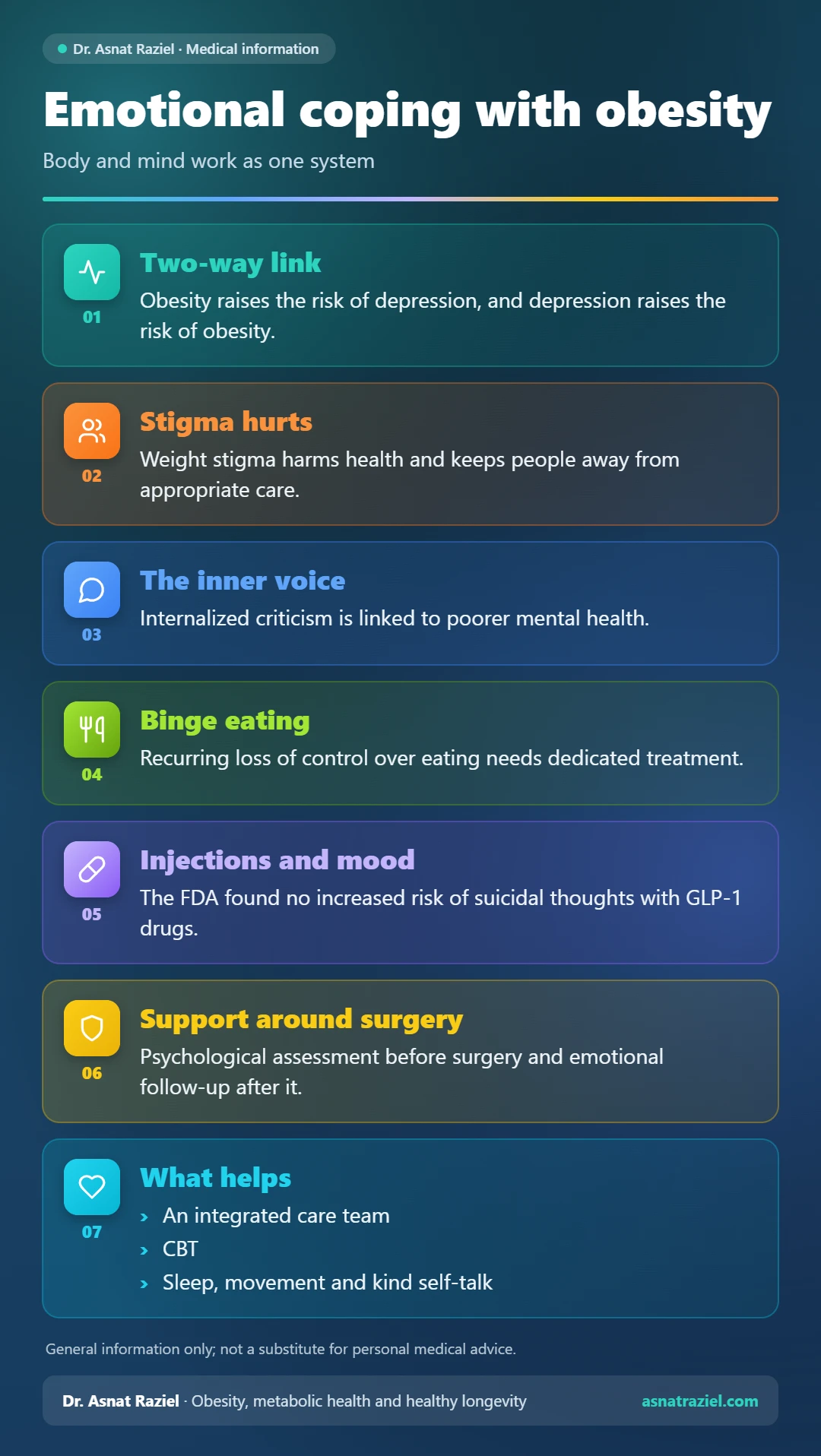
The link between obesity and depression runs in both directions. A meta-analysis of longitudinal studies included 15 studies and 58,745 participants. The researchers found that obesity at the start of follow-up raised the odds of developing depression later, with an odds ratio of 1.55. In other words, the odds were about 55% higher. Conversely, depression raised the odds of developing obesity, with an odds ratio of 1.58.
The meaning is simple: there is no chicken-and-egg question to settle here. The two conditions feed each other. So when we treat only one side, the other side keeps pulling back. Furthermore, the link between obesity and depression is especially strong in severe obesity, at a young age and in women, as an overview of the psychiatric consequences of obesity summarizes.
The body takes part in this process, too. For example, sleep problems, joint pain and chronic fatigue all drag mood down. Moreover, obesity in midlife is also linked to brain health later in life, and many studies are exploring the nervous system in diseases such as Alzheimer’s. Ultimately, body and mind work as one system.
Stigma and shame: emotional coping with obesity in society
People with obesity face stigma at work, at school and even within the health system. An international consensus statement by experts from around the world concluded that this stigma harms both physical and mental health. In addition, it keeps people away from appropriate medical care. According to the experts, stigma rests on the mistaken belief that obesity is a personal choice.
This damage builds up over the years. Someone who has heard remarks since childhood learns to hide, to feel ashamed and to avoid. As a result, some patients put off medical checkups because they fear being weighed or criticized. This is the psychosocial burden of obesity, and it does not show up on any lab test.
When criticism becomes an inner voice
Sometimes outside criticism turns into an inner voice. Professionals call this weight bias internalization: a person adopts negative views about weight and turns them against themselves. A systematic review of 74 studies showed a strong link between internalized weight bias and poorer mental health. In other words, the way people talk to themselves affects their health.
Emotional eating and binge eating
Many people use food to calm down, to comfort themselves or to pass the time. This is emotional eating, and it is a familiar human response to stress, sadness or boredom. I have written about it in depth in my article on obesity and emotional eating. Still, it is important to tell it apart from an eating disorder.
Simple tools can help. For example, Mayo Clinic’s guide to controlling emotional eating suggests keeping a food diary, taking a hunger reality check and getting support from friends, family or a support group.
Binge eating disorder is a medical diagnosis. It involves repeated episodes of eating a large amount of food in a short time, with a sense of loss of control and guilt afterward. This disorder is common among people who seek obesity treatment. That is why we ask about it at every first assessment, because it needs dedicated treatment.
Emotional coping with obesity during drug treatment
GLP-1 drugs such as semaglutide and tirzepatide change hunger and fullness signals in the brain. Many patients describe a new calm around food, and sometimes emotional relief as well. I explained the mechanism in my article on obesity drugs and the brain. Even so, medication does not replace emotional work.
In the past, there was a question of whether these drugs raise the risk of suicidal thoughts. In January 2026, the FDA (the US Food and Drug Administration) published the conclusions of its comprehensive review. The FDA found no increased risk and asked to remove the warning from the labels of Saxenda, Wegovy and Zepbound. Nevertheless, any significant change in mood is a reason to talk to your doctor.
In addition, the psychological side of side effects matters as well. For example, long-lasting nausea can trigger anxiety and frustration. I wrote about this in my article on nausea from weight-loss drugs.
Emotional coping with obesity before and after surgery
Bariatric surgery changes the body quickly, but the mind needs time to adjust. Most patients report better quality of life and mood. On the other hand, a meta-analysis of 32 studies with 148,643 patients showed a complex picture. The suicide rate after surgery was 2.7 per 1,000 patients. The rate of suicide attempts and self-harm was 17 per 1,000.
What’s more, in the same patients the risk of self-harm after surgery was 1.9 times higher than before it. So a psychological assessment before surgery and emotional follow-up afterward are part of treatment, not a bureaucratic box to tick. Likewise, enhanced recovery programs after surgery emphasize good preparation and close support.
After major weight loss, unexpected feelings sometimes come up. For example, there may be fear of going back to the old weight, or a feeling that the body is still “not mine.” I wrote about this in my article on the paralyzing fear of regaining weight and in my guide on learning to trust your body again.
Practical tools for emotional coping with obesity
There is no one solution that fits everyone. However, a few principles come up again and again in patients who succeed over time.
Build a care team
Good obesity care includes a doctor, a dietitian and a mental health professional. Cognitive behavioral therapy (CBT), a therapy that teaches you to recognize thoughts and habits and change them, helps especially with binge eating. In addition, support groups ease the sense of loneliness.
A routine that supports your mood
- Regular sleep: lack of sleep increases hunger and worsens mood.
- Daily movement: walking or strength training improves mood, whatever the effect on weight.
- Gentle tracking: note when the urge to eat shows up, not just what you eat.
- Compassionate language: talk to yourself the way you would talk to a close friend.
Over time, emotional change also shapes self-image. I wrote about this in my article on how weight loss affects self-confidence. It is important to remember that self-confidence does not depend only on the number on the scale.
Emotional coping with obesity: when to seek help
Seek help when sadness or anxiety lasts two weeks or more, or when it affects your daily functioning. Recurring binge episodes, self-induced vomiting or extreme fasting also call for help. Finally, thoughts of self-harm require immediate contact with a doctor, an emergency room or a mental health helpline, such as the 988 Suicide & Crisis Lifeline in the US.
Bottom line
Emotional coping with obesity is not a luxury; it is part of medical treatment itself. Obesity and depression feed each other, and stigma adds a heavy burden. Therefore, effective treatment combines medicine, nutrition and mental health support, without judgment. If you feel this issue weighing on you, a conversation with a doctor who specializes in obesity is a good first step.
The information in this article is general and does not replace personal medical advice.
Questions and answers
Does obesity cause depression?
The link runs both ways. Obesity raises the odds of depression, and depression raises the odds of obesity.
What is the difference between emotional eating and an eating disorder?
Emotional eating is a common response to emotions. By contrast, binge eating disorder involves repeated loss of control and needs dedicated treatment.
Do weight-loss injections affect mood?
A comprehensive FDA review found no increased risk of suicidal thoughts. Even so, any sharp change in mood calls for a conversation with your doctor.
How do you start emotional coping with obesity?
Start with an honest conversation with a doctor and build a team that includes emotional support. Small, consistent steps work better than big promises.
Sources
Overweight, obesity, and depression: a systematic review and meta-analysis of longitudinal studies
Joint international consensus statement for ending stigma of obesity