By Dr. Asnat Raziel, bariatric surgeon specializing in obesity treatment, metabolic health and healthy longevity; Director of the Multidisciplinary Center for Obesity Treatment, Assia Medical, Assuta Ramat HaChayal, Tel Aviv
Trusting your body again after years of obesity
Trusting your body again is one of the hardest tasks my patients describe after years of obesity and dieting. Many tell me, “I no longer know when I’m really hungry.” That feeling is real, and it has both a biological and a psychological explanation. The good news is that you can rebuild your connection with your body, step by step.
In this article, I’ll explain why that trust breaks down, what research says about listening to hunger and fullness signals, and which practical steps help you reconnect with them.
Why trusting your body feels so hard
Years of dieting teach us to ignore our bodies. We eat by the clock, by a meal plan or by a number on an app. At the same time, in stressful moments we eat to calm down rather than out of hunger. Little by little, the internal signals get mixed up, until it becomes hard to tell them apart.
In addition, many people blame themselves. They feel their body has “betrayed” them or that they lack willpower. A systematic review of 74 studies on internalized weight stigma found a strong link between self-criticism about weight and poorer mental health. In other words, shame doesn’t help you change habits. On the contrary, it makes change harder. So the first step is to understand that the problem is not a personal weakness.
The biology behind hunger
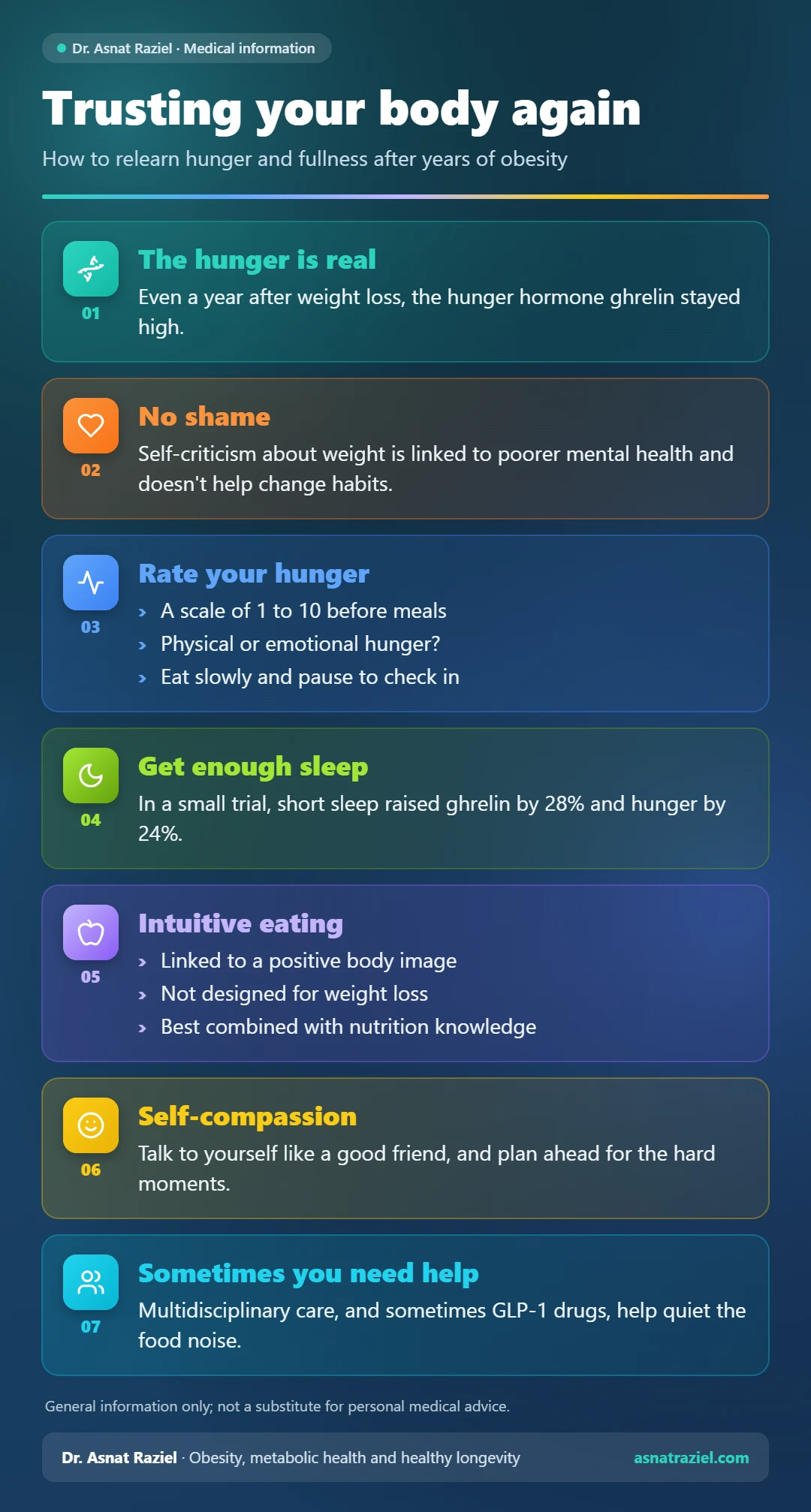
After weight loss, the body reacts as if it were in an emergency. A study published in the NEJM followed 50 people who lost an average of 13.5 kg on a very low-calorie diet. Even a year later, levels of the hunger hormone ghrelin remained high, and participants reported increased hunger. Put simply, this hunger is real and not “all in your head.”
Furthermore, a scientific review of how internal signals are perceived in obesity describes two patterns. In some people, hunger signals are especially strong. In others, it is hard to recognize fullness in time. This ability is called interoception: the capacity to sense what is happening inside your body. The good news is that it can be trained.
The brain plays a role here, too. Many people experience “food noise,” meaning constant thoughts about food. That kind of noise makes it very hard to hear the body’s subtler signals.
Intuitive eating: what it offers and what it doesn’t
The best-known approach to reconnecting with your body is intuitive eating. Two American dietitians, Evelyn Tribole and Elyse Resch, developed it. The approach includes ten principles, among them honoring hunger, recognizing fullness, coping with emotions without food and respecting your body.
What does the research say? A meta-analysis of 97 studies linked intuitive eating with a positive body image, higher self-esteem and fewer disordered eating behaviors. However, most of these studies were cross-sectional, taken at a single point in time. As a result, they show an association, not necessarily cause and effect.
It’s also worth knowing the limitations. According to Harvard’s review of research on intuitive eating, the approach was not designed for weight loss. In comparative studies, it led to a small weight loss compared with no treatment, but not more than a conventional diet. Moreover, “unconditional permission to eat” has been linked in some studies with poorer diet quality. That’s why I recommend combining body awareness with basic nutrition knowledge.
Five steps to trusting your body again
1. Rate your hunger before meals
Before you eat, pause for a moment. Rate your hunger on a scale of 1 to 10. Is there a feeling in your stomach, tiredness or trouble concentrating? Or is it boredom, stress or habit? Simply asking the question already turns your attention inward.
2. Eat slowly and notice fullness
The feeling of fullness arrives a few minutes late. So put your fork down between bites, eat without a screen and stop halfway through your plate for a quick check-in. At first it feels artificial. Over time, though, it becomes natural.
3. Tell physical hunger from emotional hunger
Physical hunger builds gradually, and almost any reasonable food satisfies it. In contrast, emotional hunger comes on suddenly and focuses on a specific food. If this sounds familiar, my guide to overcoming emotional eating offers practical tools.
4. Get enough sleep
Short sleep disrupts your appetite hormones. In a small trial in 12 young men, two nights of restricted sleep raised ghrelin by 28% and hunger by 24%. Trusting your body is hard when it’s exhausted. You can read about the broader connection in my article on sleep and brain health.
5. Move for how it feels, not for the calories
Walking, swimming or strength training restore a sense of capability. Instead of asking “How much did I burn?”, ask “How do I feel afterward?” That way, movement becomes part of a positive relationship with your body.
Self-compassion: the key to trusting your body
Trust in your body is also tied to the way you see it. Many people keep seeing themselves as “big” even after losing a significant amount of weight. If that’s the case for you, you may want to read about body image after weight loss and about the link between weight loss and self-esteem.
First, try talking to yourself the way you would talk to a good friend. Self-compassion and mindfulness practices help quiet your inner critic. In addition, mental preparation for a lifestyle change lets you anticipate the hard moments in advance.
When trusting your body needs extra help
Sometimes listening alone is not enough. Obesity is a chronic disease, and the biological mechanisms I described are powerful. Medications in the GLP-1 family act on the hunger and satiety centers in the brain. Many patients tell me that the food noise fades and that they can finally hear their bodies.
At our clinic, we combine medical treatment with a dietitian, a psychologist and a fitness coach. This way, we can address both biology and habits. If you are dealing with binge eating, ongoing emotional pain or a sense of losing control, reach out to a professional. That is a sign of responsibility, not weakness.
The bottom line
Trusting your body again doesn’t require waiting for the “right” weight. Instead, it requires understanding that the hunger is real, practicing listening with patience and replacing criticism with compassion. Ultimately, a combination of body awareness, nutrition knowledge, good sleep and, sometimes, medical treatment gradually restores that trust. As Dr. Asnat Raziel, I see this process unfold in many of my patients.
This article provides general information and is not a substitute for personal medical advice.
Frequently asked questions
How long does trusting your body again take?
There’s no single timeline. For many people, the change becomes noticeable after a few weeks of daily practice. Still, it’s a process with ups and downs, and that’s perfectly fine.
Is intuitive eating right for everyone?
Not always. People with an eating disorder, diabetes or other conditions need professional guidance. In these cases, the principles are built into a personalized treatment plan.
Is trusting your body possible while on weight loss injections?
Yes, and it may even be easier. The medications dampen hunger, so this is a good opportunity to learn to recognize fullness and build habits that last.
How can I tell hunger from thirst or tiredness?
Drink a glass of water and wait a few minutes. Also check how you slept last night. If the hunger remains, your body probably really needs food.
Sources
Long-term persistence of hormonal adaptations to weight loss
Interoceptive contributions to healthy eating and obesity
Intuitive eating and its psychological correlates: A meta-analysis
Weight bias internalization and health: a systematic review
Intuitive Eating – The Nutrition Source, Harvard T.H. Chan School of Public Health