By Dr. Asnat Raziel, bariatric surgeon specializing in obesity treatment, metabolic health and healthy longevity; Director of the Multidisciplinary Center for Obesity Treatment, Assia Medical, Assuta Ramat HaChayal, Tel Aviv
Lifestyle change starts in your head
Mental preparation for a lifestyle change is the step most people skip. On Sunday they decide that “from now on, everything will be different,” and two weeks later they are back to their old habits. The problem is not a lack of willpower. More often, what’s missing is a plan that fits your state of mind, your daily routine and the real obstacles in your way.
In my clinic, I see that patients who invest a few weeks in preparation tend to stick with the change for a long time afterward. In this article, I’ll explain what research says about changing habits and how to prepare for it in a practical way.
The stages of change: where are you right now?
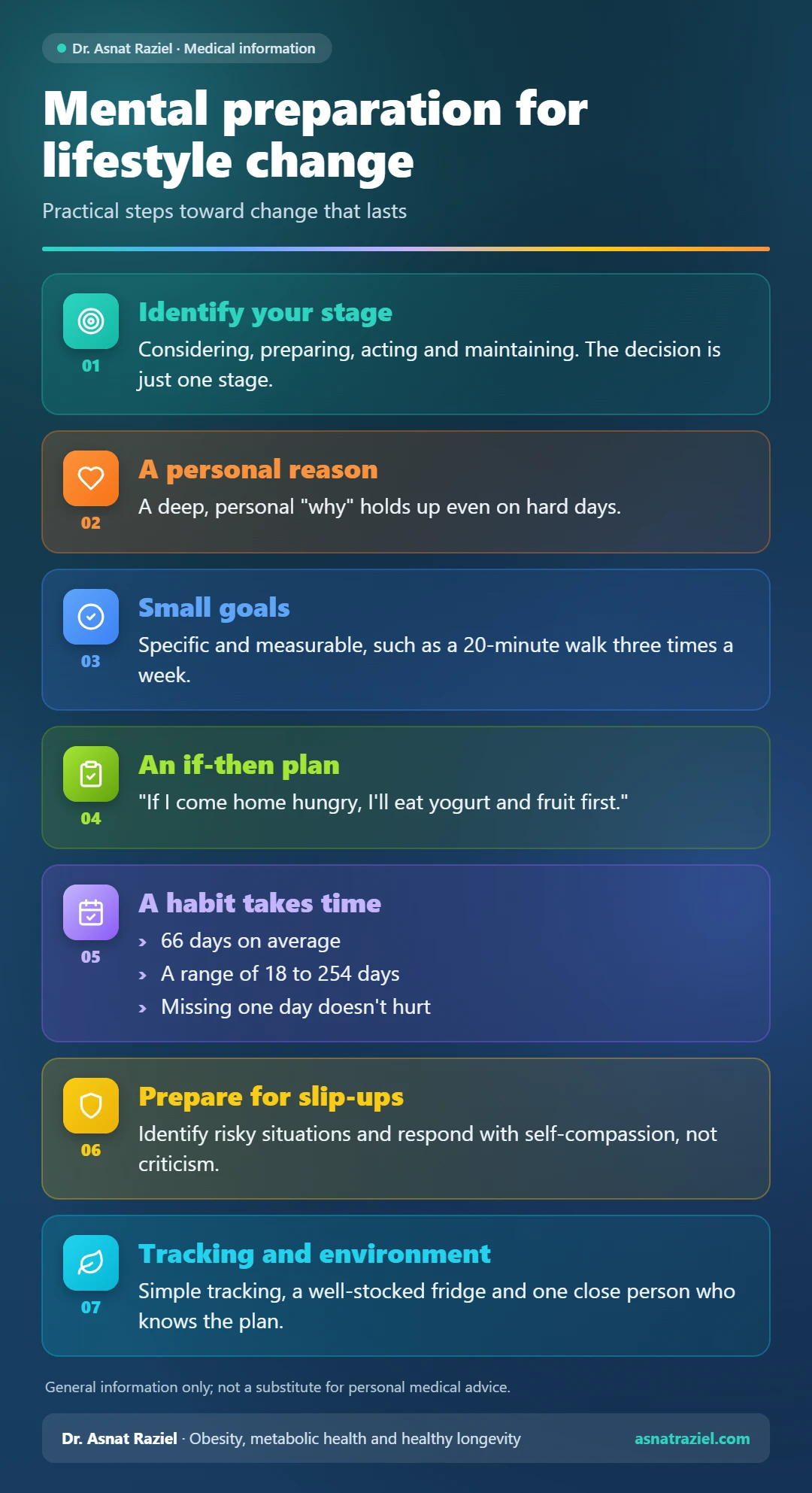
Behavioral researchers have described the transtheoretical model of behavior change. According to this model, people move through several stages. First, they are not yet considering a change. Next, they start thinking about it, then they prepare, then they act, and finally they maintain the change. In other words, the decision to act is only one stage of the process.
The practical takeaway is simple. If you are still on the fence, don’t jump straight into an extreme diet. Instead, write down what you will gain from the change and what scares you about it. That ambivalence is a legitimate part of the journey.
It’s also worth checking your timing. A move, an unusually heavy workload or a family crisis is not the ideal time to begin. On the other hand, don’t wait for the “perfect moment,” because it almost never comes. So pick a start date in the near future and mark it in your calendar.
Preparing for a lifestyle change begins with “why”
Motivation that relies on outside pressure fades quickly. By contrast, a deep personal reason holds up even on hard days. For example, “I want to keep up with my grandchildren on a hike” is far more powerful than “I need to lose five kilos.”
That’s why I suggest writing your reasons on a sheet of paper and keeping it close at hand. It also helps to identify what drives your old habits in the first place. I wrote about this in my article on a holistic approach to obesity treatment.
Mayo Clinic gives similar advice in its six strategies for weight-loss success. First, make sure you are ready. Then find your inner drive, because no one else can make you lose weight.
Small goals and an “if-then” plan
A goal like “eat healthy” is too vague. A good goal is small, specific and measurable, such as a 20-minute walk three times a week. Research shows that small changes in daily habits add up to a real effect on health.
One especially effective tool is the “if-then” plan. Researchers call it an implementation intention: a plan that sets in advance when, where and how you will act. For example: “If I come home hungry, then I’ll eat yogurt and fruit first.” A systematic review of 54 studies found that plans like these improved physical activity and eating habits in people with chronic conditions. Admittedly, the effect was small. Still, it’s a simple and inexpensive tool.
How long does it take to form a habit?
Many people have heard of “21 days.” In practice, research paints a different picture. In a study by Lally and colleagues, 96 students each chose a new health habit. On average, the habit became automatic after 66 days. However, the range was very wide: from 18 to 254 days, according to the researchers’ estimates.
What’s more, missing a single day did not derail the process. So there is no reason to give up after a slip. As a review on the psychology of habit formation explains, the secret is consistent repetition of the same action in the same context.
Lifestyle change and slip-ups: plan ahead
Slip-ups are part of every change. The question is not whether they will happen, but what you will do when they do. First, identify the high-risk situations in advance: fatigue, stress at work, family events or evenings alone in front of the TV. Second, prepare an alternative response for each one.
Likewise, the way you talk to yourself matters a great deal. Harsh self-criticism can sometimes increase the urge to eat. In contrast, self-compassion and mindfulness help you get back on track faster. If stress is a major trigger for you, you may also want to read about stress and obesity.
Lifestyle change support: self-monitoring and your environment
Self-monitoring is one of the best-tested tools. A systematic review of self-monitoring in weight loss found a consistent link between tracking food, activity and weight and losing weight. Even so, the researchers noted that the level of evidence is still limited. Therefore, choose a simple tracking method that you will actually keep up.
In addition, adjust your surroundings. Put cut fruit and vegetables in the fridge and move snacks out of sight. Share your plan with one person close to you. After a long period of struggle, your body and mind need time to relearn. I wrote about this in my article on learning to trust your body again.
When you also need medical help
Sometimes mental preparation is not enough on its own. Obesity is a chronic disease with a biological basis that includes increased hunger and hormonal changes. In such cases, anti-obesity medications can quiet the “food noise” and make the change easier. Keep in mind that even with medication, your habits determine the long-term result. You’ll find a detailed guide in my article on changing habits during drug treatment.
During treatment itself, mental health monitoring on weight-loss drugs is just as important.
If you’d like to learn more about our approach at the multidisciplinary center, you can read about Dr. Asnat Raziel.
The bottom line on lifestyle change
Mental preparation for a lifestyle change is not a luxury; it is the foundation of success. Figure out which stage you are in, define a personal reason, set small goals with “if-then” plans, and prepare for slip-ups in advance. Also remember that a habit takes time, usually two months or more. In the end, consistency beats perfection.
This article provides general information and is not a substitute for personal medical advice.
Frequently asked questions
How long does mental preparation for a lifestyle change take?
There is no fixed time. For most people, a week or two of planning, identifying obstacles and setting first goals is enough.
What should I do after a slip-up?
Go back to your plan at the next meal, with no punishment and no compensating. One missed day does not erase your progress.
Do I need professional support?
Not always. However, support from a doctor, dietitian or psychologist increases the chance of sticking with it, especially after previous attempts that did not work.
Does a lifestyle change mean changing everything at once?
Preferably not. Start with one or two changes, and only add the next one once they have become automatic.
Sources
The transtheoretical model of health behavior change
How long does it take to form a habit? – BPS Research Digest
Making health habitual: the psychology of ‘habit-formation’ and general practice
Self-monitoring in weight loss: a systematic review of the literature