By Dr. Asnat Raziel, bariatric surgeon specializing in obesity treatment, metabolic health and healthy longevity; Director of the Multidisciplinary Center for Obesity Treatment, Assia Medical, Assuta Ramat HaChayal, Tel Aviv
The long-term effects of war do not fade when the headlines do. Israel offers a rare window into this question. Researchers there happened to measure people’s mental health shortly before the attack of October 7, 2023, and then kept following them through the long war that came after. Their findings, a year on, show how chronic stress settles into the body. They also show who stays vulnerable long after the first shock has passed.
Long-term effects of war: a body that stays on high alert
The impact of war on the body is not confined to borders, headlines or the minutes of an air-raid siren. War seeps inward, into body and mind. It changes the way we breathe, sleep, eat and feel. Even people who keep functioning, going to work, caring for their children and projecting normal life, often carry a hidden load that builds up slowly.
Unlike a one-time event, a prolonged war creates chronic vigilance. The body never receives the signal that the danger has passed. So it stays on high alert over time. This is an important survival mechanism. However, when it lasts for days, weeks and months, it starts to take its toll.
Long-term effects of war: what a year of data from Israel shows
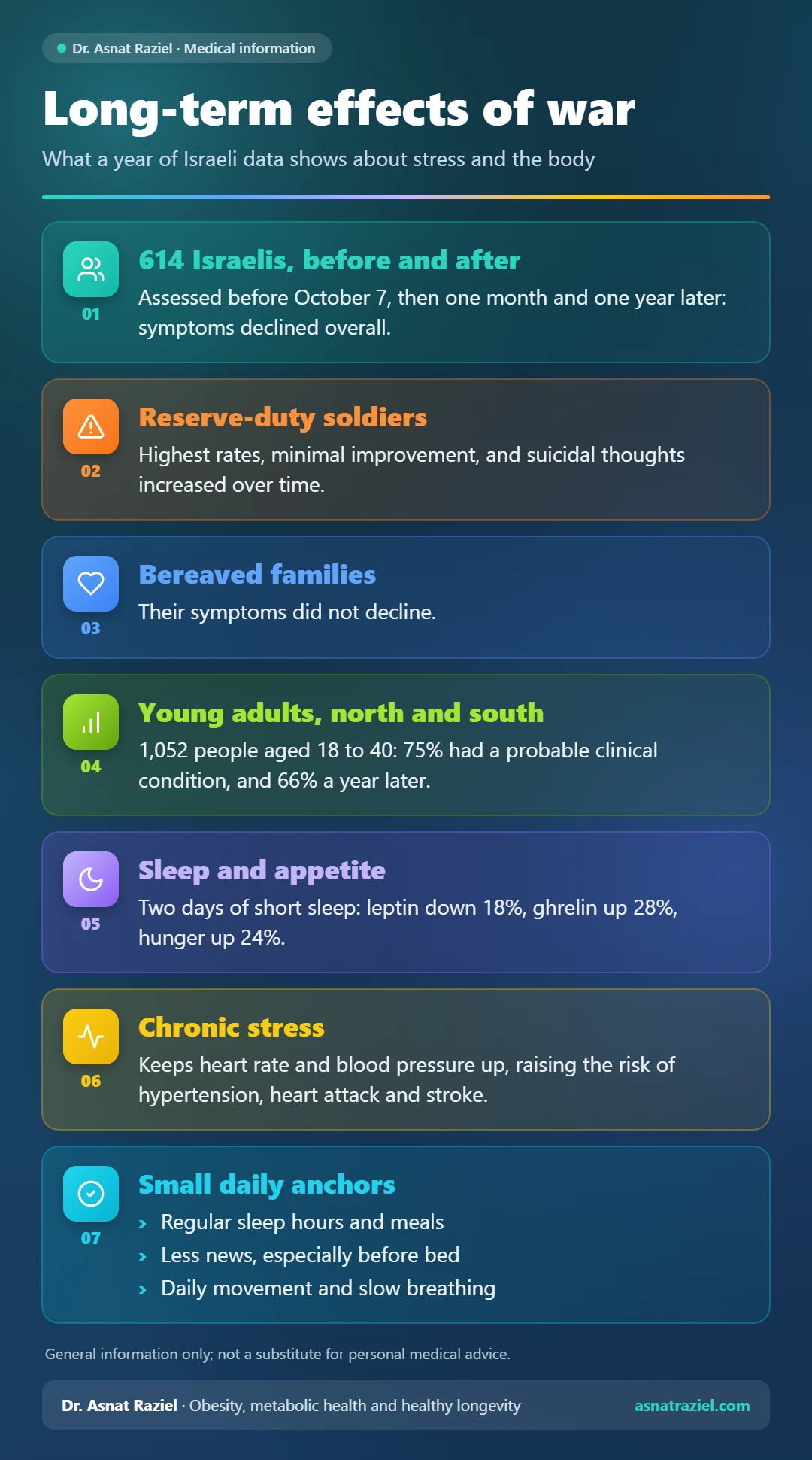
Since October 7, 2023, Israeli researchers have tracked the population’s mental health. In one unique study, 614 Israelis were assessed before the attack, and again one month and one year after it. Overall, symptoms declined over the year. Recovery, however, was not uniform. Reserve-duty soldiers showed the highest rates, with only minimal improvement. In their group, suicidal thoughts even increased over time.
Among bereaved families, too, symptoms did not decline. In another study, researchers followed 1,052 young adults aged 18 to 40 from the north and south of Israel, the regions hit hardest. At the start, 75% reported at least one probable clinical condition: anxiety, depression or post-traumatic stress. A year later, the figure still stood at 66%. In addition, the World Health Organization estimates that 22% of people who have lived through war in the past decade have a mental disorder.
Long-term effects of war: who stays vulnerable
These studies share one clear message: time alone does not heal everyone equally. For many people, symptoms ease as months pass. Yet reserve-duty soldiers improved only slightly, and their suicidal thoughts rose. Bereaved families saw no decline at all. Among young adults in the hardest-hit regions, two out of three still had a probable clinical condition after a full year.
So the long-term effects of war are often hidden in the people who seem to be coping. That is why it is worth checking in again after several months, not only in the first weeks. This applies to ourselves, to our partners and to the people we care for. Distress that persists is a signal to seek help, not a personal failure.
Pregnant women are one group that has been studied directly. I describe the findings in my article on pregnancy during war and maternal stress.
Chronic stress: when the body gets no break
Under a constant threat, the body activates its stress system again and again. Hormones such as cortisol and adrenaline are released in large amounts. As a result, the body behaves as if the danger were still immediate.
According to the American Psychological Association, chronic stress keeps the heart rate and blood pressure elevated. This raises the risk of hypertension, heart attack and stroke. It also keeps the muscles constantly tense, disrupts communication between the brain and the gut, and interferes with the natural rhythm of cortisol.
That is why many people experience a racing heart, headaches, ongoing fatigue, stomach pain, muscle tension, irritability and trouble concentrating. Sometimes it feels like a constant overload, even in moments that seem calm. The body cannot shift from alertness to rest, and that wears it down.
Sleep: nights that don’t truly restore
One of the main signs of ongoing stress is disrupted sleep. Some people struggle to fall asleep. Others wake at every small noise. And some do sleep, but still wake up tired, as if they had not rested at all.
Sleep is a vital recovery mechanism. When it suffers, body and mind pay the price. The immune system weakens, anxiety rises and the ability to regulate emotions declines. Moreover, lack of sleep disrupts the appetite hormones. In a classic study, two days of restricted sleep lowered the satiety hormone leptin by 18% and raised the hunger hormone ghrelin by 28%. Hunger also rose by 24%. I wrote more about this in my article on how lack of sleep affects your health.
So in times like these, good sleep is sometimes even more important than a diet. A tired body struggles to find its balance, and good sleep is the foundation of physical and emotional stability.
Emotional eating: when food becomes an anchor
In times of uncertainty, food takes on an extra role. Beyond nourishment, it becomes a way to calm down, find comfort and feel in control. Many people turn to sweets, snacks, late-night eating or mindless eating in front of a screen.
This is not weakness, but a human response to stress. The brain looks for instant relief, and food provides it for a short while. But when the pattern repeats, it can lead to weight gain, metabolic strain and guilt that only adds to the stress. The biological link between stress and weight is explained in my article on stress and obesity. If stress is already affecting your weight, my four-step stress management plan may help.
The quiet, long-term effects of war on health
Not every kind of harm is visible. Sometimes it shows up as fatigue that won’t go away, a short temper, unexplained aches or low energy. Some people experience sudden crying, a loss of motivation or difficulty enjoying simple things.
It is important to understand that this is not “all in your head.” The body is responding to reality. The brain and the hormonal system are affected by the environment. These reactions are a real physiological expression of a prolonged state of threat. For the everyday side of coping at home, with loneliness and a broken routine, see my article on stress, loneliness and routine in wartime. In addition, during a period like this it is easy to postpone routine checkups and the follow-up of chronic conditions. Yet this is exactly the time to keep managing blood pressure, diabetes and weight, and not to skip doctor’s appointments.
Isolation makes these effects harder for older people. Read more about protecting older adults from loneliness in wartime.
National mood: between hope and anxiety
Alongside the personal response, there is also a broader shift in the national mood. There are days of hope, unity and resilience. Beside them are days of emotional exhaustion, fear and loss of trust. In the study of young adults from the north and south, for example, the sense of betrayal actually grew over the year.
Swinging back and forth between emotional extremes creates an extra burden. Even when there is good news, the body still carries the memory of the stress. As a result, these swings show up as changes in energy, appetite, concentration and the sense of safety.
How to soften the long-term effects of war on the body
We cannot erase reality. But there are ways to support body and mind within it. The goal is not perfection, but small anchors:
- Regular sleep hours as much as possible, even if the sleep itself is not perfect.
- Enough fluids and regular meals throughout the day.
- Less exposure to the news, especially before bed.
- Daily movement, even light, which helps release tension.
- Deep, slow breathing a few times a day, which signals to the body that the danger is not immediate.
Above all, you don’t have to “hold everything together.” Recognizing that the body is reacting to the situation is already a meaningful step. The body is not the enemy, but a system trying to protect us. You will find more techniques in my practical guide to stress relief.
If symptoms persist or worsen, see your family doctor or a mental health professional. In Israel, the ERAN emotional first-aid hotline is available 24 hours a day at 1201.
Between resilience and listening
Especially in times like these, real resilience is not only the ability to keep moving forward. It is also the ability to pause and listen: to notice fatigue, acknowledge stress and give body and mind a little space to recover.
In the end, the impact of war on the body is real, but it can be softened. The war happens outside, but our health is also shaped within. The more support and understanding we give the body, the less worn down and the more stable we will be as we get through this period.
The information in this article is general and does not replace personal medical advice.