By Dr. Asnat Raziel, bariatric surgeon specializing in obesity treatment, metabolic health and healthy longevity; Director of the Multidisciplinary Center for Obesity Treatment, Assia Medical, Assuta Ramat HaChayal, Tel Aviv
Pregnancy during war: what an Israeli study found
Pregnancy during war is an especially powerful emotional experience. In itself, pregnancy is a time of deep change: the body changes, identity is reshaped and the future takes on new meaning. Alongside the excitement and anticipation, it is also an emotionally and physically vulnerable period. When an ongoing security threat and uncertainty are added, the emotional load can become very heavy.
However, a new Israeli study offers a surprising perspective. Even under extreme stress, pregnant women may experience not only distress, but also deep personal growth. Sometimes this growth comes not in spite of the hardship, but precisely out of it. Researchers from Bar-Ilan University published the study in the International Journal of Psychology in 2025. They examined personal growth among pregnant women during the first month of the Israel-Hamas war, and looked at the role of optimism and meaning in life.
Why pregnancy during war is a vulnerable time
Pregnancy on its own brings hormonal changes, emotional strain and worries about the health of mother and baby. All of these can increase anxiety, depression and post-traumatic symptoms. In wartime, the risk rises further. Air-raid sirens, threats to civilians, distressing news and uncertainty about the future create an ongoing emotional burden. Since October 2023, women in Israel have lived through several rounds of fighting, including the confrontations with Iran.
Wartime stress may also affect the body. An Israeli study of more than 30,000 births, reported by The Jerusalem Post, found higher rates of premature rupture of membranes, gestational diabetes and postpartum bleeding in the six months after October 7, 2023.
Family circumstances matter as well. For example, another Israeli study, published in October 2025 in the journal Archives of Women’s Mental Health, examined the impact of a partner’s call-up to military service during the war. The researchers found a link between the partner’s deployment and maternal depression, as well as weaker bonding with the baby. In addition, stress also affects the body, as I explain in my article on stress and obesity.
Post-traumatic growth: the other side of crisis
Psychological theories show that a crisis can also act as a catalyst for positive change. The phenomenon is called posttraumatic growth, meaning positive change that a person experiences after coping with hardship. Researchers Tedeschi and Calhoun developed the standard questionnaire for measuring it. They described five domains: new possibilities, relating to others, personal strength, spiritual change and appreciation of life. In other words, people develop inner strength, a renewed appreciation of life and a deep sense of meaning.
How the researchers ran the study
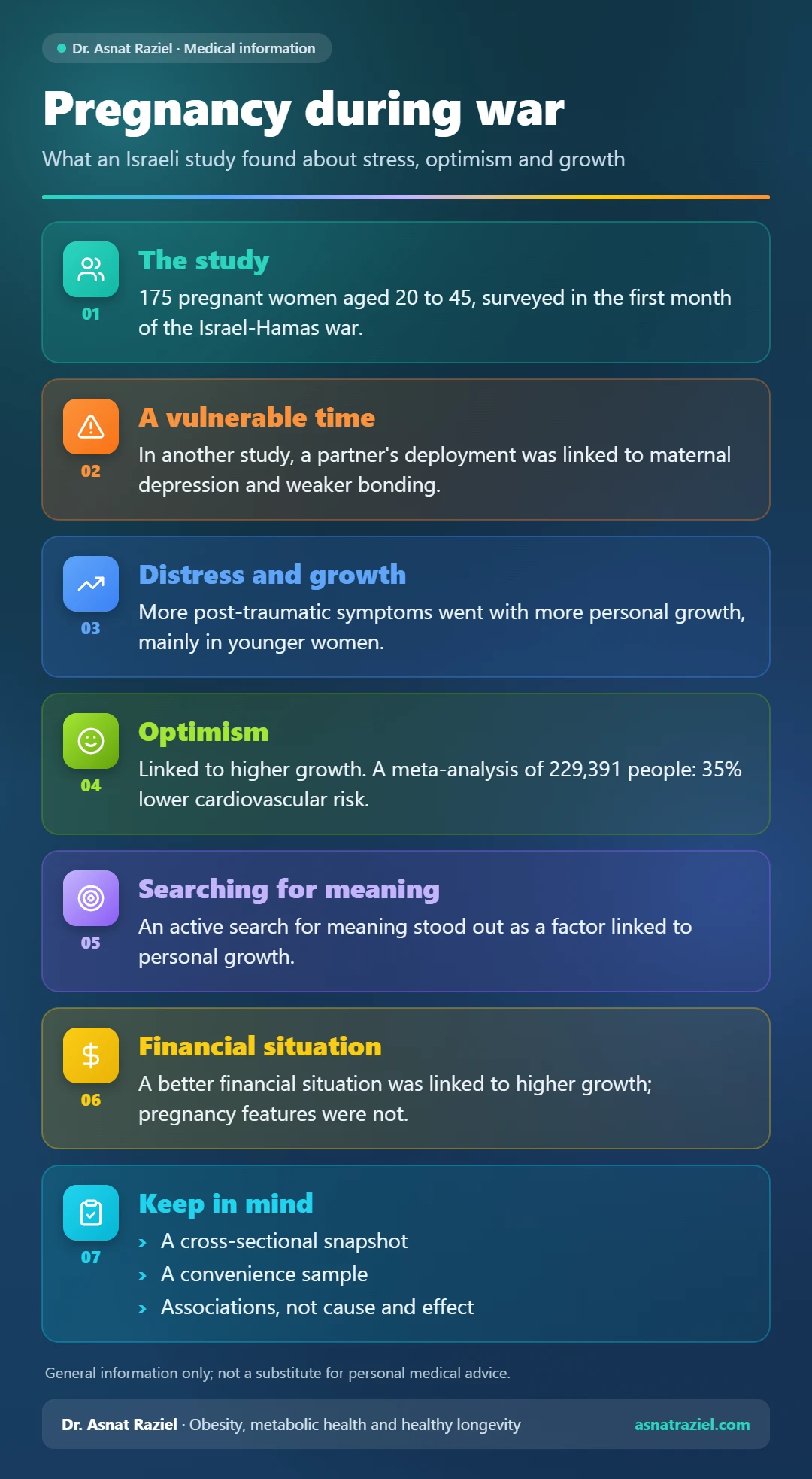
The study included 175 pregnant women in Israel, aged 20 to 45. Their average age was 31.19. The researchers recruited them during the first month of the war, which broke out on October 7, 2023. The participants completed questionnaires on post-traumatic symptoms, optimism, sense of meaning in life and search for meaning. They also answered questions about the pregnancy, their worries about the baby and measures of personal growth.
It is important to be precise about the study design. This is a cross-sectional study, meaning a snapshot at a single point in time. The participants came from a convenience sample, not a representative one. So the study shows associations, not cause and effect.
When stress becomes an engine of growth
One of the most interesting findings concerns the link between distress and growth. Women who reported many post-traumatic symptoms also reported high personal growth. This link appeared mainly among younger women.
To be clear, the finding does not mean that distress is helpful or desirable. Still, coping with significant stress may drive emotional and mental processing. At the end of that process come inner strength, a shift in perspective and a renewed appreciation of life. Models in the field explain that a crisis shakes our basic assumptions about the world and about ourselves. As a result, a person rebuilds their views on meaning, relationships and the future.
Optimism: a protective factor in pregnancy during war
Optimism was one of the factors that stood out in the study. Optimistic women reported higher personal growth. Optimism is the tendency to expect good outcomes in the future. In a crisis, it helps reduce distress, improves coping and makes it possible to see beyond the immediate hardship.
In pregnancy, optimism is especially important. It supports a sense of confidence about the future and helps maintain emotional stability. Beyond that, it is also linked to physical health. A meta-analysis of 15 studies with 229,391 participants found that optimism was associated with a 35% lower risk of cardiovascular events.
The search for meaning as an inner engine
Another key finding concerns meaning in life. The researchers distinguished between two concepts: an existing sense of meaning, and an active search for meaning. It was the active search that stood out as a factor linked to personal growth.
In a crisis, people ask existential questions: What really matters? How do I want to live and raise my children? The search for answers can become an engine of inner change and development. An Israeli study on meaning and resilience also examined the link between the two in populations affected by the war.
Age, financial situation and personal growth
The link between distress and growth was especially strong among younger women. Perhaps this is because younger women are still building their identity and their emotional resources. So such a powerful experience may change their outlook on life more deeply. Older women, by contrast, can draw on broader life experience and well-established ways of coping.
In addition, a better financial situation was linked to higher personal growth. On the other hand, the characteristics of the pregnancy itself were not among the factors the researchers linked to growth. In other words, how a woman interprets her reality may matter more than the medical features of her pregnancy.
What this means for professionals and families
These findings matter for anyone who supports pregnant women, especially in times of crisis. First, emotional distress is not only a negative factor. Alongside treating symptoms, it is possible to encourage growth, strengthen inner resources and open a conversation about meaning. Second, it is worth focusing on a few areas:
- Nurturing optimism.
- Talking about the meaning of parenthood.
- Strengthening a sense of personal capability.
- Social and family support.
This approach may contribute to the mother’s mental health, and even to her bond with the baby and to family functioning after birth. However, severe distress requires professional treatment. A pregnant woman with ongoing anxiety, depression or sleep problems should see her doctor or a mental health professional. You will find simple tools for reducing stress in my article on stress relief techniques. In times like these, eating habits also change, as I explain in my article on emotional eating in wartime. And women planning a pregnancy while taking obesity medication will find information in my article on weight-loss drugs and pregnancy.
The bottom line: pregnancy during war as a turning point
Pregnancy is a transition point in life. In calm times, it brings excitement and anticipation. In a crisis, it may become an experience in which fear and hope live side by side. The study offers an important insight: even in a harsh reality, many women find new meaning, inner strength and a sense of growth. In this sense, pregnancy during war is not only a vulnerable time. It can also be a time of deep development, in which not only a new family is built, but also a strong inner identity.
The information in this article is general and does not replace personal medical advice.
References
Personal Growth Among Pregnant Women During War: The Role of Optimism and Meaning in Life
The Posttraumatic Growth Inventory: measuring the positive legacy of trauma
Meaning and resilience in war-affected populations during crisis