By Dr. Asnat Raziel, bariatric surgeon specializing in obesity treatment, metabolic health and healthy longevity; Director of the Multidisciplinary Center for Obesity Treatment, Assia Medical, Assuta Ramat HaChayal, Tel Aviv
Liver fibrosis in obesity often goes unnoticed
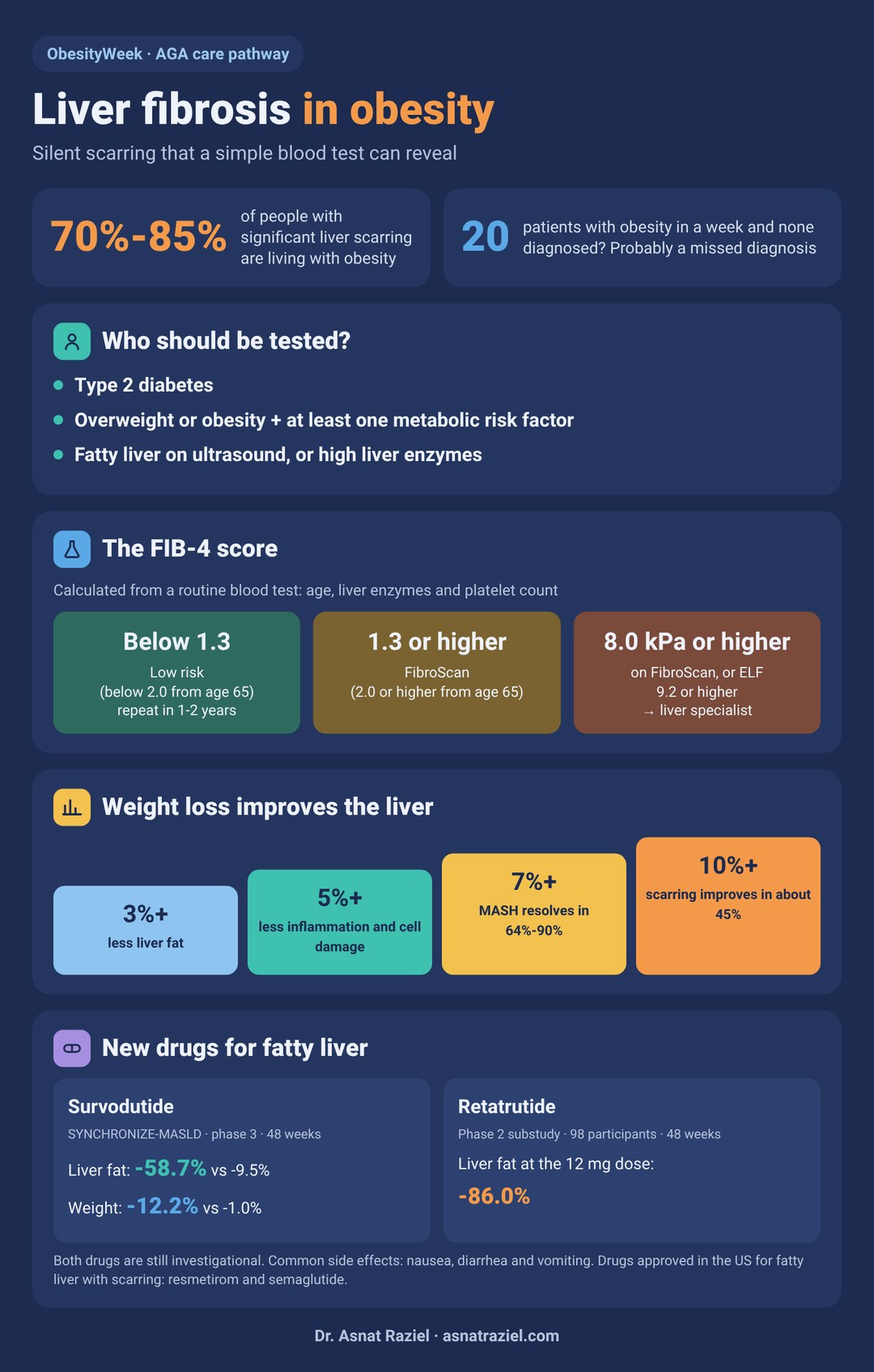
Liver fibrosis in obesity is a quiet scarring of liver tissue that usually causes no symptoms. At the recent ObesityWeek conference in the United States, two experts gave doctors a sharp message: if you see obesity, think about the liver too. According to them, 70% to 85% of people with significant liver scarring are living with obesity. The good news is that a simple blood test can identify who is at risk, and weight loss can improve the liver.
What the speakers presented at ObesityWeek
The session was led by Dr. Fernando Bril, an endocrinologist at the University of Alabama at Birmingham, and Prof. Arun Jesudian, a hepatologist at Weill Cornell in New York. First, they opened with a line that stayed with me: if you saw 20 patients with obesity last week and diagnosed none of them with significant liver scarring, you probably just missed it. In other words, the problem is not rare. It simply goes untested.
In addition, the talk presented data from the United States. A large population study by Dr. Bril found that the prevalence of fatty liver dropped slightly in recent years. However, rates of scarring and cirrhosis actually rose between 2017-2020 and 2021-2023, especially in people with diabetes.
Another session: visceral fat and waist size
Another session at the conference looked at the link between obesity, poor metabolic health and fatty liver. Dr. Mazen Noureddin, a hepatologist, and Dr. Michelle Look, a family physician and obesity medicine specialist, gave the talk. At its center was the role of visceral fat, the fat that surrounds the abdominal organs, and of fat in the liver. Both of these worsen metabolic damage throughout the body.
Therefore, according to the session program, measuring waist circumference and checking the liver early, including the FIB-4 score, should be a routine part of obesity care. The session also stressed a personal, comprehensive treatment plan that fits each person’s different needs. In its second part, two patients, Brenda and Teddy, joined the stage. Both live with obesity and fatty liver and work to raise awareness. This way, doctors heard the experience up close, beyond the diagnosis.
Why liver fibrosis in obesity matters so much
Metabolic fatty liver, now called MASLD (metabolic dysfunction-associated steatotic liver disease), begins with fat building up in liver cells. In some people, inflammation develops, called MASH, followed by scarring. Yet what determines the long-term risk is mainly the stage of scarring, not the amount of fat alone.
For example, a meta-analysis of 1,495 patients showed a sharp rise in deaths with each stage. At stage 0, there were 15.2 deaths from any cause per 1,000 person-years of follow-up. By contrast, at stage 4, cirrhosis, the number rose to 45.8. Deaths from liver disease jumped from 0.3 to 23.3.
What’s more, fatty liver affects the whole body. The speakers explained that it is an early sign of fat tissue that is not working properly. It comes with harmful blood fats, high insulin levels and high blood pressure. That is why heart disease is the leading cause of death in people with fatty liver, even before liver disease itself. I also wrote about this in my article on obesity as a disease of diseases.
Who should be tested for liver fibrosis
The updated care pathway of the American Gastroenterological Association (AGA) recommends testing three main groups:
- People with type 2 diabetes.
- People with overweight or obesity plus at least one more metabolic risk factor.
- Anyone whose ultrasound showed fatty liver, or whose liver enzymes are high.
In people with obesity, doctors find liver fibrosis only when they look for it. Metabolic risk factors include prediabetes, a large waist, high triglycerides, low HDL cholesterol and high blood pressure. Educational materials for doctors handed out at the conference also add a family history of cirrhosis.
FIB-4: a simple blood test as the first step
The first step is the FIB-4 score (Fibrosis-4), a calculation that combines four values: age, the liver enzymes AST and ALT, and the platelet count. All of these appear in routine blood tests, so no special test is needed. I covered these tests in detail in my article on fatty liver tests and the FIB-4 score.
- A score below 1.3 (below 2.0 from age 65): low risk. Repeat the calculation in one to two years.
- A score of 1.3 or higher (2.0 or higher from age 65): move on to a FibroScan, which measures liver stiffness.
- On FibroScan, a stiffness of 8.0 kPa or higher, or an ELF blood test of 9.2 or higher: referral to a liver specialist.
Note one important point. The score is affected by age, so below age 35 it may miss fibrosis, and above 65 it tends to raise false alarms. In addition, the speakers stressed that ordinary liver enzymes are still useful. In their view, the accepted normal limits are too high, and an ALT above 30 in men or above 19 in women already deserves attention.
Want to check yourself? Enter the values from your latest blood test in the calculator:
🧪 FIB-4 calculator for fatty liver
Enter four values from a routine blood test to estimate your risk of advanced liver fibrosis (scarring).
Weight loss improves liver fibrosis in obesity
The talk presented clear steps of improvement by percentage of weight lost:
- A loss of 3% or more: liver fat goes down.
- A loss of 5% or more: inflammation and cell damage go down.
- A loss of 7% or more: liver inflammation (MASH) resolves in 64%-90%.
- A loss of 10% or more: scarring improves in about 45%.
So the recommended goal is a weight loss of at least 5% when the risk is low, and at least 10% when there is obesity with liver fibrosis. The recommendations also include stopping alcohol, a Mediterranean diet, physical activity and control of blood pressure, blood fats and blood sugar. Bariatric surgery is another option, but not in decompensated cirrhosis.
However, one figure troubled the speakers. Only about 8% of people with obesity receive a prescription for an obesity medication. For comparison, over 80% of people with diabetes receive treatment to control their blood sugar.
Drug treatment today
According to the American pathway, when an obesity or diabetes drug is needed, it is better to choose one that has also been shown to help the liver. For obesity, these are semaglutide (Wegovy) and tirzepatide (Mounjaro). In diabetes, pioglitazone joins the list.
When there is moderate to advanced scarring (stages F2-F3), doctors add a treatment aimed at the liver itself. In the United States, two drugs are approved for this: resmetirom (Rezdiffra) and semaglutide. Then, after about a year, doctors repeat the stiffness test to see whether the treatment is working. I expanded on this in my articles on Wegovy for fatty liver and Mounjaro for fatty liver.
The next drugs for fatty liver
Survodutide acts on two receptors: GLP-1 and glucagon. The phase 3 trial SYNCHRONIZE-MASLD enrolled 216 adults with obesity and at-risk fatty liver. After 48 weeks, liver fat fell by 58.7% with the drug, compared with only 9.5% in the placebo group. Weight fell by 12.2%, compared with 1.0%. Earlier, in a phase 2 trial, liver inflammation improved in 47%-62%, compared with 14% in the placebo group. You can read more about the drug in my article on survodutide and fatty liver.
Retatrutide acts on three receptors. In a substudy of 98 participants, the 12 mg dose reduced liver fat by 86.0% after 48 weeks. Researchers are also testing drugs with completely different mechanisms, such as efruxifermin and lanifibranor. In the survodutide and retatrutide trials, the common side effects were digestive, mainly nausea, diarrhea and vomiting.
What you can do right now
- Measure your waist, not just your weight.
- Calculate your FIB-4 score with the calculator in this article, or ask your doctor to calculate it from your routine blood tests.
- If the score is high, ask for a referral for a FibroScan.
- Set a goal of losing 5%-10% of your weight, with professional support.
- Control blood pressure, blood fats and blood sugar, and cut down on alcohol.
- Ask whether an obesity medication suits you, especially when the liver is also affected.
At our multidisciplinary center, this is exactly how we work: a dietitian, physical activity, emotional support and drug treatment, together with liver follow-up. I described the protocol for risk grading and treatment of metabolic fatty liver in a separate article.
A surprising link between the liver and the brain: in a new study in rats, a treatment that rejuvenated liver blood vessels halved blood levels of amyloid, the protein linked to Alzheimer’s.
The bottom line on liver fibrosis in obesity
Obesity and fatty liver go together, and scarring progresses silently. In the end, a simple blood test and a one-minute calculation identify who needs further evaluation. Early diagnosis of liver fibrosis in obesity allows timely treatment, and weight loss and new drugs are already changing the picture.
This article provides general information and is not a substitute for personal medical advice.
More on the site:
Obesity and the liver
Survodutide and the heart
Liver fibrosis and fatty liver
References
AGA updates MASLD care pathway
A Phase 2 Randomized Trial of Survodutide in MASH and Fibrosis
See Obesity, Think Liver: Resources
The conference session was supported by Boehringer Ingelheim, the maker of survodutide. The speakers reported consulting relationships with drug companies in the field.