By Dr. Asnat Raziel, bariatric surgeon specializing in obesity treatment, metabolic health and healthy longevity; Director of the Multidisciplinary Center for Obesity Treatment, Assia Medical, Assuta Ramat HaChayal, Tel Aviv
Liver fibrosis: a new mechanism that may halt the scarring
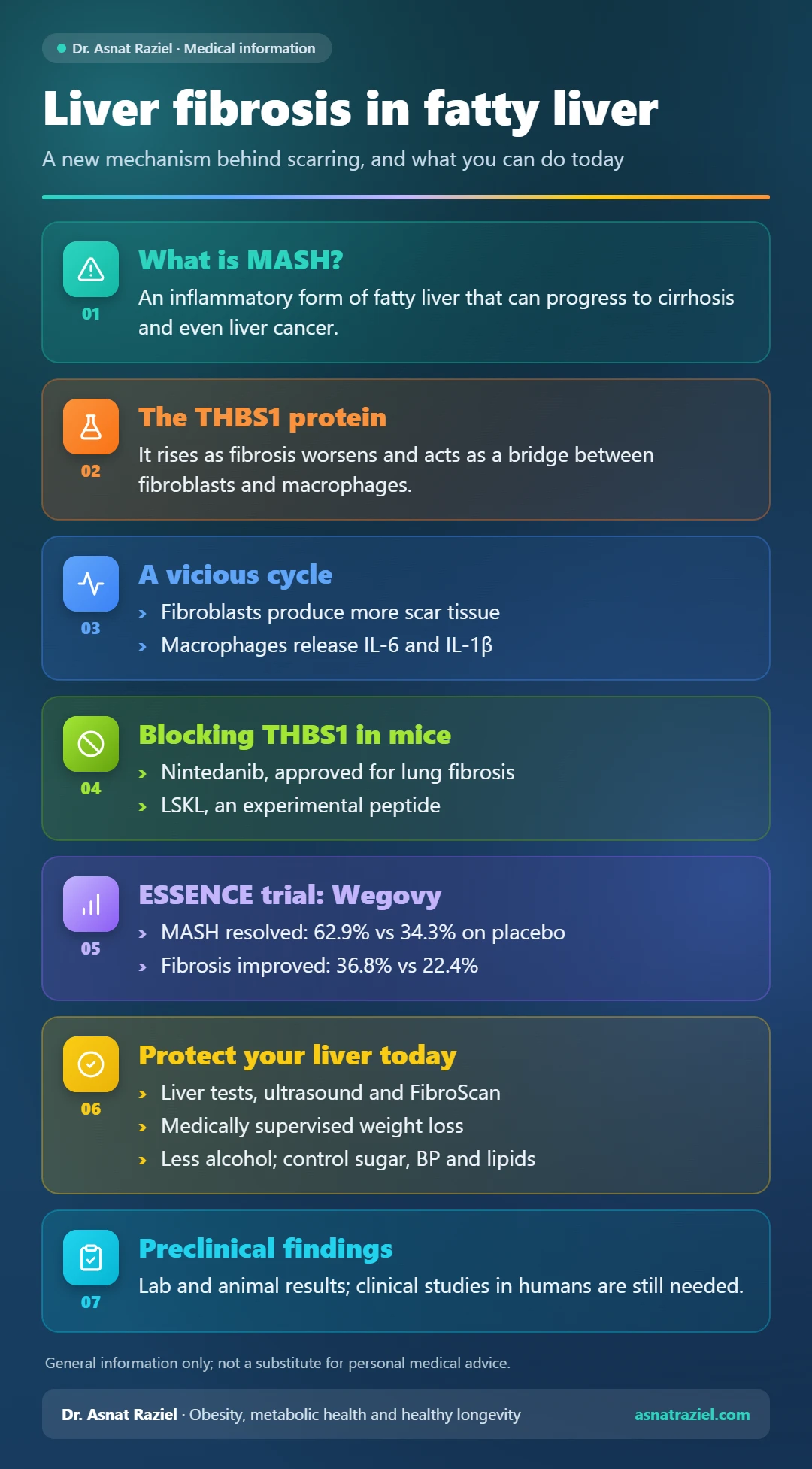
Liver fibrosis, or scarring of the liver tissue, is the dangerous complication of advanced fatty liver disease. The disease is called MASH, short for metabolic dysfunction-associated steatohepatitis, an inflammatory form of fatty liver linked to metabolic dysfunction. In recent years, it has become one of the most worrying chronic diseases in the Western world. It is closely tied to obesity, type 2 diabetes, insulin resistance and abnormal blood lipids. Over time, it can progress to cirrhosis and even liver cancer.
Now, a new study from South Korea describes a biological mechanism that may open the door to targeted treatments. The researchers identified a “vicious cycle” of inflammation and scarring that drives the disease. What’s more, they found a way to break it, for now in animal models.
The silent disease that is becoming an epidemic
MASH is the advanced and dangerous form of fatty liver disease. In the early stages, fat builds up in the liver without significant damage. In some patients, however, chronic inflammation develops, and this leads to scarring of the tissue. The scale of the problem is growing quickly, in step with rising rates of obesity and diabetes. Moreover, many patients feel no symptoms until the damage is advanced. That is why timely diagnosis matters, as I explained in my guide to diagnosing and treating fatty liver.
Mayo Clinic’s overview of fatty liver disease (MASLD) describes the same process. With ongoing inflammation, fibrosis spreads and can eventually lead to cirrhosis.
What did the researchers discover?
The study appeared in June 2026 in the Diabetes & Metabolism Journal. Prof. Si Hyun Bae and Prof. Pil Soo Sung led the team. Notably, both are from the Catholic University of Korea and its St. Mary’s hospitals. The researchers focused on the interplay between two types of cells in the liver:
- Fibroblasts, cells that produce connective tissue and scar tissue.
- Macrophages, immune cells that take part in inflammation.
The team examined liver tissue and blood from patients with fatty liver, as well as two mouse models. They found that a protein called THBS1 (thrombospondin-1) rises as fibrosis becomes more severe. In addition, the protein appeared in both fibroblasts and macrophages. It acts as a kind of “communication bridge” between the two cell types, and it prompts each of them to fuel the activity of the other.
How liver fibrosis develops: a destructive cycle
This creates a destructive cycle. First, the fibroblasts produce more scar tissue. At the same time, the macrophages ramp up the inflammatory response and release inflammatory substances such as IL-6 and IL-1β. As a result, the disease keeps getting worse. The researchers also found that THBS1 levels rise together with levels of IL-6, a marker of inflammation in the body. In other words, liver fibrosis is not just a buildup of scar tissue. It is an active process in which inflammation and scarring feed each other.
Breaking the vicious cycle
Next, the researchers blocked THBS1 activity in two ways. The first was nintedanib, a drug approved for the treatment of lung fibrosis, which they tested here in the liver. The second was an experimental peptide called LSKL, which blocks THBS1 directly.
Overall, the results were impressive. In the mouse models, nintedanib reduced THBS1 expression in both cell types and improved fibrosis in the tissue. Likewise, blocking the protein directly had a similar effect. In lab experiments, blocking THBS1 also reduced the release of inflammatory substances from macrophages. According to the researchers, this is a single treatment target that acts on both core mechanisms of the disease at once: inflammation and fibrosis.
Toward personalized treatment of liver fibrosis
The possible significance of these findings goes beyond developing a new drug. In the future, THBS1 levels could serve as a biomarker, a blood marker that reflects the state of the disease. Such a marker might identify patients at high risk of progression. It might also predict who will respond well to each treatment. This approach fits the trend toward personalized medicine, in which treatment is built around each patient’s biological profile.
What is already available today?
It is important to remember that approved treatments already exist for MASH with moderate to advanced fibrosis. In March 2024, the FDA approved resmetirom, sold as Rezdiffra, as the first treatment for the disease. Then, in August 2025, Wegovy (semaglutide) was also approved for this indication.
The Wegovy approval rests on the ESSENCE trial. After 72 weeks, liver inflammation resolved without worsening of fibrosis in 62.9% of patients on semaglutide. In the placebo group, the rate was 34.3%. In addition, fibrosis improved in 36.8% of patients, compared with 22.4% on placebo. You can read more in my article on Wegovy and fatty liver.
What does this mean for people with obesity?
For people with obesity, diabetes or metabolic syndrome, the findings reinforce an important point. The liver is one of the first organs to suffer from metabolic overload. In recent years, it has become clear that significant weight loss reduces liver fat and can even improve early-stage fibrosis. That weight loss can come from lifestyle change, obesity medications or bariatric surgery. For example, researchers have also studied tirzepatide in this setting, as I described in my article on Mounjaro and fatty liver. Now a new treatment direction joins them, one that targets the molecular mechanism of scarring directly.
What can you do today?
There is no need to wait for the next drug. Even today, there are steps that protect the liver:
- Liver enzyme tests and an ultrasound for anyone living with obesity or diabetes.
- Assessing the degree of scarring with FibroScan, an ultrasound test that measures liver stiffness.
- Medically supervised weight loss through nutrition, physical activity and, when needed, medication.
- Cutting back on or avoiding alcohol.
- Controlling blood sugar, blood pressure and blood lipids.
In addition, it is worth setting up a regular follow-up plan with your doctor. That way, you can catch disease progression in time and adjust treatment.
The bottom line on liver fibrosis
It is important to stress that this is a preclinical study, meaning it was done in the lab and in animals. Nevertheless, the findings offer hope in a field where treatment options are still limited. If clinical studies in humans confirm them, we may one day combine several tools. Weight loss, metabolic control and THBS1 blockade could slow, halt and even reverse some of the damage. In the meantime, treating liver fibrosis starts with timely diagnosis and with treating obesity and its risk factors. For more on the link between the liver and the heart, see my article on fatty liver and heart risk.
The information in this article is general and does not replace personal medical advice.
References
Phase 3 Trial of Semaglutide in Metabolic Dysfunction-Associated Steatohepatitis
FDA Approves First Treatment for Patients with Liver Scarring Due to Fatty Liver Disease