By Dr. Asnat Raziel, bariatric surgeon specializing in obesity treatment, metabolic health and healthy longevity; Director of the Multidisciplinary Center for Obesity Treatment, Assia Medical, Assuta Ramat HaChayal, Tel Aviv
Retatrutide vs Mounjaro is the question my patients ask me most this year. In this article, I compare Lilly’s experimental drug with Mounjaro, which is already available: how each one works, what the trials showed, what we know about side effects, and when a choice between them may become real. For a full review of the phase 3 results themselves, see my article on how to read the retatrutide trial numbers.
Retatrutide vs Mounjaro: three mechanisms versus two
Retatrutide is the experimental drug everyone is talking about this year. Until recently, it seemed hard to beat Mounjaro (tirzepatide). Now retatrutide, from Eli Lilly, is setting a new bar. In May and July 2026, the company released results from three large phase 3 trials. All of them met their main goals.
However, it is important to be precise. The drug is not yet approved anywhere in the world. Lilly plans to file for approval with the FDA, the U.S. Food and Drug Administration, in the first quarter of 2027.
Not just weight: treating obesity as a whole disease
Lilly stresses that the drug also targets diseases that come with obesity. Its research program has looked at type 2 diabetes, heart disease, obstructive sleep apnea and knee pain. This reflects a clear trend. New-generation drugs treat not only the number on the scale, but the whole metabolic burden. You can read more about these related conditions in my article on obesity-related diseases.
Three receptors working together
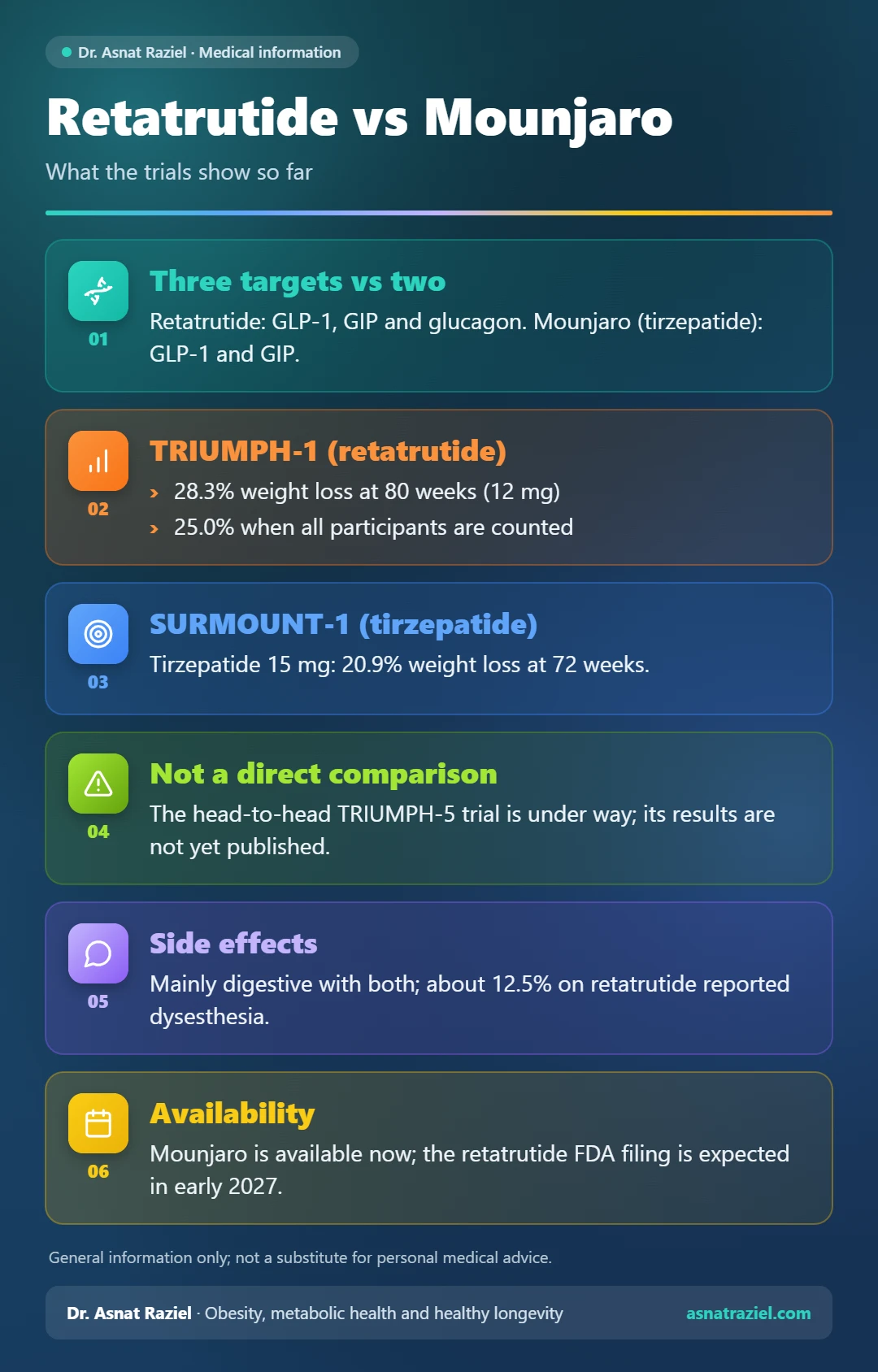
Retatrutide acts on three receptors at once: GLP-1, GIP and glucagon. For comparison, tirzepatide, the active ingredient in Mounjaro, acts on two of them. GLP-1 and GIP reduce hunger and improve blood sugar control. In contrast, activating the glucagon receptor increases energy use and fat breakdown. In other words, the body eats less and also burns energy faster than with standard treatment. This combination may explain the unusual results.
Retatrutide vs Mounjaro: the TRIUMPH-1 numbers
The TRIUMPH-1 trial included 2,339 adults with obesity or overweight and lasted 80 weeks. At the 12 mg dose, participants lost an average of 28.3% of their body weight, about 31.9 kg. In the placebo group, weight loss was only 2.2%.
The other figures are just as striking. At the high dose, 45.3% of participants lost at least 30% of their weight, and 27.2% lost 35% or more. In addition, 65.3% of people on this dose reached a BMI, or body mass index, below 30. In other words, they no longer met the definition of obesity.
It matters how the researchers calculated these numbers. They reflect people who stayed on treatment. In an analysis of all participants, including those who stopped, weight loss at 12 mg was 25.0%. For participants with a BMI of 35 or higher, the researchers extended treatment to 104 weeks. In this group, weight loss reached 30.3% at the high dose.
Diabetes, heart and knees: the other trials
The TRANSCEND-T2D-1 trial included 537 people with type 2 diabetes. After 40 weeks, HbA1c, the average blood sugar over the past three months, fell by 1.94% at the 12 mg dose, compared with 0.81% on placebo. At the same time, the high dose led to 15.3% weight loss.
In July 2026, Lilly announced two more trials. In TRIUMPH-2, in people with diabetes and obesity, weight loss reached 20.8% after 80 weeks. TRIUMPH-3 included people with severe obesity and heart disease. There, participants lost 22.6% at the 12 mg dose. Blood fats, blood pressure and the inflammation marker hsCRP also improved. However, the researchers did not design the trial to prove fewer heart events, so we don’t know the answer to that question yet.
Back in December 2025, the TRIUMPH-4 trial reported results in people with obesity and knee osteoarthritis. Participants lost 28.7% of their weight after 68 weeks, along with pain relief. I wrote about that trial in my article on the new drug and knee pain.
Side effects: a familiar profile, with a few caveats
The side effects are similar to those of other GLP-1 drugs. At the high dose in TRIUMPH-1, 42.4% reported nausea and 32.0% diarrhea. In addition, 26.1% had constipation and 25.3% vomiting. Most of these effects appeared while the dose was rising, and they were mild to moderate.
On the other hand, about 12.5% reported dysesthesia, an unpleasant or altered sensation in the skin. Also, 11.3% on the high dose stopped treatment because of side effects, compared with 4.9% on placebo. So even if regulators approve the drug, it will require close monitoring. You can find tips for coping with nausea in my article on eating habits that ease digestive side effects.
Retatrutide vs Mounjaro: what can we compare today?
Is the new treatment really better? A head-to-head trial of the two drugs, TRIUMPH-5, is still under way, and as of early November 2026 its results have not been published. In the SURMOUNT-1 trial, tirzepatide at 15 mg led to 20.9% weight loss after 72 weeks. Therefore, comparing the trials gives a direction, but not proof. The populations, trial lengths and calculation methods differ. For a broader comparison between the new drug and semaglutide, see my article on the triple drug versus Wegovy.
Retatrutide and Mounjaro: the key differences at a glance
- Mechanism: retatrutide acts on GLP-1, GIP and glucagon; Mounjaro (tirzepatide) acts on GLP-1 and GIP.
- Weight loss: 28.3% after 80 weeks in TRIUMPH-1 (25.0% when everyone is counted), versus 20.9% after 72 weeks in SURMOUNT-1. These are separate trials, so this is not a direct comparison.
- Side effects: mainly digestive with both. With retatrutide, about 12.5% also reported dysesthesia.
- Availability: Mounjaro is available today. Retatrutide is still experimental, and the FDA filing is expected in the first quarter of 2027.
When might the drug reach patients?
The full TRIUMPH-1 data were presented in June 2026 at the American Diabetes Association meeting. Lilly is now completing its manufacturing and quality file. Only then will it file with the FDA, in the first quarter of 2027. FDA review times vary from drug to drug. So it is still too early to know exactly when the drug will reach pharmacies. In Israel, the process usually starts only after U.S. or European approval.
The race is no longer about kilograms
A few years ago, we asked how many kilograms a drug could help people lose. Today the question is different. We want to know how much a drug lowers the risk of heart disease, diabetes, sleep apnea and joint pain. In addition, it is important to preserve muscle mass during rapid weight loss. That is why any such treatment should include protein, strength training and medical follow-up.
The bottom line: retatrutide vs Mounjaro
Retatrutide shows the strongest results we have seen so far for an obesity drug. It also improves blood sugar, blood pressure and blood fats. However, the drug is still experimental, and Lilly will file the approval application only in 2027. Meanwhile, Mounjaro and Wegovy remain the most effective options available. A treatment decision is right when you make it with a doctor, based on each person’s health. For information on the drug you can already get today, see my complete guide to Mounjaro.
This article is general information and does not replace personal medical advice.
References
Lilly’s triple agonist, retatrutide, delivered powerful weight loss in pivotal Phase 3 obesity trial
Phase III retatrutide study demonstrates 30% weight loss
TRIUMPH-1: Retatrutide Substantially Lowers Weight, BMI in Patients With Obesity or Overweight
Tirzepatide Once Weekly for the Treatment of Obesity
The trials were funded by Eli Lilly, the drug’s manufacturer.