By Dr. Asnat Raziel, bariatric surgeon specializing in obesity treatment, metabolic health and healthy longevity; Director of the Multidisciplinary Center for Obesity Treatment, Assia Medical, Assuta Ramat HaChayal, Tel Aviv
Retatrutide vs Wegovy: what are we comparing?
Retatrutide vs Wegovy is one of the most intriguing comparisons in obesity medicine today. Over the past few years, semaglutide has transformed the field from the ground up. Drugs such as Wegovy and Ozempic have become symbols of major weight loss and better metabolic health. Now a new candidate may set the bar even higher: retatrutide, an investigational drug from Eli Lilly.
In May 2026, the results of its main phase 3 trial, TRIUMPH-1, were presented, and in September they were published in leading journals. So this is the right time to look at what we really know, and what we still don’t. In this article, I focus on people with obesity and compare the large trials of each drug.
How do the two drugs work differently?
Semaglutide, the active ingredient in Wegovy, activates just one receptor, for the hormone GLP-1. This is a satiety hormone that the gut releases after a meal. Activating the receptor reduces hunger, increases fullness and helps balance blood sugar. You can read more in my article on semaglutide and metabolism.
Retatrutide, by contrast, acts on three receptors at once: GLP-1, the hormone GIP and glucagon. GIP strengthens the effect of GLP-1 on appetite and blood sugar. Glucagon, for its part, increases energy expenditure and fat breakdown in the liver. That is why the drug is called a “triple agonist,” meaning it switches on three pathways.
Retatrutide vs Wegovy: how much weight do people lose?
Semaglutide (Wegovy)
In the STEP 1 trial, 1,961 adults received semaglutide 2.4 mg or placebo. After 68 weeks, people on semaglutide lost an average of 14.9% of their body weight, compared with 2.4% on placebo. In addition, a higher 7.2 mg dose was approved in 2026. You can read about it in my article on the new Wegovy dose.
Retatrutide
In the phase 2 trial, people on the 12 mg dose lost 24.2% of their weight after 48 weeks. Then, in September 2026, the TRIUMPH-1 trial was published in NEJM. It included 2,339 adults with obesity and without diabetes. After 80 weeks, average weight loss reached 17.6% on 4 mg, 23.7% on 9 mg and 25.0% on 12 mg. In the placebo group, weight loss was 3.9%. Moreover, according to the company, weight loss reached up to 30% after 104 weeks in a subgroup with a BMI of 35 or higher.
In other words, a person weighing 100 kg might drop to about 85 kg on average with semaglutide 2.4 mg. With retatrutide 12 mg, the same person might reach about 75 kg.
Retatrutide vs Wegovy: is this a fair comparison?
This is where we need to be careful. To date, no trial has directly compared the two drugs in people with obesity without diabetes. The first head-to-head results, in people with type 2 diabetes, were released only at the end of October 2026. I cover them in my article on the head-to-head trial of retatrutide and Ozempic in diabetes.
So in obesity, the comparison still relies on separate trials, with different populations and different treatment lengths. For example, STEP 1 lasted 68 weeks, while TRIUMPH-1 lasted 80 weeks. Therefore, the numbers point in a direction, but they are not a final answer.
A direct comparison does exist between semaglutide and tirzepatide. In the SURMOUNT-5 trial, people on tirzepatide lost 20.2% of their weight after 72 weeks, compared with 13.7% on semaglutide. In other words, each hormonal pathway that was added increased weight loss.
What about people with diabetes?
In people with type 2 diabetes, weight loss is usually smaller. The TRIUMPH-2 trial included 1,152 adults with obesity and diabetes. After 80 weeks, people on 12 mg lost 18.8% of their weight, compared with 5.1% on placebo. Blood sugar control also improved.
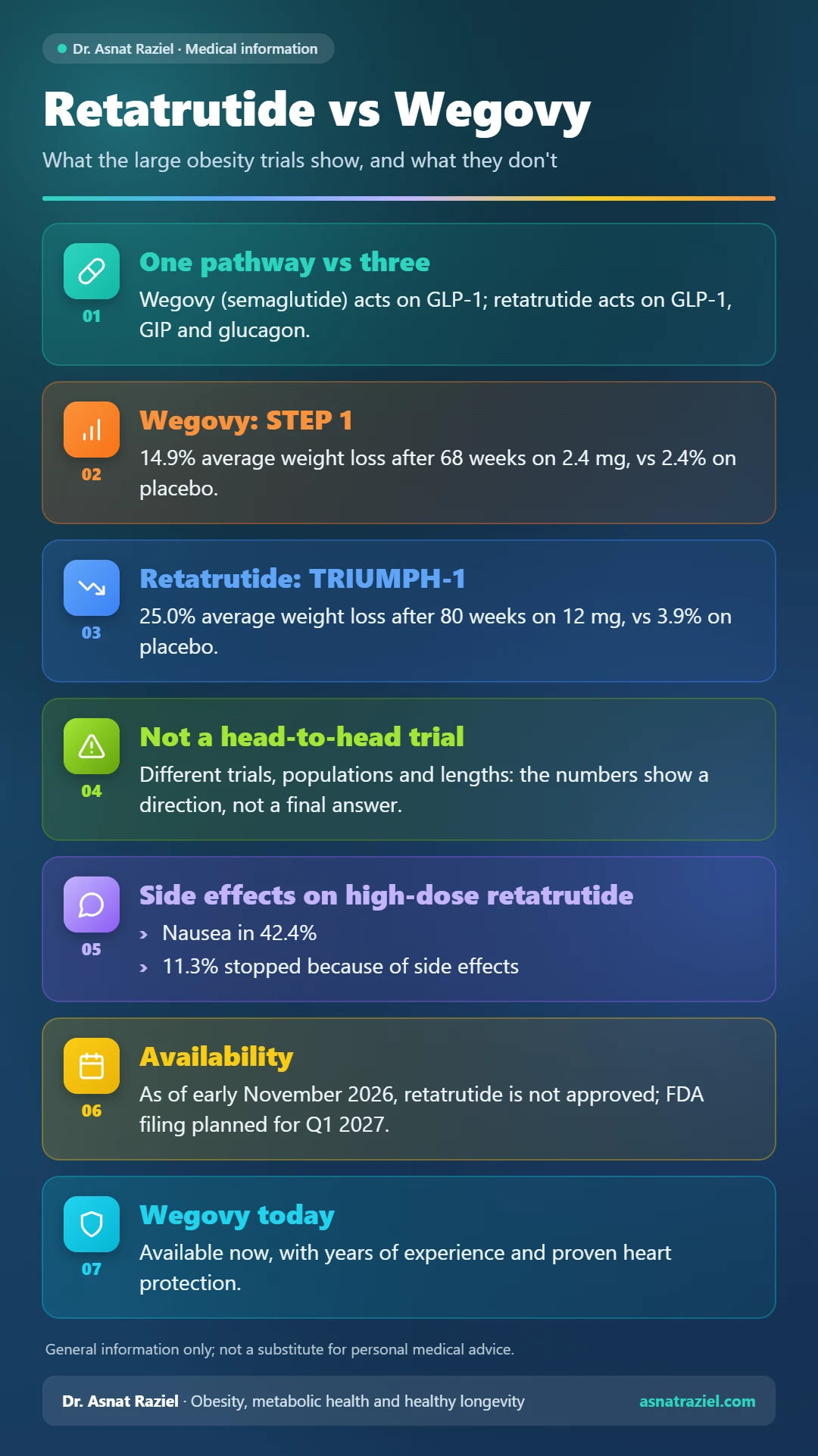
Retatrutide vs Wegovy in obesity: the numbers at a glance
How do the data look side by side? First, semaglutide 2.4 mg led to 14.9% weight loss after 68 weeks in STEP 1. By contrast, retatrutide 12 mg led to 25.0% weight loss after 80 weeks in TRIUMPH-1. On placebo, weight loss was 2.4% and 3.9%, respectively. Second, on the high dose of retatrutide, nausea reached 42.4%, and 11.3% stopped treatment because of side effects. On the other hand, semaglutide brings years of experience and proven heart protection. So the decision is not only about percentages. It is about balancing efficacy, safety and availability.
Could it replace bariatric surgery?
Retatrutide’s results are getting close to those of sleeve gastrectomy and gastric bypass, at least in the medium term. However, surgery has follow-up data of ten and twenty years. The drug does not have such data yet. In addition, we know that after stopping drugs of this type, weight tends to come back. So it is still too early to say whether the drug could replace surgery. A broader comparison appears in my article on bariatric surgery in the era of obesity drugs.
As a surgeon, I share my own perspective in a surgeon’s view of retatrutide.
Retatrutide vs Wegovy: side effects
Both drugs mainly cause digestive side effects: nausea, vomiting, diarrhea and constipation. With retatrutide, the rates are high. On the high dose in TRIUMPH-1, 42.4% of patients reported nausea, 32.0% diarrhea and 25.3% vomiting. In addition, 11.3% stopped treatment because of side effects, compared with 4.9% on placebo.
There are also unique side effects. About one in ten patients on the higher doses reported dysesthesia, an abnormal skin sensation such as tingling or sensitivity. Most cases were mild to moderate. Beyond that, the phase 2 trial showed a dose-dependent rise in heart rate. Experts also warn against losing weight too fast, which can lead to muscle loss and nutritional deficiencies.
When will retatrutide reach the market?
As of early November 2026, retatrutide is not approved in any country. According to company reports, Eli Lilly plans to submit an application to the FDA in the first quarter of 2027. In addition, according to the same report, the TRIUMPH-3 trial included patients with severe obesity and heart disease. On 12 mg, they lost 22.6% of their weight. However, the data on heart protection are still preliminary. So the drug is likely to reach Israel only later, at best. A full review of the trials appears in my article on how to read the retatrutide trial numbers.
Where is obesity treatment heading?
The past decade began with drugs that led to a loss of 5%-10% of body weight. Then came semaglutide with about 15%, tirzepatide with about 20%, and now retatrutide is approaching 25%-30%. As a result, the line between drug treatment and results that once belonged only to surgery is becoming blurred. At the same time, it is clear that even the most powerful drug does not replace good nutrition, physical activity, good sleep, muscle strengthening and behavioral support.
The bottom line
Ultimately, the comparison of retatrutide vs Wegovy shows a leap in efficacy, but also a price in side effects. Semaglutide is available today, with years of experience and proven heart protection. Retatrutide is still on its way. The future of obesity medicine is not just a drug that is stronger than the one before it. Rather, it is a smart combination of advanced drug treatment, personalized medicine and a healthy lifestyle.
The information in this article is general and does not replace personal medical advice.
References
Retatrutide, a Triple Hormone Receptor Agonist, for Treatment of Obesity
Triple-Hormone-Receptor Agonist Retatrutide for Obesity – A Phase 2 Trial
Once-Weekly Semaglutide in Adults with Overweight or Obesity
Tirzepatide as Compared with Semaglutide for the Treatment of Obesity
Phase III retatrutide study demonstrates 30% weight loss
Lilly Prepares for Retatrutide FDA Filing Following Additional Phase 3 Data in Diabetes, CVD
The retatrutide trials were funded by Eli Lilly.