By Dr. Asnat Raziel, bariatric surgeon specializing in obesity treatment, metabolic health and healthy longevity; Director of the Multidisciplinary Center for Obesity Treatment, Assia Medical, Assuta Ramat HaChayal, Tel Aviv
Retatrutide trial results: why reading them correctly matters
Retatrutide trial results in phase 3 range from 20.8% to 28.7% average weight loss on the high dose, and the phase 2 trial showed 24.2%. Why such a wide gap? Each trial looked at a different group of people, for a different length of time, and sometimes with a different way of calculating the outcome. These numbers are higher than anything we have seen so far with obesity medications. Still, a big number in a headline doesn’t tell you what will happen to any one person. In this article, I walk through the data published so far, trial by trial, in plain language. If you are looking for a broader overview of the drug itself, see my general guide to retatrutide, which covers the drug rather than how to read the data.
What the drug is and how it works
Retatrutide is a once-weekly injection developed by Eli Lilly. It acts on the receptors of three hormones: GLP-1, GIP and glucagon. That’s why it is called a “triple agonist.” For comparison, Mounjaro acts on two of them, and Wegovy on just one.
GLP-1 and GIP increase satiety and improve blood sugar control. In addition, glucagon encourages energy burning and the breakdown of fat in the liver. I have written in detail about how the drug works in the body. You can also read about it in the Wikipedia entry on retatrutide.
The first retatrutide trial results: phase 2
The first large study was published in NEJM in 2023. The phase 2 trial included 338 adults with obesity or overweight. After 48 weeks on the 12 mg dose, average weight loss was 24.2%. In the placebo group, by contrast, it was only 2.1%.
Even then, the researchers saw that side effects depended on the dose. Most were gastrointestinal, and they were mainly mild to moderate. They also found a rise in heart rate, which peaked at week 24 and then declined.
Retatrutide trial results in phase 3: the TRIUMPH program
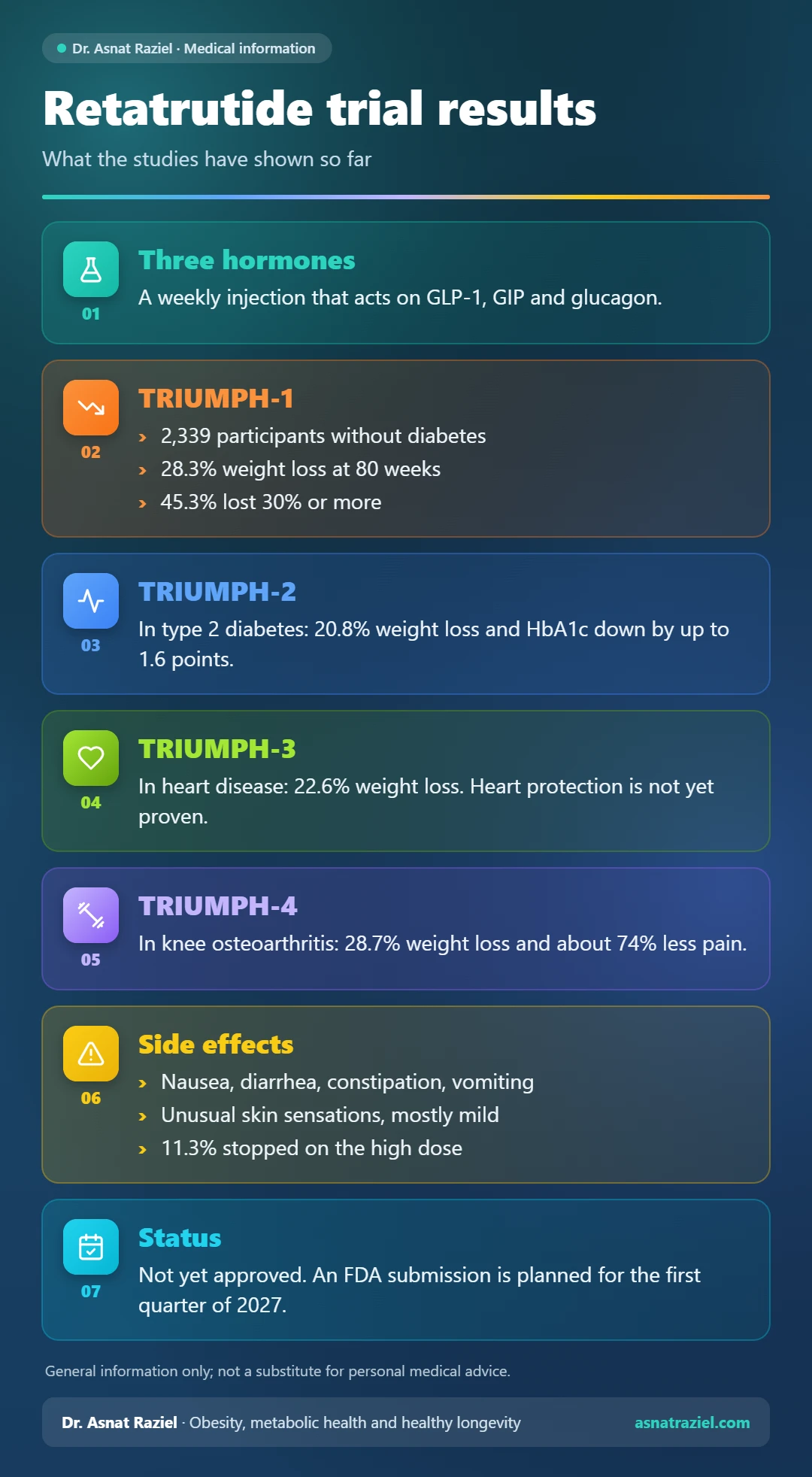
Phase 3 tests a drug in thousands of participants to confirm that it is effective and safe. The TRIUMPH program includes several trials, and each one looks at a different population. As a result, we can see how the drug works in people without diabetes, with diabetes, with heart disease or with knee pain.
TRIUMPH-1: obesity without diabetes
This is the main trial, with 2,339 participants and a duration of 80 weeks. Average starting weight was 112.7 kg. According to the company’s May announcement, participants on 12 mg lost an average of 28.3% of their body weight. Moreover, 45.3% of them lost 30% or more. In the placebo group, weight loss was 2.2%.
The full study was published in NEJM in September. The TRIUMPH-1 paper also reports relief of knee pain and fewer breathing pauses during sleep. Later, in a subgroup of 532 participants who continued to 104 weeks, weight loss on 12 mg reached 30.3%.
TRIUMPH-2: type 2 diabetes
This trial enrolled 1,152 adults with type 2 diabetes and excess weight. After 80 weeks on 12 mg, weight loss was 20.8%. In addition, glycated hemoglobin (HbA1c, a measure of average blood sugar over the past three months) fell by up to 1.6 percentage points. As usual with drugs in this family, weight loss is somewhat smaller in people with diabetes. You’ll find more on this in my article on retatrutide and diabetes.
TRIUMPH-3: established heart disease
This trial included 1,949 people with a BMI of 35 or higher and cardiovascular disease. The results were released in the company’s July announcement. On 12 mg, weight loss was 22.6%, compared with 3.2% on placebo. Triglycerides, blood pressure and the inflammation marker hsCRP also improved. You can look up the trial registration on ClinicalTrials.gov.
However, it’s important to be precise here: the trial did not prove a reduction in heart events. There were fewer events than expected in both groups, so the difference was not statistically significant. Answering that question will require a dedicated outcomes trial.
TRIUMPH-4: knee pain
This trial included 445 people with excess weight and knee osteoarthritis. After 68 weeks on 12 mg, weight loss was 28.7%. In addition, the pain score dropped by about 74%, compared with about 40% on placebo. On the 9 mg dose, pain fell by 75.8%.
Side effects in the retatrutide trial results
Most side effects involved the digestive system. For example, in TRIUMPH-1 on 12 mg, 42.4% reported nausea, compared with 14.8% on placebo. Vomiting occurred in 25.3%, versus 4.8%. In addition, 11.3% stopped treatment because of side effects, compared with 4.9% on placebo.
A less familiar side effect is dysesthesia, meaning unusual skin sensations such as tingling or sensitivity to touch. It occurred in 12.5% of people on 12 mg, versus 0.9% on placebo. According to the company, most cases were mild to moderate and resolved during treatment. For general tips on coping with effects like these, see my article on side effects of weight-loss medications.
How to read retatrutide trial results correctly
Trials usually report two calculations. The first describes what happens to people who stay on the drug as planned. The second includes everyone who started, even those who stopped along the way. In TRIUMPH-1, for example, the first calculation showed 28.3%, while the second showed 25.0%. Both numbers are correct, but the second is closer to everyday reality.
In addition, large weight loss also includes some loss of muscle mass. That’s why, with any powerful treatment, it is worth combining enough protein with strength training. I have also written about weight-loss injections and muscle loss.
Why retatrutide trial results differ from one trial to the next
First, the population changes the picture. In people without diabetes (TRIUMPH-1), weight loss was 28.3%, whereas in people with type 2 diabetes (TRIUMPH-2) it was 20.8%. Second, the trials ran for different lengths of time: 48 weeks in phase 2, 68 weeks in TRIUMPH-4 and 80 weeks in TRIUMPH-1. Third, the dose matters, and most of the numbers in this article refer to the high dose of 12 mg. Finally, the calculation method has an effect, as with 28.3% versus 25.0% in the very same trial. So when you see a number in a headline, ask who it was measured in, for how long and at what dose.
What retatrutide trial results don’t tell us yet
First, there are no very long-term data yet. Second, we don’t know what happens to weight after treatment stops. Also, there is still no full head-to-head comparison with Mounjaro or Wegovy. In the meantime, you can read how it stacks up against semaglutide in my article on retatrutide versus Ozempic.
At the same time, research in the field is moving in completely different directions, too, such as a DNA-based injection instead of a weekly shot. For now, though, those ideas are at much earlier stages.
What the numbers mean for you now
As of early November 2026, retatrutide is not approved in any country. According to Lilly, the FDA submission is planned for the first quarter of 2027. Until then, the drug is legally available only to trial participants. So please don’t buy “retatrutide” online: there is no way to know what is in the vial.
If you are living with obesity today, there are approved, effective medications. At our clinic, we choose treatment based on each patient’s medical situation, goals and preferences.
Bottom line
In phase 3, retatrutide trial results show average weight loss of 20.8% to 28.7% on the high dose, depending on the population and the dose. There were also improvements in blood sugar, blood fats and knee pain. On the other hand, side effects are common, and there is no proof yet that the drug protects the heart. Because it is not yet approved, the practical decision today is between the existing treatments.
The information in this article is general and does not replace personal medical advice.
Frequently asked questions
Is retatrutide approved in Israel?
No. It is not approved anywhere yet, and it is available only within clinical trials.
What do the retatrutide trial results show for weight loss?
In TRIUMPH-1, on the high dose, average weight loss was 28.3% after 80 weeks. In people with diabetes, it was 20.8%.
What are the main side effects?
Nausea, diarrhea, constipation and vomiting. In addition, some participants reported unusual skin sensations, which were usually mild.
Does the drug protect the heart?
We don’t know yet. In TRIUMPH-3, risk factors improved, but a reduction in heart events was not proven.
Sources
Retatrutide, a Triple Hormone Receptor Agonist, for Treatment of Obesity
Triple-Hormone-Receptor Agonist Retatrutide for Obesity – A Phase 2 Trial
Lilly’s triple agonist, retatrutide, delivered powerful weight loss in pivotal Phase 3 obesity trial
TRIUMPH-3 (NCT05882045) – ClinicalTrials.gov
Funding: the studies were funded by Eli Lilly.