By Dr. Asnat Raziel, bariatric surgeon specializing in obesity treatment, metabolic health and healthy longevity; Director of the Multidisciplinary Center for Obesity Treatment, Assia Medical, Assuta Ramat HaChayal, Tel Aviv
Next-generation obesity drugs: why we need hormone combinations
Next-generation obesity drugs are already moving from the lab into the clinic. The GLP-1 revolution marked a turning point in obesity medicine. For the first time, we could offer effective, biology-based drug treatment. It led to significant weight loss and proven improvements in metabolic markers and heart health.
But as clinical experience grew, it became clear that obesity is too complex for a single hormone to solve on its own. This opened the next stage: smart combinations, new molecules and medicine tailored to each patient’s biology.
Why GLP-1 is not always enough
Despite their success, the response to GLP-1 drugs varies. Some patients respond very well, and others less so. Some achieve major weight loss, while for others the weight loss stalls early on. In addition, some patients find it hard to stay on treatment or have side effects that limit it. I discuss the bigger picture in my article on the obesity epidemic and the GLP-1 revolution.
The key insight today is that obesity has no single mechanism. A complex network of hormones, nerve pathways, metabolic signals and behavior patterns controls it. So a treatment that targets only one mechanism may be only partly effective. I have written in detail about the link between the brain, hunger and fullness in my article on the physiology of satiety.
Hormone combinations: next-generation obesity drugs
The new approach focuses on multi-agonist drugs. These are drugs that activate several biological pathways at the same time. Alongside GLP-1, other hormones come into play: GIP, glucagon and amylin. These combinations try to mimic the natural physiology of fullness, hunger and energy expenditure as closely as possible.
The first example is already in use. Tirzepatide, the active ingredient in Mounjaro, combines GLP-1 and GIP. It opened the door to a whole generation of combination drugs that show especially deep weight loss.
Retatrutide: three hormones in one molecule
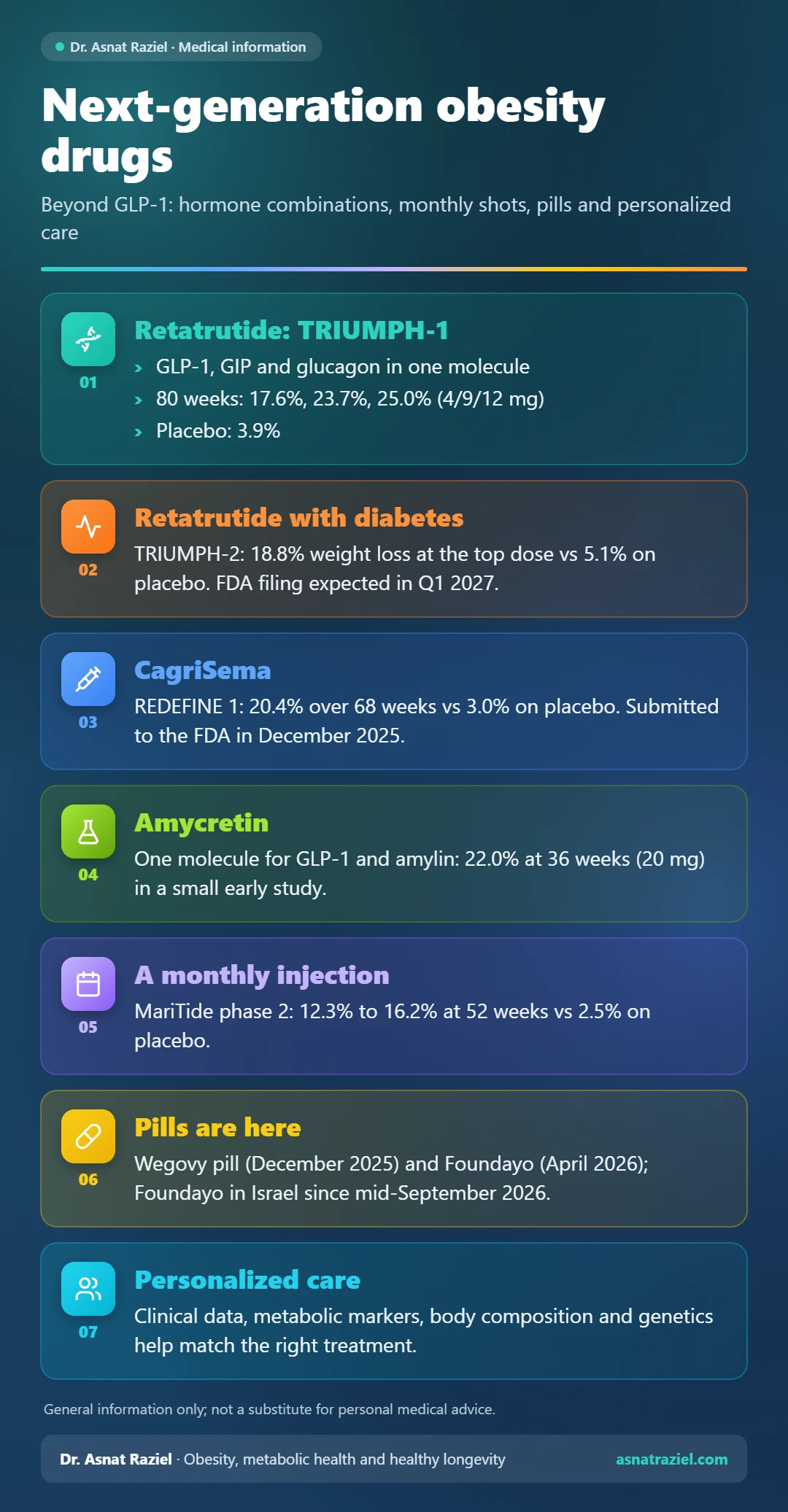
Lilly’s retatrutide acts on three receptors: GLP-1, GIP and glucagon. The TRIUMPH-1 trial, published in September 2026, included 2,339 adults with obesity. After 80 weeks, weight fell by 17.6%, 23.7% and 25.0% at doses of 4, 9 and 12 mg. In the placebo group, weight loss was 3.9%.
At the same time, the TRIUMPH-2 trial tested the drug in people with obesity and type 2 diabetes. There, weight loss reached 18.8% at the highest dose, compared with 5.1% on placebo. According to the company, it expects to file for FDA approval in the first quarter of 2027. You can read more in my article on retatrutide for weight loss.
CagriSema and amylin: mimicking natural fullness
Amylin is a hormone that the pancreas releases together with insulin, and it signals fullness to the brain. Novo Nordisk’s CagriSema combines cagrilintide, an amylin analog, with semaglutide. In the REDEFINE 1 trial, participants lost 20.4% of their weight over 68 weeks, compared with 3.0% on placebo.
The company submitted the drug for FDA approval in December 2025, and a decision is expected in the last quarter of 2026. In addition, Novo is developing amycretin, a single molecule that activates both GLP-1 and amylin receptors. In an early-stage study, weight loss reached 22.0% after 36 weeks at a dose of 20 mg. This was a small study, so we need to wait for phase 3. I explain the full mechanism in my article on amylin and obesity.
One injection a month
Another approach tries to reduce how often treatment is needed. Patients take Amgen’s MariTide once a month. In a phase 2 trial, weight fell by 12.3% to 16.2% after 52 weeks, compared with 2.5% on placebo. You can read more about this direction in my article on the monthly weight-loss injection.
Beyond injections: the oral future is already here
One of the most important developments is drugs in pill form. For years, treatment relied almost entirely on injections. Today, there are already two approved pills in the United States: the Wegovy pill, approved in December 2025, and Foundayo, approved in April 2026. Foundayo has been available in Israel since mid-September 2026.
Pills may widen access to treatment and lower psychological barriers. They are especially suitable for people who struggle with injections. However, we are still learning about long-term adherence, and clinicians will need to learn who a pill truly suits.
I explore what this change means in practice in oral obesity medications and the shift from injections.
Personalized medicine: next-generation obesity drugs for every patient
Alongside the progress in drugs, precision medicine is also developing. Combining clinical data, metabolic markers, body composition and sometimes genetic information helps us understand which treatment suits whom.
The goal is no longer one uniform treatment for everyone. Who will benefit from a particular hormone? Who will need a drug combination? And who will also need behavioral or surgical treatment? This is a deep shift in thinking. It brings obesity medicine closer to the model already standard in fields such as oncology. The European obesity society, EASO, has outlined a framework for this approach.
Not just drugs
Despite all this progress, it is important to remember that no treatment stands alone. Even the new drugs work best when combined with tailored nutrition, physical activity, muscle preservation and behavioral support. Without these, even the most advanced drug may lose its effectiveness over time. In addition, very deep weight loss calls for special attention to protein and strength training. Cost is also a key question. Most of the new drugs are expensive, and most are not covered by Israel’s national health basket. So the choice of treatment should also consider whether you can stay on it over time, not just how much weight it takes off.
A look ahead at next-generation obesity drugs
Obesity treatment is now taking a leap forward. We are moving from a focus on one hormone and on weight alone to an era of smart combinations, new molecules and personalized medicine. Next-generation obesity drugs greatly expand the treatment options. However, most of them are not yet approved, and long-term safety data are still accumulating. That is why they call for professionalism, caution and a deep understanding of biology and of the person behind it.
The information in this article is general and does not replace personal medical advice.
References
Retatrutide, a Triple Hormone Receptor Agonist, for Treatment of Obesity
Coadministered Cagrilintide and Semaglutide in Adults with Overweight or Obesity
Once-Monthly Maridebart Cafraglutide for the Treatment of Obesity – A Phase 2 Trial
The trials were funded by the companies developing the drugs: Lilly, Novo Nordisk and Amgen.