By Dr. Asnat Raziel, bariatric surgeon specializing in obesity treatment, metabolic health and healthy longevity; Director of the Multidisciplinary Center for Obesity Treatment, Assia Medical, Assuta Ramat HaChayal, Tel Aviv
Oral obesity medications: the future is already here
Oral obesity medications are no longer a distant vision. Over the past decade, drugs from the GLP-1 and GIP families have revolutionized the treatment of obesity and metabolic disease. Until recently, however, treatment relied almost entirely on weekly or daily injections. Now we have entered a new stage: effective drugs that you simply swallow as a pill. This change is not just a matter of convenience. In fact, it changes the way we think about treating obesity as a chronic disease.
In this article, I look at what the shift from injections to pills really changes, on four levels: medical, therapeutic, everyday and for health systems.
Which pills have already been approved
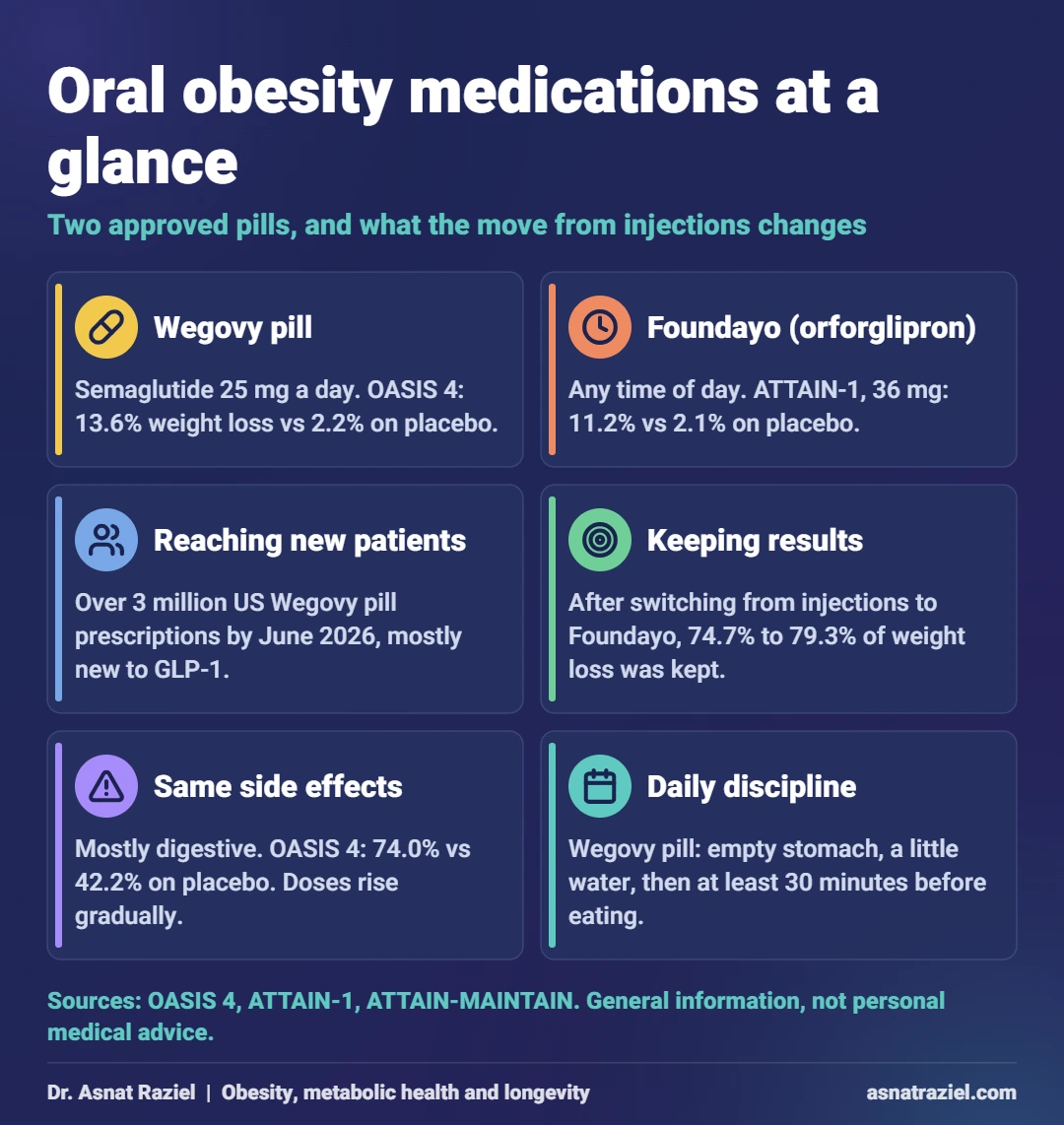
In December 2025, the FDA approved the Wegovy pill. The FDA is the US Food and Drug Administration. The pill contains semaglutide at a dose of 25 mg a day. The OASIS 4 trial included 307 adults with overweight or obesity and without diabetes. After 64 weeks, they lost an average of 13.6% of their body weight, compared with 2.2% on placebo. Then, in July 2026, the pill was also approved in the European Union.
In April 2026, a second pill joined it: Foundayo. Its active ingredient is orforglipron, a small molecule that is not a protein. Therefore, according to the approval announcement, you can take it at any time of day, without food or water restrictions. The ATTAIN-1 trial included 3,127 adults with obesity. On the 36 mg dose, they lost 11.2% of their body weight after 72 weeks, compared with 2.1% on placebo. For details on the pill in Israel, see my article on Foundayo in Israel.
The medical meaning of oral obesity medications
The pills work on the same hormonal pathways as the injections. As a result, they open the door to a much wider group of patients. People who were put off by injections, postponed treatment or avoided it altogether may now seek help earlier. The data already show this. According to Novo Nordisk, by June 2026 more than three million prescriptions had been written for the Wegovy pill in the United States. Moreover, most new prescriptions went to people who had not taken a GLP-1 drug before.
This means earlier treatment of obesity, before complications appear. Examples include diabetes, high blood pressure, fatty liver and heart disease. In addition, more accessible treatment may improve long-term adherence to treatment. Still, the effect on adherence needs to be tested in long-term studies.
The treatment meaning: a flexible continuum
The move to pills allows broad flexibility in treatment. We can adjust doses precisely, combine drugs and build a stepwise treatment plan. For example, a patient can start with a pill and move to an injection when needed, or the other way around. The ATTAIN-MAINTAIN trial tested exactly that reverse direction. In a study published in Nature Medicine, people who switched from an injection to Foundayo kept 74.7% to 79.3% of their weight loss. You can read about the switch itself in my article on moving from an injection to a pill.
For some patients, especially older adults or people who fear needles, oral obesity medications may be the best solution. They allow ongoing, discreet treatment. On the other hand, it is important to remember that not all of these drugs are equally effective. A detailed comparison of the two pills appears in my article Wegovy pill vs. Foundayo.
The practical, everyday meaning
In practical terms, a pill fits easily into a daily routine. There is no injection pen, and no worry about injection mistakes. Treatment looks like any other chronic treatment, much like drugs for blood pressure or cholesterol. This change also helps normalize public perception. Treating obesity is not an extreme measure. Rather, it is legitimate medical care for a chronic disease, and that is an important step against obesity stigma.
However, a daily pill requires discipline. The Wegovy pill, for example, is taken in the morning on an empty stomach. According to the prescribing information, you swallow it with a little water and wait at least 30 minutes before eating. Foundayo, by contrast, is much more flexible about timing.
Side effects of oral obesity medications: same family, same rules
A pill does not eliminate side effects. They are similar to those of the injections and are mostly digestive: nausea, diarrhea, constipation and vomiting. In OASIS 4, for example, such effects occurred in 74.0% of pill users, compared with 42.2% on placebo. In ATTAIN-1, 5.3% to 10.3% of patients on Foundayo stopped treatment because of side effects, compared with 2.7% on placebo. For this reason, here too we increase the dose gradually and keep up medical follow-up. You will find practical tips in my article on side effects of weight loss drugs.
Oral obesity medications and the health system
The move to pills may also affect health systems. Pills are simple and cheap to produce compared with pens. Consequently, treatment may one day be available to much broader populations. In addition, the question of funding through Israel’s health funds (HMOs) will come up again. In Israel, Foundayo has been on the market since September 2026. The Wegovy pill arrived in November 2026 and is available through Form 29C, the Israeli Ministry of Health form for prescribing a drug that is not yet in the national registry.
Looking ahead
Novo Nordisk and Eli Lilly are investing enormous resources in developing new pills. Their goal is high efficacy and an improved safety profile. In the coming years, we will see more and more treatments in pill form. Some of them may come close to the effect of today’s advanced injections. For now, though, the most powerful injections still lead in weight loss. Ultimately, the goal is not just weight loss. Instead, the goal is better metabolic health, a better quality of life and less stigma.
Bottom line on oral obesity medications
The future of obesity treatment is not a choice between a pill and an injection. Instead, it combines the two. Oral obesity medications add an important tool to the toolbox. The key is personalized care, proper medical guidance and a healthy lifestyle. In this way, obesity treatment becomes accessible, precise and respectful of the patient. For a broad review of the available pills, see my article on GLP-1 pills. If you are weighing the two routes yourself, my guide to choosing a pill or an injection may also help.
The information in this article is general and does not replace personal medical advice.
References
Oral Semaglutide at a Dose of 25 mg in Adults with Overweight or Obesity
Orforglipron, an Oral Small-Molecule GLP-1 Receptor Agonist for Obesity Treatment
FDA Approves Oral Semaglutide as First GLP-1 Pill for Weight Loss
WEGOVY (semaglutide) – Prescribing Information
No more injections? New weight-loss pill to launch in Israel next week
The OASIS 4 trial was funded by Novo Nordisk; the ATTAIN-1 and ATTAIN-MAINTAIN trials were funded by Eli Lilly.