By Dr. Asnat Raziel, bariatric surgeon specializing in obesity treatment, metabolic health and healthy longevity; Director of the Multidisciplinary Center for Obesity Treatment, Assia Medical, Assuta Ramat HaChayal, Tel Aviv
Pill or injection for obesity: the new question in obesity medicine
Pill or injection for obesity? It is one of the questions I hear most often in my clinic. Obesity treatment has changed dramatically in recent years. In the past, the conversation focused on diets, willpower and exercise. Today, medicine treats obesity as a chronic, progressive biological disease. At an international conference on the new treatments, one question came up again and again: does the future belong to injections, or to the new pills now entering the market?
The disease we do not talk about enough
The conference session covered injectable and oral drugs for long-term treatment. The experts stressed that obesity has more than 200 possible medical complications. These include type 2 diabetes, high blood pressure, sleep apnea, heart disease, joint damage and fertility problems. In addition, obesity harms both quality of life and life expectancy.
Despite the progress, only a small share of people who qualify for drug treatment actually receive it. Many others stop treatment too soon. The reasons include cost, access, stigma and fear of side effects. I discuss how respectful language changes care in my article on obesity stigma.
Why wait until complications appear?
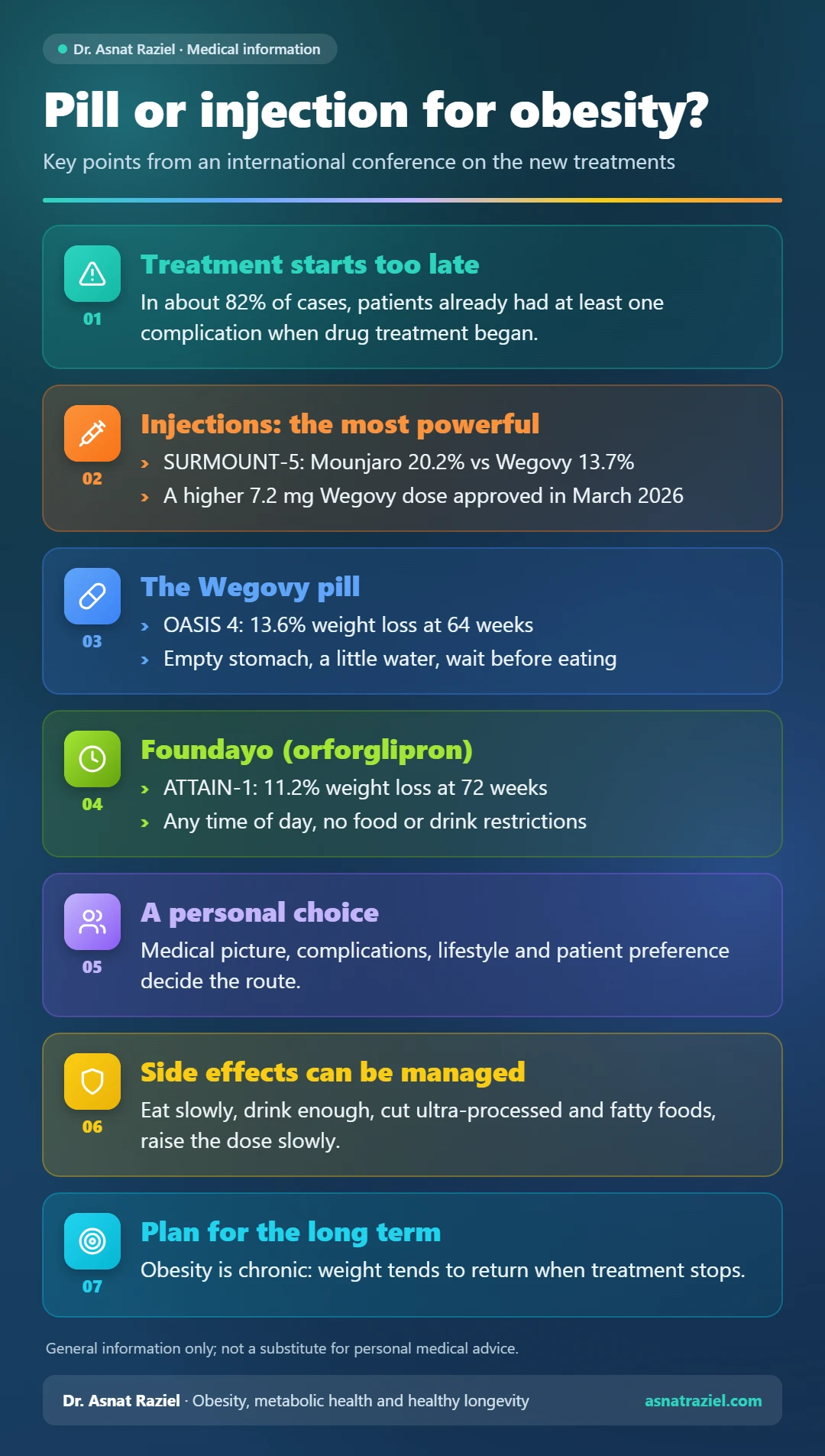
One of the key messages at the conference was that treatment often starts too late. According to the data presented, in about 82% of cases patients already had at least one medical complication when they started drug treatment.
The experts explained that inflammatory and metabolic processes begin in the early stages of obesity. Sometimes this happens years before diabetes or heart disease appears. So the longer we wait, the harder treatment becomes, and some of the damage is less reversible.
Not just BMI: the new approach
Modern obesity medicine no longer relies on BMI, the body mass index, alone. Today we also look at waist circumference, waist-to-height ratio, physical function, sleep quality, mental health and quality of life. In other words, the question is not only how much a person weighs. Rather, it is how excess fat actually affects the body, daily function and health.
Pill or injection for obesity: what do the injections offer?
Weekly injections are still the most powerful treatment. In the SURMOUNT-5 trial, tirzepatide, the active ingredient in Mounjaro, led to 20.2% weight loss after 72 weeks. By comparison, semaglutide, the active ingredient in Wegovy, led to 13.7% weight loss. In addition, in March 2026 the FDA approved a higher 7.2 mg dose of Wegovy.
Pill or injection for obesity: the new pills
This is where the big change has happened. The FDA approved the Wegovy pill in December 2025, and the European Union approved it in July 2026. In Israel, it began reaching pharmacies at the end of October 2026. In the OASIS 4 trial, participants on the pill lost 13.6% of their weight after 64 weeks, compared with 2.2% on placebo. You take the pill on an empty stomach with a little water and wait before eating. I answer common questions about it in my article on weight-loss pills.
The second pill is Foundayo (orforglipron). The FDA approved it in April 2026, and it has been available in Israel since September 2026. You can take it at any time of day, with no food or drink restrictions. In the ATTAIN-1 trial, the highest dose led to 11.2% weight loss after 72 weeks, compared with 2.1% on placebo. I compare the two pills in my article on the Wegovy pill and Foundayo.
Pill or injection for obesity: how do you decide?
One of the most fascinating parts of the conference dealt with choosing between the two routes. The experts stressed that there is no single answer for everyone. Instead, the choice should be personal. It depends on the medical picture, complications, lifestyle and the patient’s preferences.
For example, the panel discussed a woman with a high BMI, prediabetes, high blood pressure and sleep apnea. Many panel members preferred an injection for her, because of its higher efficacy. At the same time, they stressed close follow-up and gradual dose increases to reduce side effects. By contrast, for a man with a lower BMI and a fear of needles, the panel presented the pill as an excellent option. This is especially true for people who want to start treatment before complications appear.
Side effects: not a fate you must accept
The experts devoted much of the discussion to digestive symptoms. In their view, nausea, constipation or vomiting are not a sign that the drug is working well. Moreover, you do not have to put up with them. An expert consensus recommends eating slowly, drinking enough fluids, cutting down on ultra-processed and fatty foods, and raising the dose slowly when needed. Such symptoms are common with both pills and injections. In OASIS 4, for example, they occurred in 74.0% of participants on the pill, compared with 42.2% on placebo.
Start with the long-term goal
Another prominent message was to think about persistence from the very start. How will the patient stay on treatment after six months, a year and beyond? In other words, do not focus only on the initial weight loss, but plan ahead for keeping the results. You can read more in my article on sticking with treatment.
The experts compared obesity to high blood pressure or high cholesterol. When you stop treating a chronic disease, the problem tends to return. The same is true of obesity. Regaining weight after stopping treatment is not a personal failure, but an expected biological response. I cover this in more depth in my article on weight gain after stopping the injections.
The stigma that still follows patients
Stigma came up many times at the conference. The participants called on health professionals to change the way they talk about obesity. Many patients still feel shame, guilt and judgment when they seek help. That is why respect, sensitive language and an understanding of the biology are part of the treatment itself.
The bottom line on a pill or injection for obesity
The main message from the conference was clear: obesity treatment is moving toward personalized medicine. Already today we have advanced injections, two new pills, and more combinations on the way. Ultimately, you decide between a pill or injection for obesity together with the care team, based on each person’s goals and health. The aim is not just weight loss, but long-term metabolic health, function and quality of life.
This article provides general information and is not a substitute for personal medical advice.
References
Tirzepatide as Compared with Semaglutide for the Treatment of Obesity
FDA Approves Oral Semaglutide as First GLP-1 Pill for Weight Loss
Oral Semaglutide at a Dose of 25 mg in Adults with Overweight or Obesity