By Dr. Asnat Raziel, bariatric surgeon specializing in obesity treatment, metabolic health and healthy longevity; Director of the Multidisciplinary Center for Obesity Treatment, Assia Medical, Assuta Ramat HaChayal, Tel Aviv
The history of GLP-1 drugs: a revolution that did not happen overnight
The history of GLP-1 drugs is much longer than many people think. To many, these weight-loss drugs seem like news that came out of nowhere. In reality, they are the product of a long, step-by-step medical process built on decades of research. The first drug in the family reached the market as early as 2005. However, only in recent years did all the conditions come together to make this treatment widespread, effective and life-changing. To understand the picture, it helps to look at the timeline.
Over time, patients have also reported less expected effects, including changes in libido on GLP-1 drugs.
The roots: a hormone discovered in the 1980s
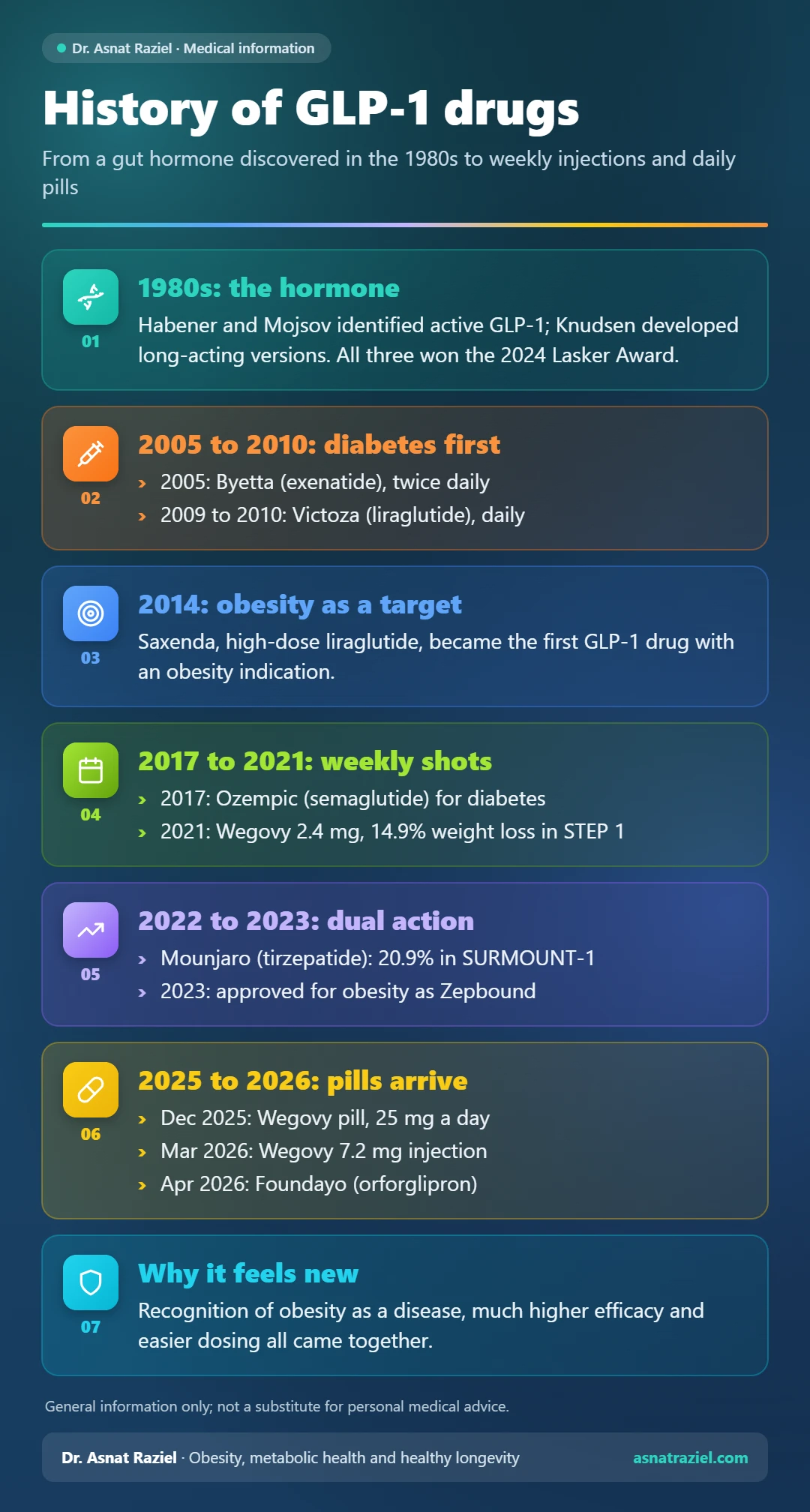
GLP-1 is a hormone that the gut releases after a meal. Specifically, it boosts insulin release, slows stomach emptying and sends a fullness signal to the brain. Researchers Joel Habener and Svetlana Mojsov identified the active form of the hormone in the 1980s. Later, Lotte Knudsen of Novo Nordisk developed long-acting versions of it. For this work, all three won the 2024 Lasker Award. You’ll find a detailed explanation of the mechanism in my article on how obesity medications work.
The problem was that the natural hormone breaks down in the body within minutes. Therefore, it took years of development to create molecules that work for hours, days and even a full week.
2005 to 2010: it began as a diabetes story
The first drugs in the family targeted type 2 diabetes. Initially, the goal was blood sugar control. Yet even in the early stages, doctors noticed weight loss as a welcome side benefit. The United States approved Byetta, whose active ingredient is exenatide, in 2005. It was an injection taken twice a day. Next came Victoza, whose active ingredient is liraglutide. Europe approved it in 2009 and the United States in 2010, as a once-daily injection.
2014: obesity becomes a treatment target in its own right
In fact, this was a turning point. At the end of 2014, the United States approved Saxenda, a high dose of liraglutide. For the first time, a GLP-1 drug received a dedicated indication for obesity, not just for diabetes. This also strengthened the recognition that obesity is a chronic disease that deserves drug treatment, not a personal failure.
2017 to 2021: the weekly generation and the Wegovy breakthrough
At the end of 2017, the United States approved Ozempic, whose active ingredient is semaglutide. Its approval covered diabetes, as a once-weekly injection. Here too, weight loss stood out as a benefit, even though it was not the official indication.
In June 2021, the real breakthrough arrived. The US Food and Drug Administration (FDA) approved Wegovy, semaglutide at a dose of 2.4 mg for obesity. In the STEP 1 trial, participants lost an average of 14.9% of their body weight after 68 weeks, compared with 2.4% on placebo. This was the first time a drug had achieved weight loss on this scale.
2022 to 2023: the dual-action era
Mounjaro, whose active ingredient is tirzepatide, acts on two hormones: GLP-1 and GIP. The United States approved it for diabetes in May 2022. In the SURMOUNT-1 trial, participants on the 15 mg dose lost an average of 20.9% of their weight after 72 weeks, compared with 3.1% on placebo. In November 2023, the same drug won approval for obesity under the name Zepbound. Later, the SURMOUNT-5 trial compared the two drugs head to head. Tirzepatide led to 20.2% weight loss, compared with 13.7% with semaglutide. You’ll find a detailed comparison in my article on tirzepatide vs. high-dose semaglutide.
2025 to 2026: the history of GLP-1 drugs moves to pills
In the original draft of this article, I wrote that the era of pills was expected around 2026. Since then, that forecast has become reality. In December 2025, the FDA approved the Wegovy pill, semaglutide at 25 mg a day. In April 2026, the FDA also approved Foundayo, an orforglipron pill that you can take at any time of day. Meanwhile, in March 2026, the United States approved a high dose of Wegovy, 7.2 mg. For more information, see my Foundayo treatment guide.
And what about Israel? The drugs usually reached Israel after their approval abroad, and at first mainly through private care. Today, some of them are also available through Israel’s health funds (HMOs), under certain conditions.
So why does the history of GLP-1 drugs feel so new?
Indeed, the sense of novelty is no accident. Over the past decade, several processes came together. First, obesity gained broad recognition as a chronic disease rather than a personal failure. Second, the effectiveness of the drugs rose to levels that approach, and sometimes even rival, bariatric surgery. In addition, treatment frequency dropped from an injection twice a day to a weekly injection, and now to a daily pill. Finally, the public and economic discussion around obesity simply exploded.
Moreover, the history of GLP-1 drugs also matters for understanding safety. Millions of people have taken drugs from this family over two decades. As a result, a great deal of information has accumulated on their side effects, both common and rare. That said, monitoring continues, especially for the high doses and the new drugs.
So even though GLP-1 drugs have existed for more than twenty years, only since 2021 have we truly entered a new era. In short, this is not a passing trend. Rather, it is a deep change in modern medicine, in the way we understand obesity, treat it and support patients over time.
The bottom line on the history of GLP-1 drugs
The history of GLP-1 drugs shows that the current revolution took shape slowly, step by step. It began with the discovery of a gut hormone, moved through diabetes drugs and reached dedicated obesity drugs. Today, it also continues with pills and higher doses. Ultimately, this knowledge strengthens trust in the treatment: behind it stand more than twenty years of experience and research on an enormous scale.
The information in this article is general and does not replace personal medical advice.
References
The discovery and development of GLP-1 based drugs that have revolutionized the treatment of obesity
FDA Approves New Drug Treatment for Chronic Weight Management, First Since 2014
Once-Weekly Semaglutide in Adults with Overweight or Obesity
Tirzepatide Once Weekly for the Treatment of Obesity
FDA Approves New Medication for Chronic Weight Management
FDA Approves Oral Semaglutide as First GLP-1 Pill for Weight Loss
Tirzepatide as Compared with Semaglutide for the Treatment of Obesity
FDA Approves Higher Dose Semaglutide (Wegovy HD) Injection 7.2 mg for Obesity