By Dr. Asnat Raziel, bariatric surgeon specializing in obesity treatment, metabolic health and healthy longevity; Director of the Multidisciplinary Center for Obesity Treatment, Assia Medical, Assuta Ramat HaChayal, Tel Aviv
Monthly weight loss injection: why does it matter?
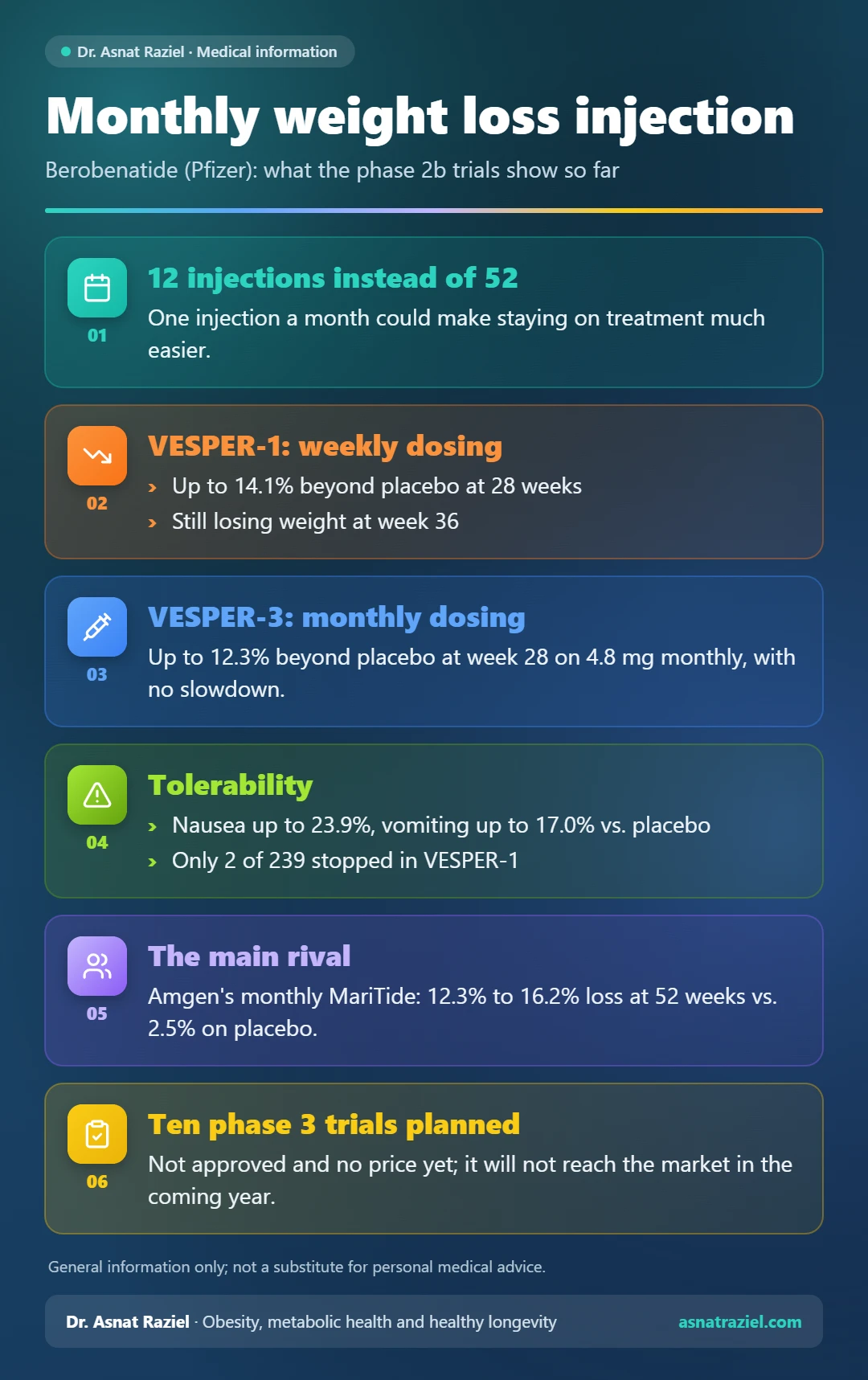
A monthly weight loss injection is one of the big goals of drug companies today. Most current treatments, such as Wegovy and Mounjaro, require one injection a week. By contrast, one injection a month means 12 injections a year instead of 52. For many patients, that makes a real difference in convenience and in staying on treatment.
The leading candidate right now is berobenatide. The drug was developed under the name MET-097i at Metsera, and it then passed to Pfizer. In this article, I review what the studies have shown so far, what is still unknown, and when we can expect answers.
What is berobenatide and where did it come from?
Berobenatide belongs to the GLP-1 drug family, like semaglutide. The difference lies in how long it acts. The company describes it as “ultra-long-acting,” meaning a drug that stays active in the body for an especially long time. For this reason, it is suited, at least in theory, to monthly dosing. If you want to understand the basics, you can read about how obesity medication works.
In September 2025, Metsera published its phase 2b results. Shortly afterward, a bidding war broke out between Pfizer and Novo Nordisk. In the end, Pfizer completed its acquisition of Metsera in November 2025, in a deal worth about $10 billion.
VESPER-1 results: up to 14.1% weight loss
According to the company’s September 2025 announcement, the VESPER-1 trial included 239 people with obesity or overweight who did not have diabetes. They received a weekly injection at doses of 0.4 to 1.2 mg, without gradual dose escalation. After 28 weeks, at the highest dose, weight fell by 14.1% more than with placebo. The largest loss in a single participant reached 26.5%.
What’s more, in a follow-up analysis at week 36, weight was still going down. In other words, the researchers had not yet seen a plateau, the point at which weight loss stops. Later, in data that Pfizer presented in June 2026, participants who moved up to a weekly dose of 2.4 mg lost an average of 15.9% after another 32 weeks. To be precise, this figure is not placebo-adjusted, and it comes from an open-label extension phase.
VESPER-3: a monthly weight loss injection on trial
The trial that tests monthly dosing itself is VESPER-3. In the fall of 2025, it did not yet have efficacy results. Today, it does. Pfizer’s February 2026 announcement reported the week-28 results.
Participants received a weekly injection for 12 weeks and then switched to one injection a month. At week 28, all four treatment arms outperformed placebo. The placebo-adjusted weight loss reached up to 12.3% at the monthly dose of 4.8 mg. In addition, here too the researchers saw no slowdown at week 28. The trial will continue to week 64, which is when we will get the full picture.
Tolerability and side effects
In the fall of 2025, the company reported rates of 13% for nausea and 11% for vomiting. However, these were not overall rates. Instead, they were differences compared with placebo, in a single arm only, in an interim analysis of VESPER-3. In other arms the differences were higher: nausea up to 23.9% and vomiting up to 17.0%.
Even so, the overall picture is encouraging. In VESPER-1, only 2 of 239 participants stopped treatment because of side effects. According to Pfizer, the digestive side effects were mostly mild to moderate. Still, it is worth remembering that a monthly injection will probably also have familiar side effects. I have written about how to cope with them in my guide to preventing side effects of obesity medications.
A low dose and a new platform
According to the company, berobenatide achieved weight loss similar to the leading drugs at a dose 5 to 10 times lower. It also required fewer dose-escalation steps. The company’s models estimate that it may match tirzepatide 15 mg. But this is an estimate from a model, not the result of a direct comparison. Only a head-to-head trial can answer that question.
The technology behind the drug is designed to extend how long the peptide stays active in the body. On the other hand, the advantage of a low dose may help with manufacturing and costs in the future. Even so, this is still a hypothesis. As of today, the drug has no price and is not approved in any country.
The pipeline: combinations, a pill and a quarterly injection
Pfizer is also testing berobenatide in combination with other drugs. In the SOLIS-1 trial, it is studying a combination with an amylin analog, a satiety hormone from the pancreas. I wrote about this direction in my article on amylin and obesity. In addition, the company is developing a combination with a GIP-type drug, a pill version (MET-097o), and a version for quarterly dosing (MET-815). The last two were only in early stages in 2025.
Amgen’s monthly weight loss injection: the main rival
Berobenatide is not alone in the race. Amgen’s drug MariTide is also given once a month. A phase 2 trial published in NEJM included 592 people. Among participants with obesity without diabetes, weight fell by 12.3% to 16.2% after 52 weeks, compared with 2.5% on placebo. In other words, a monthly weight loss injection is no longer a distant idea. That said, MariTide is also still in phase 3 trials.
What’s next: phase 3 and timelines
According to a summary of the presentation at the ADA meeting in June 2026, Pfizer is planning ten phase 3 trials of berobenatide. VESPER-4 is testing weekly dosing in people without diabetes. VESPER-5 is testing weekly dosing in people with diabetes. VESPER-6 will test monthly dosing. In addition, seven more trials will focus on related conditions, such as sleep apnea and knee osteoarthritis. Indeed, one of them, VESPER-OSA 1 in sleep apnea, began recruiting in September 2026.
The practical meaning is clear. Even in the best-case scenario, a monthly drug will not reach the market in the coming year. So if you need treatment today, you do not need to wait. It is worth getting to know the new weight loss injections that are already available.
The bottom line: will a monthly weight loss injection replace the weekly one?
The data so far are promising. Berobenatide showed up to 12.3% weight loss beyond placebo with monthly dosing, with no sign of a plateau at week 28. However, these are still phase 2 trials, with a few dozen participants in each arm. The important questions remain open: what will happen after a year, how safe the treatment is over time, and what it will cost.
Ultimately, a monthly weight loss injection could greatly improve persistence with treatment. And that matters, because stopping GLP-1 treatment usually leads to weight regain. If phase 3 results confirm the findings, we may see a real change in the way we treat obesity. Until then, the right treatment is the one that suits you today, with a physician’s guidance. I have also written about the broader trends in my article on the future of obesity medicine.
This article provides general information and is not a substitute for personal medical advice.
References
Pfizer finalizes Metsera buy after contentious bidding war with Novo Nordisk
Berobenatide weight loss benefit maintained in shift to monthly dosing, phase 2b data show
Once-Monthly Maridebart Cafraglutide for the Treatment of Obesity – A Phase 2 Trial
The VESPER trials were funded by Metsera and Pfizer, and the MariTide trial was funded by Amgen.