By Dr. Asnat Raziel, bariatric surgeon specializing in obesity treatment, metabolic health and healthy longevity; Director of the Multidisciplinary Center for Obesity Treatment, Assia Medical, Assuta Ramat HaChayal, Tel Aviv
AI-designed obesity drug: what exactly was reported
An AI-designed obesity drug made headlines in early 2026. The biotech company Insilico Medicine reported in January 2026 on a new molecule it had developed with artificial intelligence. According to the company, the molecule led to weight loss of up to 31.3%. But it’s important to be precise from the very first line: this figure comes from a study in mice, not in humans.
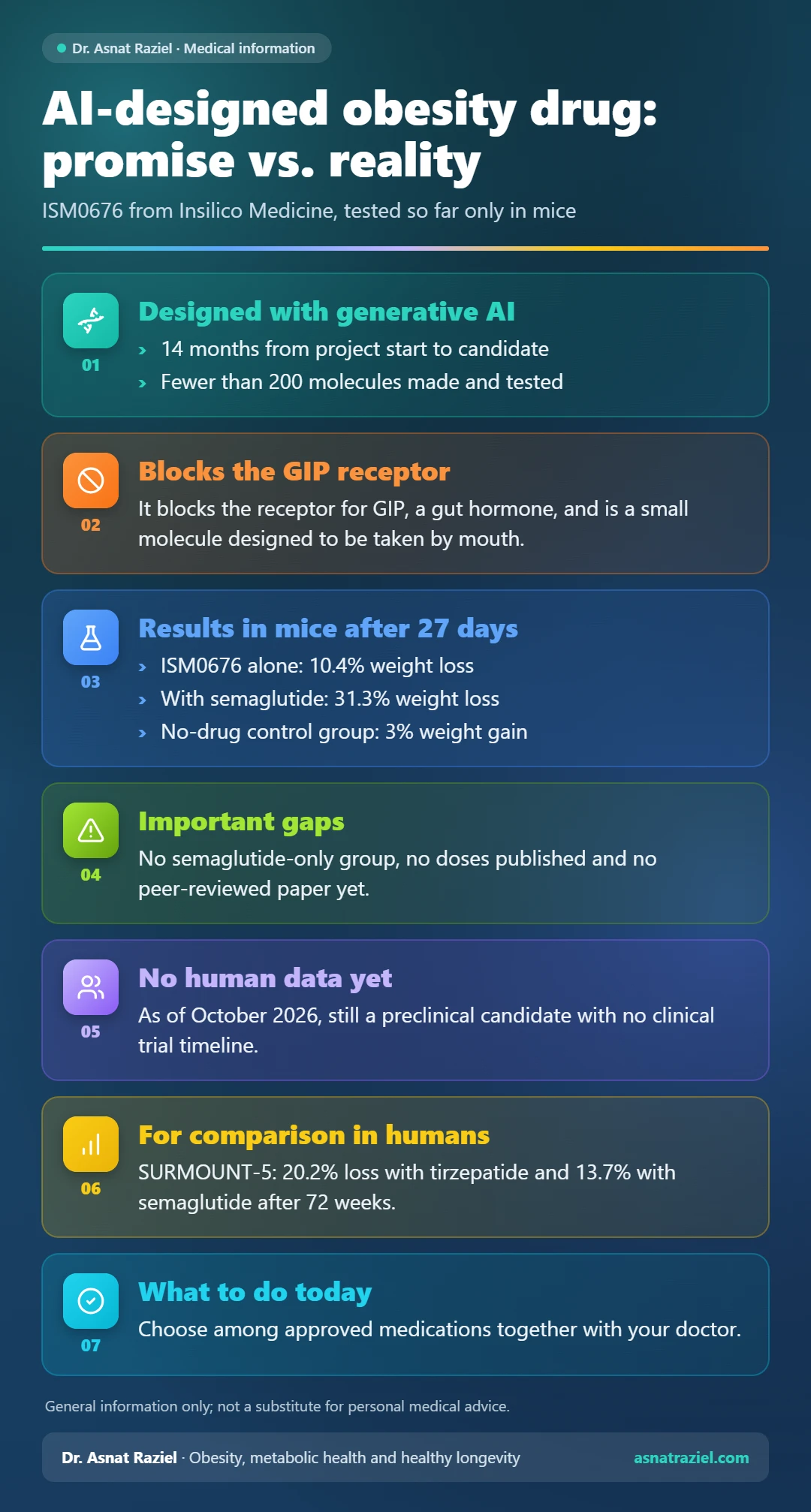
As of October 2026, the company has not published any human data. Even in the company’s annual report from March 2026, the drug appears as a preclinical candidate, with no timeline for clinical trials. In other words, this is an interesting promise, not a treatment you can get.
How artificial intelligence developed the molecule
The experimental drug is called ISM0676. The company developed it using a generative AI engine called Chemistry42. First, the engine scans possible chemical structures, and then it proposes molecules with high biological potential. According to the company, the path from the start of the project to choosing the candidate took only 14 months. In addition, the researchers synthesized and tested fewer than 200 molecules. Traditional methods, by contrast, usually rely on long rounds of trial and error.
Beyond GLP-1: blocking the GIP receptor
Most of today’s well-known obesity drugs work through the GLP-1 receptor. One example is semaglutide, the active ingredient in Novo Nordisk’s Wegovy and Ozempic. These drugs reduce appetite and slow stomach emptying. ISM0676, however, works differently. It blocks the receptor for GIP, a gut hormone that affects insulin release and energy balance. Moreover, it is a small molecule designed to be taken by mouth.
This may sound counterintuitive, since Mounjaro actually activates the GIP receptor. However, blocking the receptor, combined with GLP-1, has also led to weight loss in humans. For example, in a phase 2 trial of the drug MariTide, participants with obesity lost 12.3% to 16.2% of their body weight after 52 weeks. In the placebo group, weight loss was 2.5%. I explain this paradox in my article on the role of GIP in metabolism.
What the mouse study showed
The researchers ran the study in mice with obesity caused by a high-fat diet. The mice had a human (humanized) GIP receptor, to mimic the response in people. After 27 days, these were the results:
- ISM0676 alone led to 10.4% weight loss.
- The control group, which received no drug, gained 3% in weight.
- The combination with semaglutide led to 31.3% weight loss.
In addition, the company reported improved body composition, meaning a high ratio of lean mass to weight. However, the announcement doesn’t include data for a group that received semaglutide alone. So it’s hard to judge how much ISM0676 added beyond semaglutide. The company also didn’t publish the exact doses. The results have not yet appeared in a peer-reviewed scientific journal.
The company also points to other advantages of the molecule: good stability in the body, a low risk of interactions with other drugs and a good safety profile in experiments. It also expects the required dose in humans to be low. Still, it’s important to remember that this is a computer prediction, not a measurement. Only clinical trials can test it.
Drug combinations: a future direction in obesity treatment
The interesting finding is not just the weight loss itself, but the synergistic effect, a combined effect greater than the sum of its parts. In recent years, obesity treatment has been moving from “one drug for everyone” thinking to a combined approach. This is similar to how we treat high blood pressure or diabetes. Combining mechanisms may have a deep effect on the brain’s hunger centers, on metabolism and on body composition.
If the trend continues, we may one day see personalized protocols that combine several molecules. I give a broad overview of this direction in my article on new obesity treatment targets. And you can read about obesity pills in my article on weight loss pills.
AI-designed obesity drug: between promise and reality
For all the excitement, it’s important to stress that this is only a preclinical stage. Animal studies don’t guarantee success in humans. Indeed, many molecules that succeed in mice fail later on. Questions about safety, long-term tolerability and effects on other body systems remain open. The road to approval includes staged clinical trials, and it usually takes years.
The number itself also calls for caution. A 31.3% weight loss in mice within 27 days is not equivalent to a similar loss in humans. For comparison, in the SURMOUNT-5 trial in humans, tirzepatide led to 20.2% weight loss after 72 weeks. With semaglutide, the loss was 13.7%. These are results from a large clinical trial with approved drugs. You’ll find more details in my complete guide to Mounjaro.
Has an AI-designed drug already succeeded in humans?
Not yet in obesity, but there are early signs that the approach works. Insilico’s most advanced drug, rentosertib, is meant for pulmonary fibrosis, an advanced scarring of the lungs. A phase 2a trial included 71 patients over 12 weeks. At the high dose, forced vital capacity (FVC) rose by an average of 98.4 mL. In the placebo group, by contrast, it fell by 20.3 mL. The researchers describe it as a drug whose target and molecule were both discovered with generative AI.
In other words, artificial intelligence is already bringing molecules into human trials. That said, success in one field doesn’t guarantee success in obesity. You can read about other smart tools in the field in my article on AI in bariatric surgery.
The AI-designed obesity drug and a new era in treatment
Today, obesity is a recognized chronic disease. Furthermore, it is linked to diabetes, fatty liver and heart risk. The success of GLP-1 drugs has already changed the medical and social conversation. The arrival of AI-based development may further expand treatment options, and perhaps also shorten the path from the lab to the patient. Read more about the new directions in my article on the ECO congress and new obesity drugs.
The bottom line on the AI-designed obesity drug
Is this a first step toward the next generation of obesity drugs? It’s too early to know. As of today, ISM0676 is a preclinical candidate with data from mice only. If the findings hold up in clinical trials, we may witness the moment when algorithms also shape the future of metabolic medicine. Until then, this AI-designed obesity drug remains a promise, not a treatment. If you’re looking for treatment today, you can choose among the approved medications together with your doctor.
This article provides general information and does not replace personal medical advice.
References
Once-Monthly Maridebart Cafraglutide for the Treatment of Obesity – A Phase 2 Trial
Tirzepatide as Compared with Semaglutide for the Treatment of Obesity
The ISM0676 data come from announcements by Insilico Medicine, the drug’s developer. Amgen funded the MariTide trial, and Eli Lilly funded the SURMOUNT-5 trial.