By Dr. Asnat Raziel, bariatric surgeon specializing in obesity treatment, metabolic health and healthy longevity; Director of the Multidisciplinary Center for Obesity Treatment, Assia Medical, Assuta Ramat HaChayal, Tel Aviv
AI in bariatric surgery: from gimmick to scientific tool
AI in bariatric surgery is no longer a distant vision. Over the past decade, artificial intelligence (AI) has grown from a tech gimmick into a serious research tool. In bariatric surgery, one of the fastest-moving fields in metabolic medicine, it is starting to change how we choose, plan and follow up on treatment.
An article published in November 2025 on the International Bariatric Club website reviews the tools available today. They rely on machine learning, meaning algorithms that learn patterns from data, as well as on advanced statistical models. The goal is to predict weight loss after surgery and to improve decision-making at every step of the way.
Data-driven medicine: from prediction to guidance
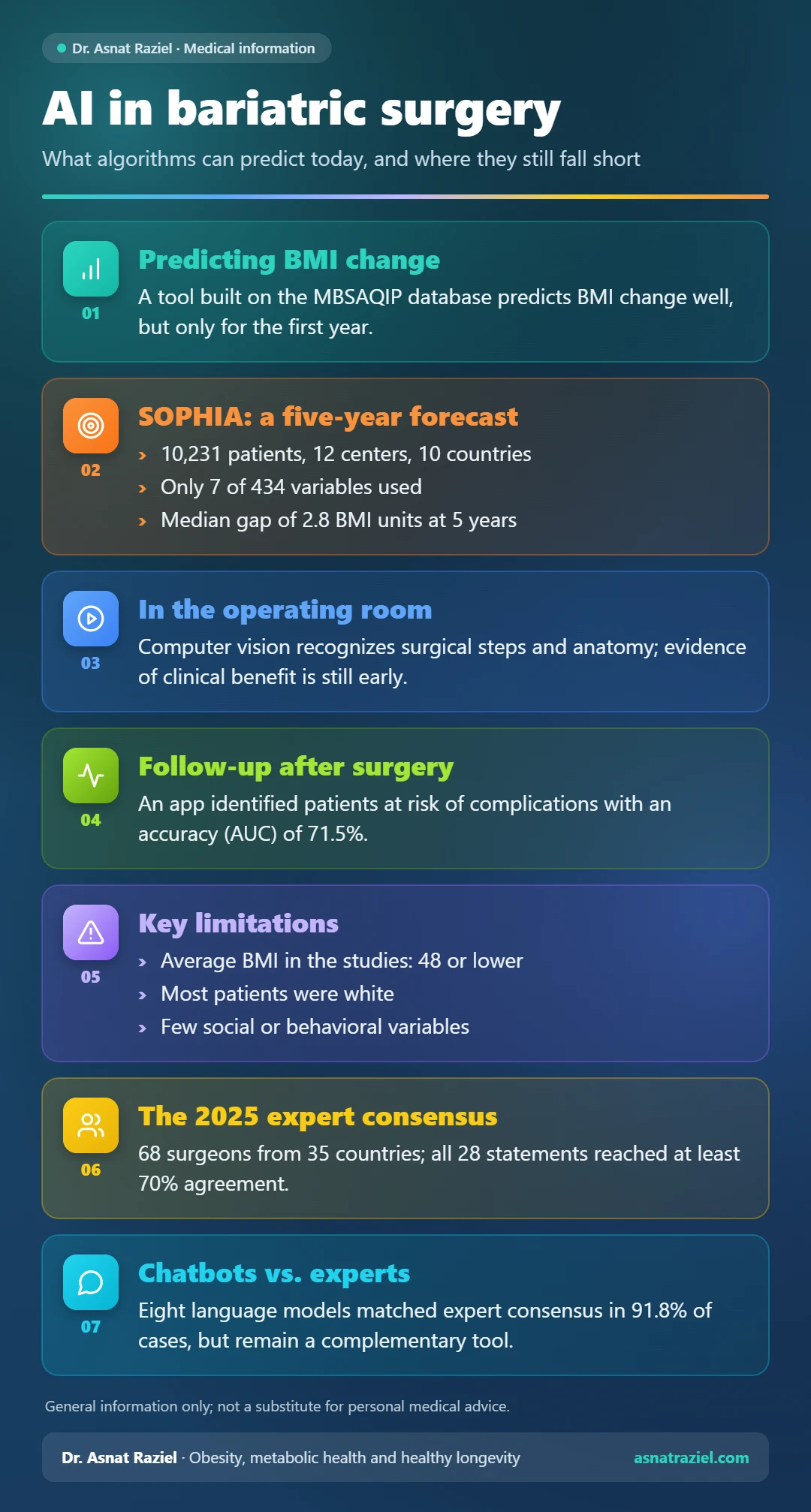
One of the main uses is predicting outcomes after surgery. The American College of Surgeons developed a tool based on the MBSAQIP database, the American quality and accreditation program for metabolic and bariatric surgery. The tool estimates the expected change in BMI after a gastric band, sleeve gastrectomy, gastric bypass or duodenal switch.
The model draws on the patient’s characteristics, existing medical conditions and starting BMI. According to the article, it predicts the change in BMI well, but only for the first year after surgery. In other words, even the best tools struggle to see far ahead.
The SOPHIA project: predicting weight five years out
A fascinating example is the SOPHIA project (Stratification of Obesity Phenotypes to Optimize Future Therapy). This European initiative focuses on personalized medicine for obesity. The researchers built a machine learning-based calculator that predicts a patient’s weight trajectory five years after gastric bypass, sleeve gastrectomy or a gastric band. It was developed and validated in 10,231 patients from 12 centers in ten countries across Europe, the Americas and Asia.
Interestingly, out of 434 variables, the algorithm selected only seven. These were height, weight, type of surgery, age, diabetes, diabetes duration and smoking. After five years, the median gap between the BMI the model predicted and the actual BMI was 2.8 units. The researchers then turned the model into a simple online tool that supports decisions before surgery. Even so, the review notes that accuracy drops the further out the forecast goes. Personal tailoring is therefore still needed, including psychological and social factors.
AI in bariatric surgery: from the operating room to the app
Artificial intelligence does not stop at the planning stage. Around the world, computer vision systems are being developed that recognize the steps of an operation and anatomical structures on video. In addition, these systems allow an objective assessment of surgical skill. However, the evidence that they reduce bleeding or shorten operations is still early. For now, they are best seen as a promising tool rather than a standard of care.
After surgery, smart apps make continuous follow-up possible. They can track symptoms, sleep, physical activity and eating patterns. A 2025 review in the journal Obesity Surgery describes an app that identified patients at risk of complications with an accuracy (AUC) of 71.5%. In the future, tools like this may also flag an early risk of weight regain. This way, AI becomes part of long-term, multidisciplinary care. You can read more in my article on weight regain after a sleeve.
Big advantages, but real challenges
Alongside the benefits, there are significant limitations. According to the review, the average BMI in all the studies that built these tools was 48 or lower. Most patients were white, and the share of ethnic groups was not reported at all. Moreover, the models include almost no socioeconomic or behavioral variables. As a result, an algorithm may skew its forecast for patients who do not resemble the study population.
There is also a deep ethical question. When a system recommends a particular operation, who is responsible if the outcome is poor? That is why the algorithms should be explainable AI. In other words, they should not only predict, but also explain the reasoning behind each forecast.
What the experts think: the 2025 consensus
In March 2025, an international consensus on artificial intelligence in bariatric surgery was published. The process included 68 leading surgeons from 35 countries. All 28 statements reviewed reached at least 70% agreement. The experts agreed that AI can improve the assessment of surgical skill, the selection of candidates and the choice of operation. On the other hand, they voiced concern about over-reliance on machine recommendations. They also called for clear ethical rules and for including the role of AI in the patient’s informed consent process.
Another interesting study compared large language models, the technology behind chatbots, with human experts. Eight models weighed in on 135 professional statements from IFSO, the International Federation for the Surgery of Obesity and Metabolic Disorders. Where the experts had reached consensus, the models came to the same conclusion in 91.8% of cases. Still, the models leaned toward conservative positions. Accordingly, the researchers present them only as a complementary tool.
What AI in bariatric surgery means for patients today
If you are considering surgery, the message is practical. Tools such as the SOPHIA calculator give an initial estimate of the expected weight loss. However, the forecast is a starting point for a conversation, not a promise. The decision itself rests on a full medical evaluation, your existing conditions, your nutritional and emotional state, and your personal goals. So it is worth asking your care team which tools they use and how these fit into your treatment plan.
Looking ahead: truly precise medicine
In the near future, algorithms are expected to combine with genomics, the microbiome, image analysis and even voice analysis. Together, these will create a complete patient profile. As a result, each patient will get treatment, surgery and follow-up that match their own characteristics. This is also the basis of personalized obesity treatment, where surgery is just one option alongside the new obesity medications.
The goal is not to replace the doctor, but to strengthen the doctor. Artificial intelligence turns huge amounts of data into a precise and fast working tool that serves the patient. I have also written about the broader picture of artificial intelligence in obesity treatment.
The bottom line on AI in bariatric surgery
Artificial intelligence is changing how we understand obesity and how we operate on it, in every sense of the word. It makes precise, predictive and personalized medicine possible. At the same time, it demands humility, ethics and humanity. Ultimately, the combination of an experienced surgeon, a multidisciplinary team and AI in bariatric surgery may make operations safer, more effective and more precise than ever.
The information in this article is general and does not replace personal medical advice.
References
The role of Artificial Intelligence in Bariatric Surgery Weight Loss Outcomes




