By Dr. Asnat Raziel, bariatric surgeon specializing in obesity treatment, metabolic health and healthy longevity; Director of the Multidisciplinary Center for Obesity Treatment, Assia Medical, Assuta Ramat HaChayal, Tel Aviv
Menopause weight gain: what is really happening in your body
Menopause weight gain is something I hear about almost every day in my clinic. Women tell me they are eating just as they always have, and yet their pants feel tighter at the waist. It is a familiar and frustrating feeling. Still, the explanation is not only hormonal, and the research paints an interesting picture.
In short, the drop in estrogen mainly changes where your body stores fat and the balance between fat and muscle. At the same time, age, sleep, stress and how much you move all affect your weight itself. That is why the solution draws on several areas, not just diet.
What studies tell us about menopause weight gain
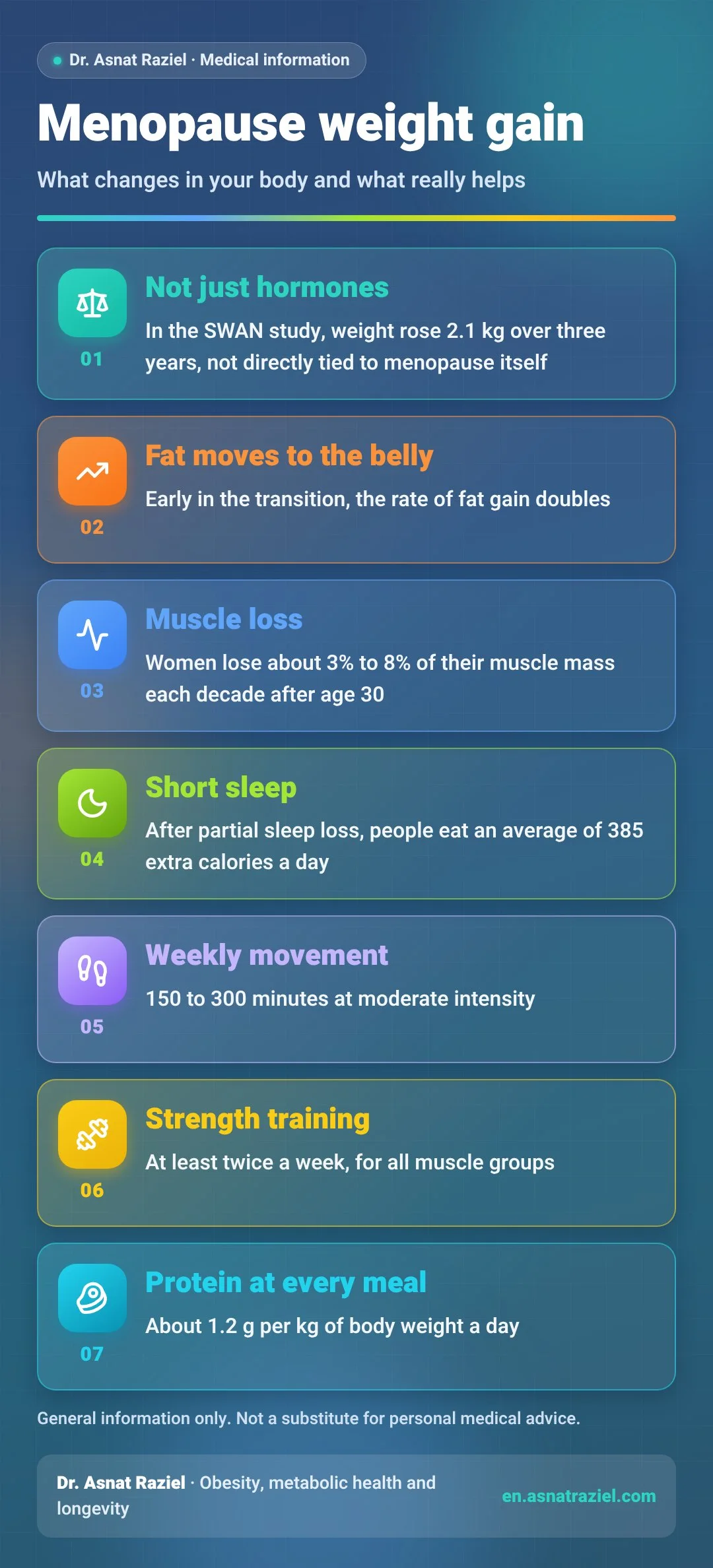
The best data come from the American SWAN study, which follows thousands of women through the menopause years. In an analysis of 3,064 women aged 42 to 52, weight rose by an average of 2.1 kg over three years. Waist size grew by an average of 2.2 cm. However, the change in menopausal status itself was not linked to the weight gain.
What is more, the same study showed that regular physical activity softened the gain. Women who stepped up their exercise or daily walking gained less weight over time. In other words, your habits make a real difference during this stage of life too.
Later, an analysis of body composition using DXA scans (a scan that measures fat, muscle and bone) added an important detail. At the start of the transition, the rate of fat gain doubled, and muscle mass began to decline. This process continued until about two years after the final menstrual period and then leveled off. By contrast, the rate of gain in total weight did not change. Put simply, the number on the scale does not always tell the whole story.
Why menopause weight gain settles around the belly
Estrogen influences where the body stores fat. According to The Menopause Society’s patient information sheet, falling estrogen encourages fat storage around the abdomen. Belly fat is linked to a higher risk of heart disease and metabolic disease.
In addition, according to a Mayo Clinic review, excess belly fat raises the risk of type 2 diabetes, cardiovascular disease and several types of cancer. That makes your waist measurement an important marker, sometimes more important than the number on the scale. I wrote more about the metabolic changes of this period in my article on menopause and metabolism.
Muscle loss and metabolism
Muscle is active tissue that burns energy even at rest. According to The Menopause Society, women lose about 3% to 8% of their muscle mass each decade after age 30. As a result, the body burns fewer calories at rest.
The practical meaning is simple. According to Mayo Clinic, to keep your weight stable in your 50s, you will need about 200 fewer calories a day than in your 30s and 40s. So eating exactly the same way can lead to slow weight gain.
Sleep, stress and appetite
Hot flashes and night sweats disrupt sleep for many women. Short sleep has a direct effect on appetite. A meta-analysis of sleep restriction studies found that after partial sleep loss, participants ate an average of 385 extra calories a day. Meanwhile, the energy they burned did not go up.
Ongoing stress also drives snacking and emotional eating. That is why better sleep is part of the treatment, not a luxury. You will find practical ideas in my article on improving your sleep naturally.
Menopause weight gain: movement and strength training
The World Health Organization guidelines recommend that adults get 150 to 300 minutes a week of moderate-intensity aerobic activity. Alternatively, you can do 75 to 150 minutes of vigorous activity. In addition, it is recommended to strengthen all the major muscle groups at least twice a week.
During menopause, strength training is especially important. It helps you hold on to the muscle that starts to decline at this stage. You will find practical examples in my article on strength training to preserve muscle mass. Alongside it, brisk walking or low heart rate training (Zone 2) builds aerobic fitness without putting much strain on your joints.
Eating to manage menopause weight gain: what to change
There is no need for an extreme diet. First, put protein at the center. The Menopause Society recommends about 1.2 grams of protein per kilogram of body weight a day to help preserve muscle. It is a good idea to spread it across your meals. For example, eggs or yogurt in the morning, legumes or fish at lunch, and chicken or tofu in the evening.
Second, choose whole grains, vegetables, fruit and legumes. Third, watch the sweet drinks. According to Mayo Clinic, Americans consume about 300 calories a day from added sugar, and roughly half of that comes from sweetened beverages. Finally, limit alcohol, which adds calories and harms sleep. I also wrote more about protein in my article on protein during weight loss medication.
Hormone therapy and medication
Hormone therapy is the standard treatment for hot flashes and night sweats. However, it is not a weight loss treatment. According to The Menopause Society, some studies point to a slight reduction in belly fat, but the effect is modest. On the other hand, better sleep thanks to the treatment may help indirectly.
When there is significant excess weight or related health conditions, obesity medication may also be an option. The decision is personal and is made together with your doctor. You will find detailed information in my guide to obesity in women during menopause.
When menopause weight gain calls for a doctor’s visit
Rapid weight gain without a clear explanation deserves a checkup. Unusual fatigue, irregular bleeding or signs of diabetes also need to be looked into. In these cases, it is worth checking thyroid function, blood sugar and blood lipids, among other things.
Our clinic has a dietitian on staff. In addition, as needed I refer patients to a multidisciplinary mind-body team: dietitians, psychologists, holistic coaches, naturopaths and complementary-medicine practitioners, as well as Pilates and yoga instructors and experts in stress-reduction techniques.
The bottom line
Menopause weight gain is not inevitable. Research shows that hormones mainly change how fat is distributed and the balance between muscle and fat. So the most important steps are strength training, daily movement, enough protein and good sleep. Start with one habit and stick with it. You will find more ideas in my article on lifestyle for women in menopause.
This article is general information and does not replace personal medical advice.
Frequently asked questions about menopause weight gain
How is menopause weight gain related to hormones?
The link is only partial. In the SWAN study, the change in menopausal status was not linked to weight gain. Hormones mainly affect fat buildup around the belly and the loss of muscle. Age, physical activity and sleep affect weight itself.
Why does my belly grow even when my weight barely moves?
At the start of the transition, the rate of fat gain doubles, while muscle mass declines. So your body composition changes even when your weight stays stable. Measuring your waist helps you spot the change.
How much exercise is recommended at this age?
The World Health Organization recommends 150 to 300 minutes a week of moderate-intensity activity. In addition, strength training is recommended at least twice a week.
Does hormone therapy help with weight loss?
Not directly. The treatment is mainly meant for hot flashes and night sweats. Some studies show a modest effect on belly fat.
Sources
Changes in body composition and weight during the menopause transition
The effects of partial sleep deprivation on energy balance: a systematic review and meta-analysis
World Health Organization 2020 guidelines on physical activity and sedentary behaviour