By Dr. Asnat Raziel, bariatric surgeon specializing in obesity treatment, metabolic health and healthy longevity; Director of the Multidisciplinary Center for Obesity Treatment, Assia Medical, Assuta Ramat HaChayal, Tel Aviv
GLP-1 and eye health: what the largest meta-analysis found
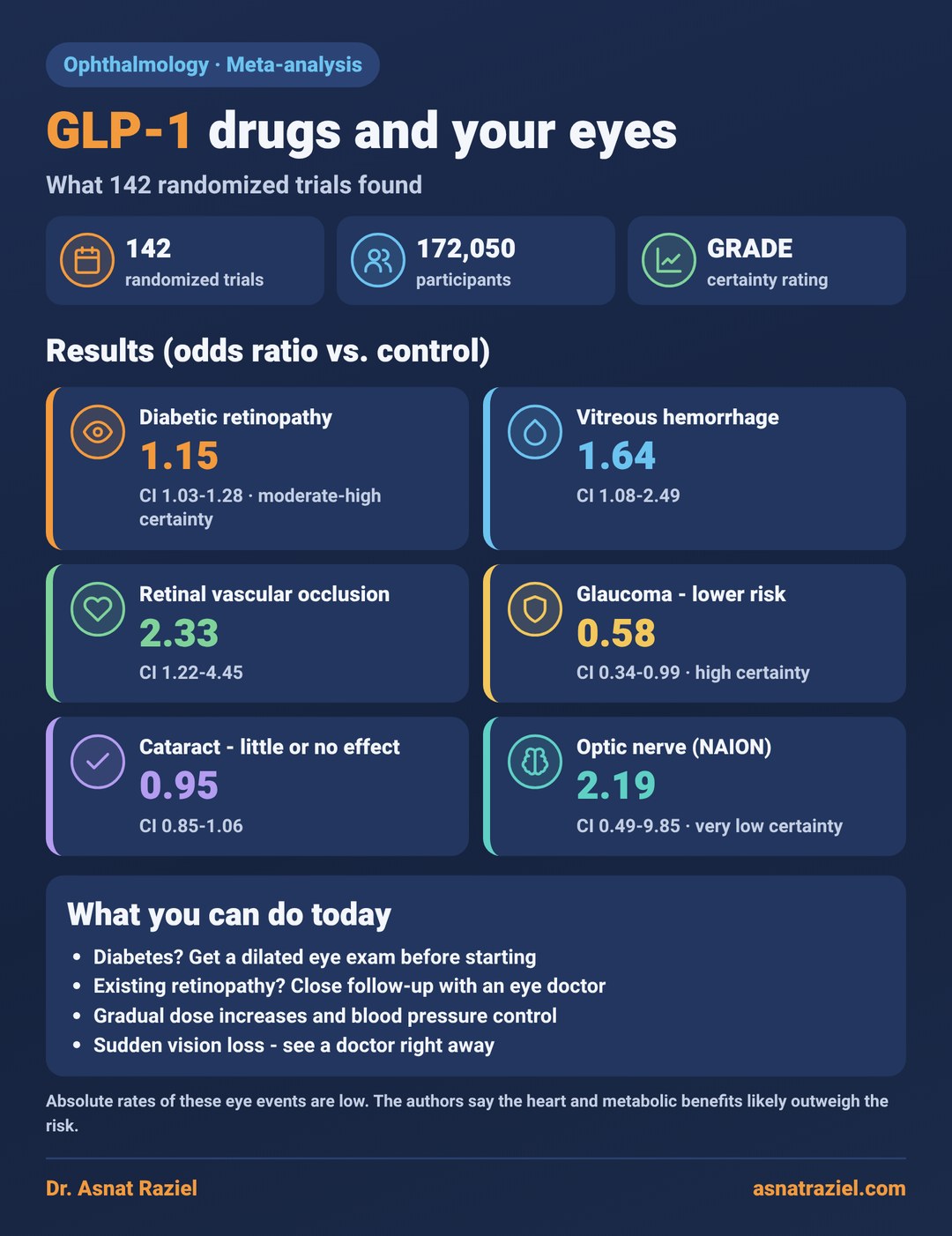
Questions about GLP-1 and eye health come up in almost every clinic visit. Now we have a solid answer. A new meta-analysis in the journal Ophthalmology pooled 142 randomized trials with 172,050 participants. The researchers found a small rise in some retinal events, alongside a lower risk of glaucoma. Their conclusion is clear: the eye risk is small, and the heart and metabolic benefits likely outweigh it.
Why ask about the eyes at all?
GLP-1 drugs treat diabetes, obesity and heart disease. This group includes, for example, semaglutide, the active ingredient in Ozempic and Wegovy, and liraglutide. Over the years, two concerns came up. The first is worsening diabetic retinopathy, damage to the tiny blood vessels of the retina. The second is NAION, a “stroke” of the optic nerve, which I covered in my article on the FDA warning about the optic nerve.
However, most of the data so far came from observational studies. In those studies, it is hard to separate the effect of the drug from the effect of diabetes itself. So the team at McMaster University in Canada chose to pool only randomized trials.
What did the researchers do?
The team searched five databases through August 2025. They included any trial that compared a GLP-1 drug with placebo, usual care or another drug, for any indication. In total, 142 trials qualified. In addition, they rated the certainty of each finding with GRADE, a standard method for grading evidence.
GLP-1 and eye health: the main results
First, the outcomes where risk rose, with moderate to high certainty:
- Diabetic retinopathy: odds ratio (OR) 1.15 (95% confidence interval 1.03-1.28).
- Vitreous hemorrhage, bleeding into the gel that fills the eye: OR 1.64 (1.08-2.49).
- Need for retinal procedures: OR 1.37 (1.07-1.75).
- All retinal vascular disorders: OR 1.54 (1.12-2.12), including retinal vascular occlusion: 2.33 (1.22-4.45).
In contrast, glaucoma moved the other way. Risk fell, with an OR of 0.58 (0.34-0.99), at high certainty. Cataract and retinal detachment showed little or no effect: OR 0.95 (0.85-1.06) and 1.40 (0.87-2.27).
What about the optic nerve?
For NAION, the picture is still unclear. The OR was 2.19, but the interval was very wide, 0.49-9.85. The authors say they are “very uncertain” about this finding. The same goes for macular degeneration, with an OR of 0.91 (0.15-5.45). Moreover, results held when the team looked only at placebo- or usual-care-controlled trials. Length of follow-up did not change the picture.
GLP-1 and eye health: how to read the numbers
An odds ratio of 1.15 means a small relative increase. In other words, when the baseline risk is low, the added risk is small too. The authors stress that the absolute rates of these events are low. That is why they suggest doctors tell patients the eye risk is small and likely outweighed by the heart and metabolic benefits.
On the other hand, one group needs extra attention: people with diabetes, especially those who already have retinopathy. For them, the authors advise early eye monitoring. One possible explanation, known from insulin treatment, is a very fast drop in blood sugar. A sharp drop can temporarily worsen existing retinopathy. This study did not test the mechanism.
Approval status in Israel and the US
GLP-1 drugs are approved in the US and Israel for type 2 diabetes, and some are also approved for obesity. This study does not change those approvals. The FDA has already updated the labels regarding NAION. I cover Wegovy side effects in a separate article.
GLP-1 and eye health: what you can do today
These drugs remain an important and safe tool for most patients. Here are the steps I recommend at our center:
- A dilated eye exam before starting treatment for anyone with diabetes. If you already have retinopathy, see an eye doctor regularly.
- Gradual dose increases, as I explain in my guide to Mounjaro dosing. That way blood sugar also falls at a gentle pace.
- Control of blood pressure and blood lipids, which also affect the vessels of the eye.
- See a doctor right away for any sudden vision loss, new blurring or a “shadow” in your field of vision.
- A lifestyle that supports your blood vessels: a Mediterranean diet, strength and aerobic training, enough sleep and no smoking.
Good obesity care is also team care. At our multidisciplinary center, a physician, dietitian, psychologist and exercise coach work together. When needed, we add medication, and sometimes surgery. I also wrote about this in my guide to obesity and type 2 diabetes.
Study limitations
First, many trials were not designed to study the eyes, so eye events were reported only as side effects. Second, rare events such as NAION need much larger studies. Finally, the abstract does not report results by individual drug or dose.
Bottom line
In the end, concerns about GLP-1 and eye health are not a reason to give up effective treatment. The retinal risk is small, and glaucoma risk even fell. People with diabetes need an eye exam before treatment and follow-up during it. That way, you can enjoy the benefits of treatment safely.
This article is general information and does not replace personal medical advice.
References
PubMed: Glucagon-like peptide-1 receptor agonists and eye-related outcomes