By Dr. Asnat Raziel, bariatric surgeon specializing in obesity treatment, metabolic health and healthy longevity; Director of the Multidisciplinary Center for Obesity Treatment, Assia Medical, Assuta Ramat HaChayal, Tel Aviv
Longevity genetics: when good health runs in the family
Longevity genetics has fascinated researchers for decades. In some families, good health seems to pass from one generation to the next. The grandparents reach a very old age while staying active and independent. Their children pass the age of 70 without diabetes or heart disease, and the grandchildren also develop chronic diseases later than average. Is this just a matter of shared habits, good living conditions and luck? Or is there also a biological protection that is inherited?
A new longevity genetics study from the Netherlands offers an intriguing answer. The researchers identified rare genetic changes in families in which several generations reached old age in good health. One of them sits in the CGAS gene, which helps regulate the immune system and inflammation. The change appears to weaken an inflammatory mechanism that grows stronger with age. However, it does not disable the body’s ability to fight infections.
Not just how many years we live, but how we live them
Life expectancy has risen sharply in recent decades. However, the number of healthy years has not always kept pace. Many people today live for long years with diabetes, heart disease, cognitive decline, frailty and functional limitations.
That is why modern research focuses on healthspan: the number of years a person lives without significant chronic disease while keeping their independence and function. I have also written about this in an article on healthy aging.
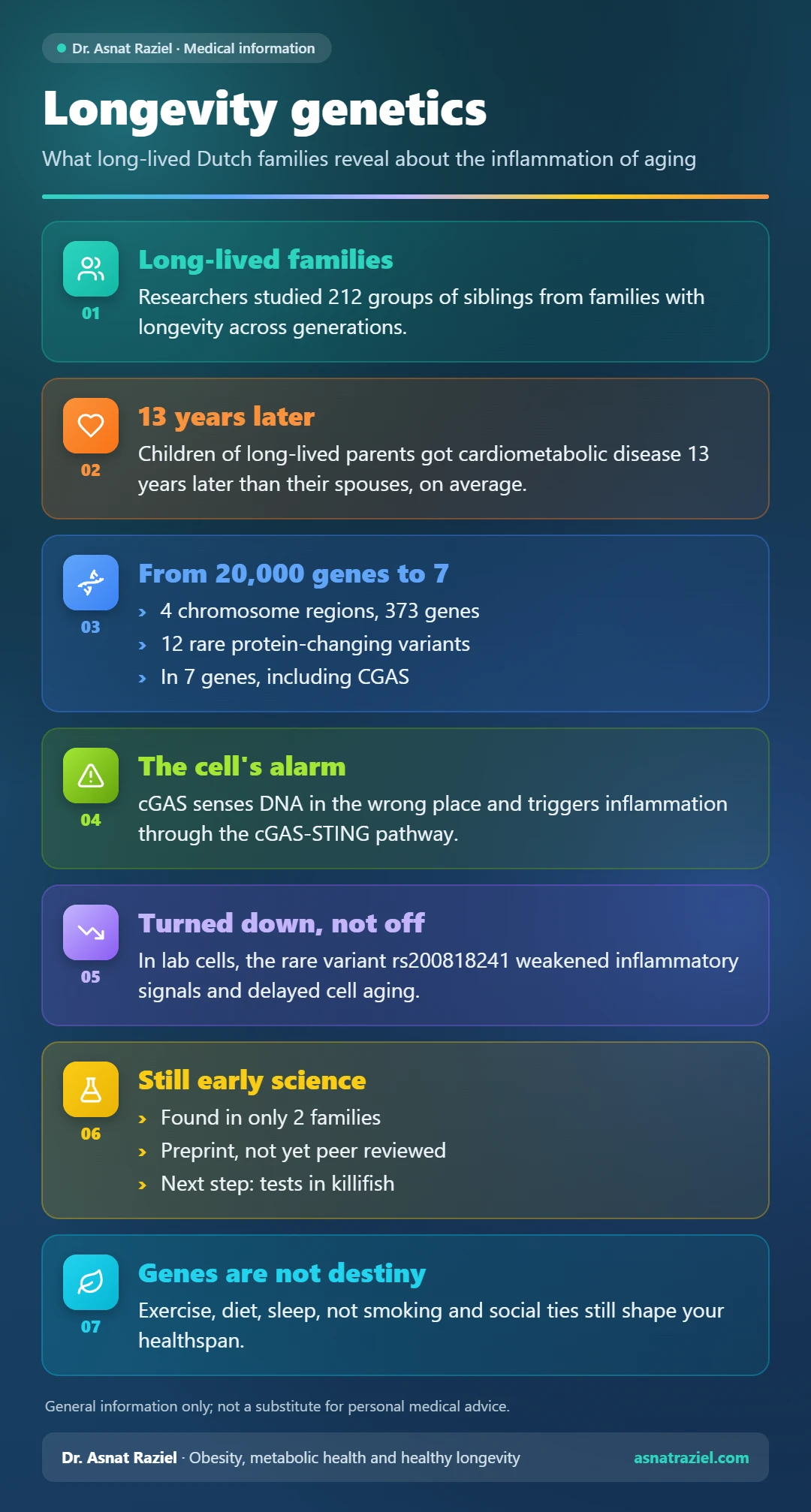
The Leiden Longevity Study has been following such families for more than two decades. According to the researchers, middle-generation members born to long-lived parents developed cardiometabolic diseases an average of 13 years later than their spouses. This comparison is especially interesting. After all, spouses share a home, a diet and an environment, but not the same genetic makeup.
The figure does not mean that everyone from a long-lived family will gain 13 extra years of health. Still, it suggests that the tendency to age well may run in families, and that heredity plays a part in it too.
How researchers study longevity genetics within families
Instead of examining individuals who reached a very old age, the researchers studied 212 groups of brothers and sisters. All of them came from families with an unusual concentration of longevity across generations. This family-based approach makes it possible to find rare changes that large population studies simply miss.
First, the researchers located four chromosome regions that were likely to contain factors linked to longevity. In this way, they narrowed the search from about 20,000 genes to just 373. Next, they identified 12 rare variants (genetic versions) that change the structure of a protein, in seven genes: NUP210L, SLC27A3, CD1A, CGAS, IBTK, RARS2 and SH2D3A.
The most striking finding was a single-letter change in the CGAS gene, known as rs200818241. The researchers found it in two long-lived families. It is important to stress that this is a very rare change. So we should not see it as the one “longevity gene” or as a full explanation for healthy aging.
This finding also connects to chronic inflammation. I explore it further in my article on inflammaging and a rare longevity gene variant.
The cell’s alarm system
The CGAS gene, short for cyclic GMP-AMP synthase, makes a protein that acts as an alarm sensor inside the cell. Normally, our genetic material sits in the cell nucleus and in the mitochondria. When DNA shows up in the cytoplasm, where it does not belong, the protein detects it.
This happens during a viral infection, when foreign genetic material enters the cell. But it also happens when cells are damaged and fragments of DNA leak into the wrong place. Once it detects the DNA, the protein activates a signaling pathway called cGAS-STING. This pathway triggers an immune response, the production of interferons and the release of inflammatory substances.
With age, however, DNA damage, mitochondrial injury and old cells build up. As a result, the alarm may keep ringing even without an infection. Such prolonged activation contributes to inflammaging, a silent chronic inflammation linked to aging. This inflammation plays a role in heart disease, degenerative diseases and metabolic damage. In addition, a study in Nature showed that blocking the pathway in aging mice reduced inflammation and improved tissue and brain function. I have also written about the link between inflammation and metabolism in an article on chronic inflammation.
Turning the alarm down, not off
The change found in these families does not shut the protein down completely. In experiments on human and mouse cells, it reduced the protein’s stability and weakened activation of the pathway. The effect varied between cell types. Overall, though, inflammatory signaling dropped and the signs of cellular aging appeared later.
So it is possible that members of these families were born with an immune system that responds to threats but does not overreact to every small injury. Instead of an alarm that never stops ringing, it works at a moderate, controlled level.
This is a delicate balance. Fully disabling the protein could impair the detection of infections, and perhaps of cancer cells as well. On the other hand, chronic overactivity damages tissues and speeds up aging. In other words, the message is not to “block inflammation” across the board. Healthy aging probably depends on a precise immune response: strong when needed, and quiet once the threat has passed.
Will longevity genetics lead to a drug?
This longevity genetics study points to the cGAS-STING pathway as a possible target for future drugs against age-related inflammation. In theory, a treatment that tones the pathway down without disabling it might mimic part of the effect of the rare change. You can read about this direction and other efforts in my article on drugs that target aging.
Even so, the road to treatment in humans is still long. A finding in lab cells does not prove that the change extends life. Nor does it prove that blocking the pathway with a drug would be safe. Moreover, the change appeared in only two families. Researchers therefore need to find more carriers, study diverse populations and track its effect on infections, cancer and chronic diseases.
The work appeared as a preprint, meaning before peer review. In June 2026, the researchers presented it at the European Society of Human Genetics conference. Next, they plan to introduce the change into killifish at the Max Planck Institute for Biology of Ageing in Cologne. These are the shortest-lived vertebrates, living only a few months. This makes it possible to test quickly whether the change affects lifespan and tissue health.
Genes matter, but they are not destiny
This study does not diminish the importance of lifestyle. Physical activity, diet, sleep, not smoking, social connections and access to medical care all have a major impact on healthspan. Even in long-lived families, some people fall ill at a young age. And in ordinary families, some people reach a very old age in good health. In my article on small changes that extend life, I outline practical steps.
Longevity genetics involves thousands of genetic differences, repair mechanisms, the immune system, metabolism and the environment. One rare variant may give an advantage, but it works within a whole system. To track your personal pace of aging, it is also worth getting to know biological age measures.
Bottom line
The value of this longevity genetics research is not a blood test that will reveal who is “destined” to live to 100. Rather, its value is that it uncovers a natural mechanism that protects certain people from accelerated aging. If we understand how these families keep the balance between immune defense and inflammation, we may be able to mimic it in people who were not born with the change. In the end, health in old age depends not only on the ability to fight, but also on knowing when to stop.
The information in this article is general only and is not a substitute for personal medical advice.
References
Family genetics study reveals clues to longer healthspan
cGAS-STING drives ageing-related inflammation and neurodegeneration
Inflammaging: a new immune-metabolic viewpoint for age-related diseases
New research helps understand how a long, healthy lifespan may be passed down across generations