By Dr. Asnat Raziel, bariatric surgeon specializing in obesity treatment, metabolic health and healthy longevity; Director of the Multidisciplinary Center for Obesity Treatment, Assia Medical, Assuta Ramat HaChayal, Tel Aviv
Art therapy: what one father knew without reading any research
For Dr. Cathy Malchiodi, art therapy began in the basement of her parents’ house. She was eight years old when her grandmother died, and she did not understand what was happening to her. Her father, a steel mill worker, gave her a few cans of house paint. He told her to go down to the basement and paint whatever she wanted on the wall. She says she still remembers the feeling in her body, the movement and the rhythm.
Today, Malchiodi is a world-renowned psychologist and expressive arts therapist. According to the summit, the institute she founded has trained more than 25,000 professionals on six continents. She works with children, families, communities after disasters, and soldiers and veterans. At the Nervous System Reboot summit, she explained why creative work succeeds where words stop.
What is expressive arts therapy?
Of course, many people are familiar with therapy through drawing, music or movement. Expressive arts therapy combines all of them. In a single session, you might move, make sounds, draw and tell a story. The goal is to find the way each person communicates best, and what calms their body.
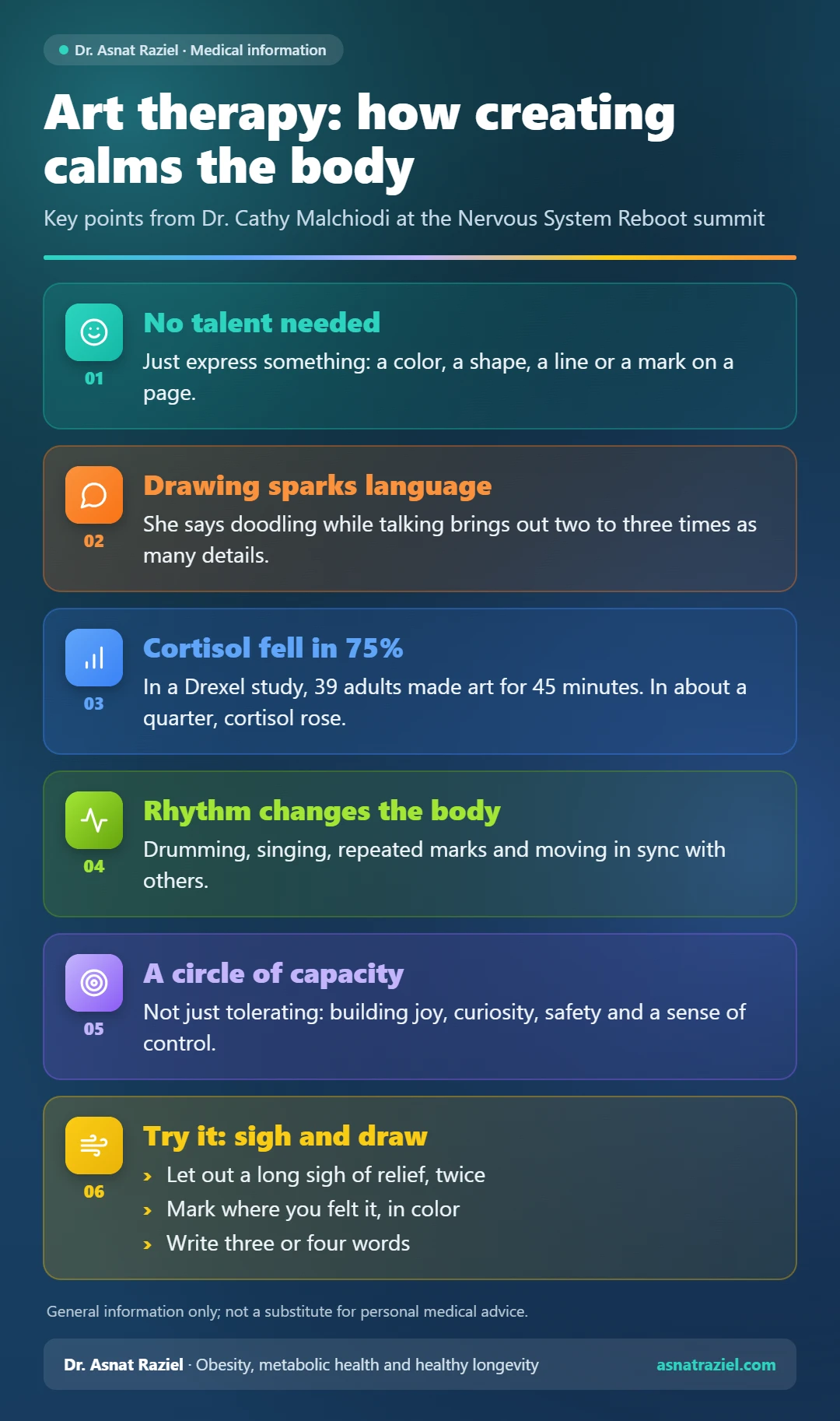
Malchiodi stresses that you don’t need talent. Many of us stopped drawing at age nine or ten, and that is natural. So she does not ask her clients to be “creative.” She only asks them to express something: a color, a shape, a line or a mark on a page.
Why art therapy helps people tell their story
One of the most interesting points in the conversation is about language. According to Malchiodi, drawing activates the language areas of the brain. When people doodle while they talk, they usually share a lot. She says studies show two to three times as many details, and sometimes new memories surface as well. In this way, a simple page of lines and colors becomes an opening for conversation.
In addition, trauma robs people of the ability to play and be curious. A small moment of play, such as touching a pleasantly soft pastel crayon, is already a change. After all, we only play when we feel safe enough.
Watch the full talk: Dr. Cathy Malchiodi on art therapy
The full interview, in English, was presented at the Heart Mind Institute’s Nervous System Reboot 2026 summit.
What happens in the body when we create?
Beyond language, creative work has a physical effect. Malchiodi mentions decreases in the stress hormone cortisol and in blood pressure. In a Drexel University study, 39 adults made art for 45 minutes. In 75% of them, cortisol levels dropped. However, in about a quarter of the participants, cortisol actually rose. Almost half of the participants had little prior experience with art, and the result did not depend on experience.
Malchiodi also talks about rhythm. Drumming, singing, repeated marks on a page and movement in sync with others all change how the body feels. In her view, beyond fight, flight or freeze, there are other states too: pleasure, excitement and flow. In flow, we are completely absorbed in what we are doing, and we lose track of time. For another way the body calms itself, see my article on shaking after trauma.
Bilateral movement and the circle of capacity
In the 1990s, Malchiodi trained in EMDR, an eye movement therapy for processing trauma. She developed her own version, in which the whole body moves from side to side. For example, you draw with both hands on a large sheet of paper, sometimes to music. She points out that many cultures have done this for hundreds of years, for instance in tai chi and qigong. I cover another gaze-based method in my article on brainspotting.
Instead of a “window of tolerance,” she prefers to talk about a “circle of capacity.” In her view, her clients have already suffered enough. The goal is not just to tolerate, but to build capacity: joy, curiosity, safety and a sense of control over your life.
A short exercise: a sigh of relief and a drawing
Malchiodi ended the conversation with a simple exercise. Try it now:
Step one: Breathe in and let out a long sigh of relief. Notice how your body moves and what sound comes out.
Step two: Repeat it once more. You can also take two breaths in a row and then breathe out slowly.
Step three: Take a sheet of paper, or an outline drawing of a body, and use colors to mark where you felt the sigh.
Step four: Write three or four words about the experience.
You can even use highlighters from your desk. There is no “right” drawing here.
Art therapy, stress and health
In fact, chronic stress affects sleep, eating and weight. That is why it is worth looking for a variety of ways to calm your nervous system. Read my article on stress and obesity and my practical guide to stress relief. In addition, curiosity and playfulness benefit the brain, and human connection contributes to healthy longevity. When you create in a group, you get both at once.
The bottom line
Art therapy does not require talent. It only requires a willingness to express something on a page, in a sound or in movement. Creative work can calm the body, bring up memories and open a conversation. If you are dealing with trauma, it is best to do this with the support of a qualified therapist.
The information in this article is general and does not replace personal medical or therapeutic advice.