By Dr. Asnat Raziel, bariatric surgeon specializing in obesity treatment, metabolic health and healthy longevity; Director of the Multidisciplinary Center for Obesity Treatment, Assia Medical, Assuta Ramat HaChayal, Tel Aviv
Brainspotting therapy: a story that began with one jump on the ice
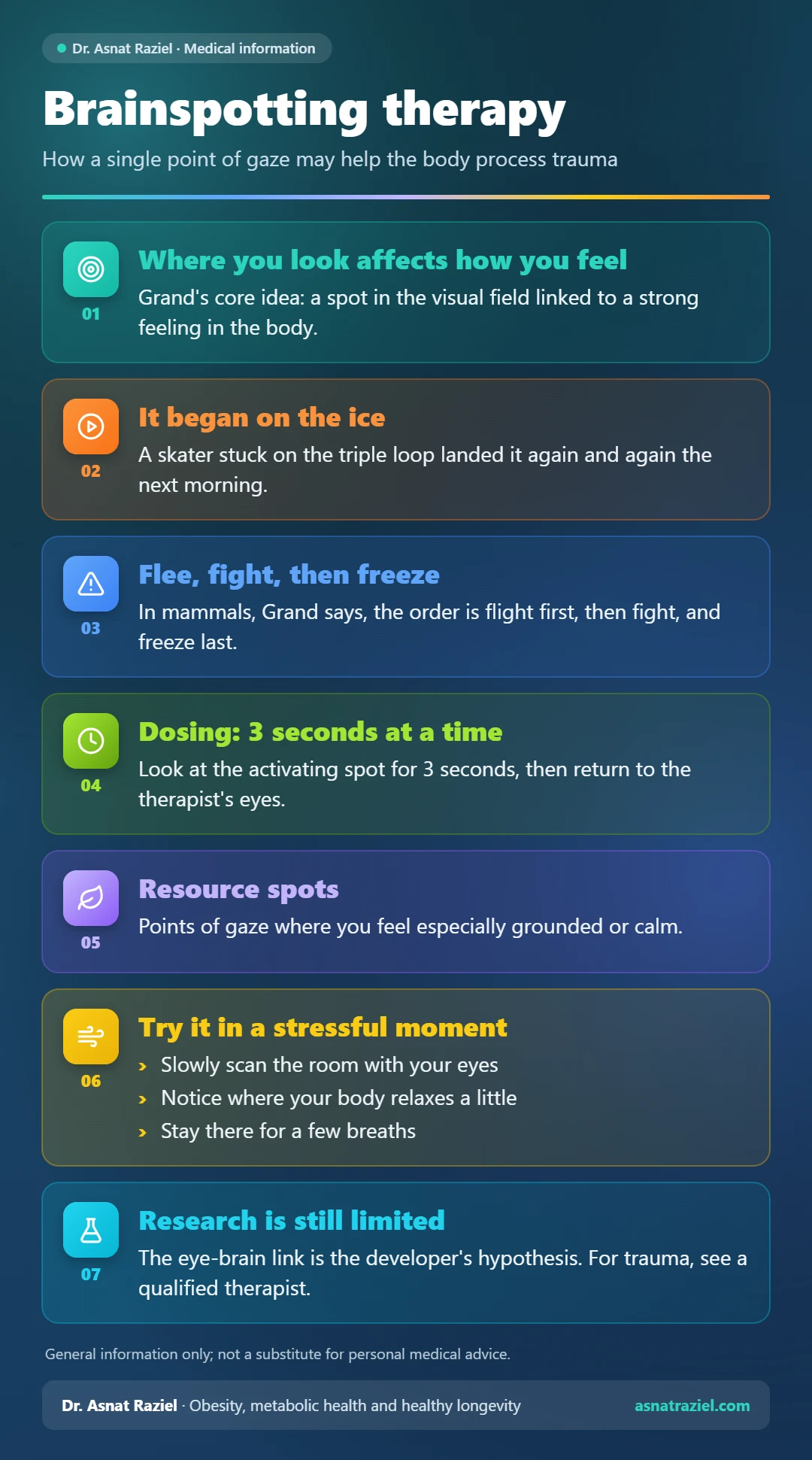
Brainspotting therapy was born by accident, in the office of psychotherapist Dr. David Grand. One of his clients was a championship-level figure skater. A single jump kept stopping her: the triple loop, with three rotations in the air. Every time, just before the third rotation, she pulled out of the jump. So Grand asked her to picture that moment in slow motion, and he slowly moved his hand in front of her eyes.
At one point her eye wobbled hard and then locked. Grand stopped his hand right there. For ten minutes, painful memories surfaced one after another, and then passed. The next morning she called him from the rink. She had landed the jump again and again, without any difficulty. According to Grand, that jump never stopped her again.
What is brainspotting therapy?
Brainspotting is a method Grand developed after that session. Its core principle is simple: “where you look affects how you feel.” First, the therapist asks the client to focus on an issue that troubles them. Then, together, they look for a spot in the visual field where the feeling in the body is especially strong. The client keeps looking at that spot, and the processing happens from within.
The method grew out of Grand’s earlier work with eye movements, in a very slow version of EMDR, an eye-movement therapy for processing trauma. Today, he says, thousands of therapists around the world use it. He has also worked with survivors of major disasters, as well as with athletes and artists looking for a breakthrough.
The need for effective trauma care is very real in Israel today. As Ynetnews reported on volunteer therapists helping Israelis, local care is widely regarded as high quality, but heavy demand and bureaucracy make it hard to access.
For another perspective, see my article on trauma healing with Katja Cahoon.
The eyes as a window to the nervous system
According to Grand, the eyes have unique access to the nervous system. The retina and the optic nerve are made of nerve cells, and several cranial nerves connect to the eye muscles. From this, he concludes that our gaze opens a direct pathway to deep regions of the brain and body. To be clear, this is a hypothesis from the method’s developer. Research on the method is still limited, and you can follow it on the organization’s research page.
Grand also offers an interesting image of trauma. In his view, it is not frozen in one place. Instead, trauma resembles smoke rising from a campfire, constantly changing shape. In this way, it moves between different parts of the nervous system and tries to find a way out. Within a safe therapeutic setting, he says, the nervous system finds that way out on its own.
Flight, fight and freeze in brainspotting therapy
We usually talk about “fight or flight.” Grand points out that in mammals the order is actually reversed. First we try to flee, then we fight, and only at the end do we freeze. In his view, every stage we do not complete carries over into the next one. That is why a single person can show both hypervigilance and heaviness or disconnection. In addition, he distinguishes between a hard freeze, a kind of paralysis, and a soft freeze of shutting down and disconnecting. This distinction helps explain why people react to stress in such different ways.
Watch the full talk: Dr. David Grand on brainspotting
The full interview, in English, was presented at the Nervous System Reboot 2026 summit of the Heart Mind Institute.
Brainspotting therapy: the therapist follows the client
One of the most striking ideas in the conversation concerns the relationship between therapist and client. Grand argues that the nervous system is so complex that no one can truly know what is happening inside another person. Therefore, in his view, the therapist does not need to lead. He compares the client to the head of a comet and the therapist to its tail. The head chooses the path, and the tail simply follows.
This approach also takes pressure off the therapist. There is no need to solve everything. Instead, the therapist stays present, attentive and curious. According to Grand, many clients have never had anyone listen to them this way.
Brainspotting therapy in small doses
Not everyone is ready to dive in right away. With people who become overwhelmed easily, Grand uses a technique he calls dosing. The client looks at the activating spot for just three seconds and then returns to the therapist’s eyes. They wait together until the body calms down, and only then go back to the spot. In this way, the capacity to hold difficult feelings grows, step by step.
In addition, Grand describes resource spots. These are points of gaze where a person feels especially grounded or calm, for example with a pleasant sensation in the soles of the feet.
A small exercise from brainspotting therapy
Grand shared a personal story. Before a hernia operation, he lay in bed with an IV, and the surgery ran two hours late. Meanwhile, he searched the room for the spot where he felt most neutral, and found an electrical outlet on the wall. He looked at it for two hours. As he tells it, he did not feel great, but his anxiety did not take off.
You can try this in a stressful moment. Slowly scan the room with your eyes. Notice whether there is a direction in which your body relaxes a little. Then keep your gaze there for a few breaths.
Our gaze, stress and our health
Chronic stress affects sleep, appetite and weight. So any tool that helps the body leave a state of high alert deserves attention. I also recommend reading about stress relief techniques, about meditation, stress and weight, and about physical and mental fatigue. In addition, curiosity, which Grand places at the center of therapy, also benefits the brain over the years.
The bottom line
Brainspotting therapy offers an intriguing idea: our gaze is linked to what we feel. The skater’s story is impressive, but it is a single story, and research on the method is still in its early days. So if you are dealing with trauma, see a qualified, experienced therapist.
The information in this article is general and does not replace personal medical or therapeutic advice.