By Dr. Asnat Raziel, specialist in obesity treatment, metabolic health and healthy longevity; Director of the Multidisciplinary Center for Obesity Treatment, Assia Medical, Assuta Ramat HaChayal, Tel Aviv
Researchers from the University of Connecticut revealed at ObesityWeek that GLP-1 stigma now wears new clothes. Most of the talk on TikTok is positive and encouraging. But alongside the old “you have no willpower,” there is now also “you lost weight because you cheated.”
GLP-1 drugs have changed obesity treatment. They include semaglutide, known as Ozempic and Wegovy, and tirzepatide, known as Mounjaro. At the same time, these drugs have also changed the way people talk about weight.
At ObesityWeek, the meeting of The Obesity Society, researcher Rui Wu of the University of Connecticut (UConn) presented a new study. Her co-authors were Prof. Rebecca Puhl, one of the world’s leading weight stigma researchers, Dr. Ryan Watson and Dr. Lisa Eaton. Together, the team analyzed 74,480 public TikTok posts from the US. The central question: does the conversation about obesity drugs add a new layer of stigma?
Why TikTok?
According to Pew data presented in the talk, 37% of US adults use TikTok. About half of 18- to 29-year-olds use it every day. Among teens, the numbers are even higher: 61% use TikTok daily, and 21% say they are on it “almost constantly.”
Earlier studies showed that popular TikTok content on food, nutrition and weight mostly glorifies thinness. Social media can both amplify weight stigma and weaken it, especially among young people.
What we knew so far about GLP-1 stigma
Until now, most of the evidence came from experiments. Participants read a short description of a fictional person and rate them. Overall, the findings are consistent:
- A study by Post and Persky in the International Journal of Obesity included 357 adults. They read about a woman who lost 15% of her body weight, either on a GLP-1 drug or with diet and exercise. They judged the woman who chose the drug more harshly. The key mechanism: the belief that she “took a shortcut.” This happened whether she was thin or had obesity.
- A follow-up study in Stigma and Health included 402 women aged 30 to 49 with overweight or obesity. Here too, weight loss with a drug triggered more stigma. The belief that “it’s the easy way” predicted more fear of fat, more blame and more desire for distance.
- Another study described a “no way to win” situation. People who chose a drug were judged more harshly than people who chose a diet. And people who regained weight after stopping treatment were judged similarly, regardless of the method.
- A different study asked whether simply knowing about effective drugs reduces stigma. The answer was no. In fact, people who had lost weight without drugs believed more strongly that obesity is a matter of self-control.
What was missing was an analysis of the real conversation online, on a large scale and over time. The new study set out to fill that gap.
How GLP-1 stigma on TikTok was measured
First, the researchers collected the posts through TikTok’s official Research API. The period: June 2023 to June 2024. Search terms included the brand names (Ozempic, Wegovy, Mounjaro and Zepbound), semaglutide and tirzepatide, and the nicknames GLP1 and GLP-1. The analysis covered the description text, the speech transcript, hashtags, posting date, and view and like counts.
Next, the tools were natural language processing and machine learning:
- An algorithm identified 10 topics, which the researchers grouped into four themes.
- A tool called VADER rated the tone of each description, from -1 (negative) to +1 (positive).
- A statistical model checked which posts got more likes relative to views.
- A dedicated dictionary found words of stigma and blame, such as shame, guilt and “obesity epidemic.” It also found words of “personal responsibility,” such as lazy, “the easy way” and “just eat less.”
- The researchers also read the flagged posts in their full context.
What people talk about, and in what tone
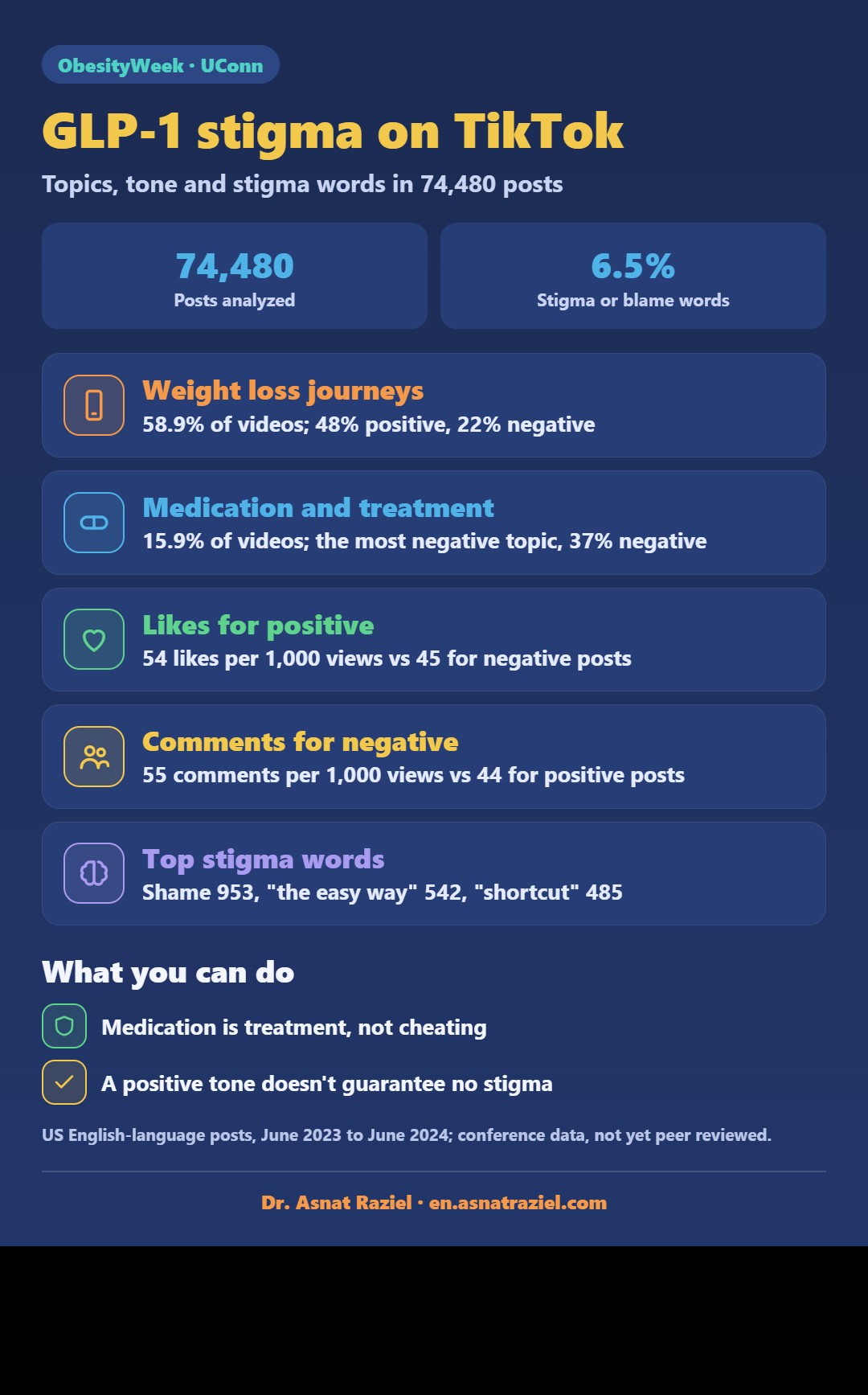
Above all, weight loss journeys dominate the conversation: 58.9% of the videos are about them. Next come community and social support (18.1%), medication and treatment (15.9%) and diabetes management (7.1%). The tone varies a lot by topic:
- Weight loss journeys: 48% positive, 30% neutral, 22% negative.
- Community and social support: 40% positive, 42% neutral, 17% negative.
- Medication and treatment: 32% positive, 31% neutral, 37% negative. This is the most negative topic.
- Diabetes management: 38% positive, 53% neutral, 8% negative.
Still, the researchers stressed an important point: “positive” describes the tone of the text. It doesn’t necessarily mean the writer supports the drugs.
Likes for positive, comments for negative
For example, positive posts received 54 likes per 1,000 views. Neutral posts received 46, and negative ones 45. In the adjusted model, a positive post got about 16% more likes per view than a neutral one (rate ratio 1.16, 95% CI: 1.12 to 1.21). There was no difference in likes between negative and neutral posts (0.98, CI 0.94 to 1.03).
With comments, however, the picture flips. Negative posts got 55 comments per 1,000 views. Positive posts got 44, and neutral ones 36. In other words, positive content earns quiet approval, while negative content sparks debate. One more finding: posts about drugs and doses got fewer likes per view than community posts (rate ratios 0.79 and 0.87), even though many people watched them.
The study abstract, which appears in the conference app, pointed to the same trend. The abstract is based on an earlier analysis of the same dataset, using other methods. According to it, negative posts received more shares (r=0.24) and more comments (r=0.33). Positive “transformation” posts received more likes (r=0.22), but fewer shares. The conclusion there: stories of stigma and hard experiences reach a large audience relative to how common they are. Some figures differ between the abstract and the final analysis, so this article relies on the figures from the talk.
What GLP-1 stigma looks like in practice
6.5% of the posts (4,841) included language of stigma and blame. Another 4.7% (3,501) included language of “personal responsibility.” These are the most common words:
- Shame: 953 posts.
- “The easy way”: 542 posts.
- “Shortcut”: 485 posts.
- Stigma: 401 posts.
- “Obesity epidemic”: 361 posts.
- Lazy: 328 posts.
The first three words alone made up 24% of all matches. When the researchers read the posts themselves, they identified four patterns:
- Medication as “cheating”: a user said someone messaged her privately that she was “cheating” because she takes a GLP-1.
- Treatment in secret: another user wrote that many people hide their treatment. The reason: public reactions like these.
- Internalized stigma: a user described being ashamed to tell people about her treatment. “Not only do I have obesity, I also have diabetes,” she wrote.
- Pushing back against stigma: posts along the lines of “there’s no shame in the GLP-1 game.”
It’s important to understand that a word match is not agreement with the stigma. Some matches came from anti-stigma hashtags. Some came from people describing stigma they had experienced. Indeed, most descriptions were written by the patients themselves, about their own journey. So the researchers believe stigma from others is actually more common in the comments, which this study didn’t examine.
Even a “positive” post can carry stigma
About two-thirds of the posts with stereotype words were classified as positive. Reading them explains why. Some humor repeats the stereotype: “Here’s to hard work and taking the easy way.” Some openly reject the shame: “I’ve lost more than 45 kilograms and I’m not ashamed to say I used a GLP-1 drug.” And some protest the label: “Whoever said GLP-1 is the easy way never dealt with insurance companies.”
The researchers’ conclusion: a positive tone doesn’t guarantee the absence of stigma. In fact, stigma can appear as a joke, a hidden assumption or something people fight against. Tone analysis alone can’t tell them apart.
Why it matters: GLP-1 stigma harms health
Weight stigma is linked to psychological stress, depression, anxiety and harmful health behaviors. The body’s stress response to stigma may even contribute to weight gain. The authors of the experimental studies warn that stigma around GLP-1 drugs may deter people from evidence-based treatment. It may also deepen shame in people already living with a chronic disease.
An international consensus statement in Nature Medicine stated several years ago that obesity is not the result of a lack of willpower. Since then, many professional organizations have adopted it. It calls for an end to stigma, including in the language we use.
Besides stigma, TikTok also has a problem with information quality. An analysis of 218 Spanish-language videos on semaglutide found that 71% mentioned no risks at all. Only 11.9% mentioned any serious risk. In 85% of them, obesity appeared as a personal problem. Another analysis of 4,340 videos on GLP-1 drugs (not yet peer reviewed) found that only 35.1% dealt with risks, and only 4.6% described them in detail.
Study limitations
- The data are from June 2023 to June 2024. Since then, the conversation about these drugs has most likely only grown.
- The analysis covered the description, transcript and hashtags. It did not include comments, on-screen text or the video itself.
- A word dictionary can’t tell apart someone expressing stigma, reporting it or fighting it.
- The conversation is from the US and in English.
- The findings were presented at a conference and are not yet a peer-reviewed journal article.
Next, the researchers plan to classify whether each post endorses, challenges or reports stigma. They also want to analyze comments, on-screen text and speech, and to examine hidden stigma in “before and after” content.
How to cope with GLP-1 stigma today
- Medication is not cheating. Obesity is a chronic disease, rooted in the biological regulation of hunger and fullness. GLP-1 drugs act on the appetite and satiety centers in the brain. It’s similar to a blood pressure drug that acts on the blood vessels. No one tells a patient with high blood pressure that they’re “taking a shortcut.”
- The drug is a tool, not a substitute for lifestyle. The best results come from combining a diet with enough protein, strength training to preserve muscle mass, good sleep and support from a multidisciplinary team.
- You don’t have to tell everyone. But it helps to have a supportive circle. Complete secrecy can isolate you just when support helps the most.
- Pay attention to your inner language. Words like “lazy” or “weak-willed” hurt motivation. Talk to yourself the way you would to a close friend living with an illness.
- Stories online are inspiration, not medical guidance. Dose, side effects and personal fit are decided with a doctor who knows you.
- For professionals and content creators: language carries weight. Fewer than 4% of weight mentions in the posts used neutral terms or body-shape descriptions. “A person with obesity” instead of “fat” or “obese” is a small step that changes the conversation.
The bottom line
GLP-1 drugs are changing the way people treat their weight. Most likely, they are also changing the way we talk about weight and judge one another online. The good news: most of the conversation on TikTok is positive and encouraging. And more and more people say openly, “I have nothing to be ashamed of.” Our task, as doctors, patients and society, is to keep moving in this direction: to treat obesity as a disease, treatment as treatment, and every person who chose to take care of themselves with respect.
This article provides general information and is not a substitute for personal medical advice.
Further reading on the site:
Stopping GLP-1 in diabetes
The optic nerve and weight loss drugs
GLP-1 drugs and emotional eating
Sources
- Wu R, Puhl R, Watson R, Eaton L. GLP-1 Discussions and Weight Stigma on TikTok. ObesityWeek, Oral-043, November 2026.
- Post & Persky, Int J Obes 2024
- Post, Stock & Persky, Stigma and Health
- Goldkorn et al., Obes Sci Pract 2025
- Heitmann, Curr Obes Rep 2025
- Study on weight loss and regain (News-Medical)
- Campos-Rivera et al., Soc Sci Med 2025
- Almenara et al., JMIR Preprints
- Rubino et al., Nat Med 2020
- Minadeo M, Pope L. PLoS One 2022.