By Dr. Asnat Raziel, bariatric surgeon specializing in obesity treatment, metabolic health and healthy longevity; Director of the Multidisciplinary Center for Obesity Treatment, Assia Medical, Assuta Ramat HaChayal, Tel Aviv
Obesity prevention and care: the message of the JAMA report
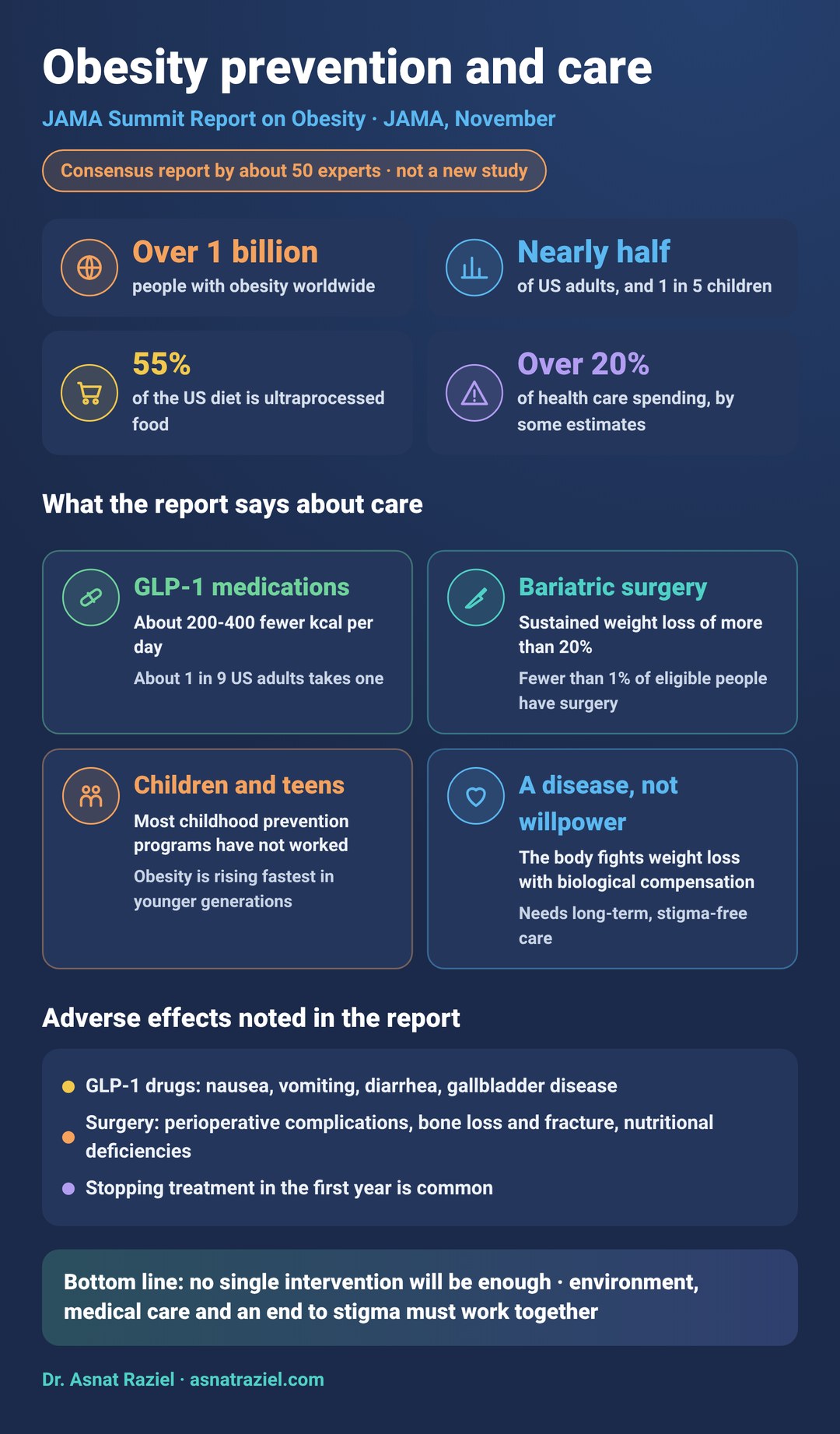
Obesity prevention has not stopped the epidemic so far, and the new medications will not do it alone either. That is the central message of a special report published in JAMA on November 17. According to the report, obesity is not a failure of willpower. It calls for coordinated action by the health system, government, the food industry and communities.
Behind the report: an expert summit in Chicago
The report summarizes the JAMA Summit on Obesity, held in Chicago in May. About 50 experts signed it, including physicians, researchers and policy experts. It was also presented at ObesityWeek.
It is important to know that this is a consensus report, not a new study. In other words, it presents no original data. Instead, it summarizes current knowledge and proposes directions for action. Most of its examples come from the United States.
The scale of the problem: more than a billion people
First, the numbers. Obesity now affects more than 1 billion people worldwide, according to the World Health Organization. In the United States in 2023, nearly half of adults and 1 in 5 children had obesity. Moreover, two-thirds of people with obesity live in low- and middle-income countries.
Obesity raises the risk of type 2 diabetes, high blood pressure and heart disease. It is also linked to sleep apnea, kidney disease, fatty liver disease, osteoarthritis and many cancers. No wonder it is called a disease of diseases. By some estimates, it accounts for more than 20% of health care spending.
Why obesity prevention has fallen short
The report takes an honest look at what has been tried. For example, nutrition standards, food labeling and school meal standards worked where they were implemented. By contrast, taxes on sugar-sweetened beverages in US cities had mixed effects.
Subsidies for healthy food improved purchasing and consumption. However, their effect on obesity itself is still unclear. Community lifestyle programs also drew few participants. Finally, most childhood obesity prevention programs did not reach their goals. That is why the authors describe the overall impact of obesity prevention so far as “inadequate.”
The food environment: calories and ultraprocessed food
One key driver is the environment we live in. In the United States, available calories per person rose from about 3,200 to almost 4,000 a day after agricultural policy changes in the 1970s. Today, ultraprocessed food makes up 55% of the American diet.
Still, the report notes fairly that the evidence linking ultraprocessed food to obesity rates is mixed. In addition, people with lower socioeconomic status have less access to healthy food and less time to cook. They also face more targeted marketing and fewer places to be active. Common medications, such as steroids (glucocorticoids), antipsychotics, antidepressants and insulin, can also cause weight gain.
Obesity is a disease, not a failure of willpower
The report states clearly that obesity is a disease, not just a risk factor. When people lose weight, the body activates biological compensation. These mechanisms make weight loss harder and promote regain. Therefore, obesity needs long-term treatment and support, much like high blood pressure.
The authors also warn about stigma. Some health professionals still hold outdated views about willpower. Furthermore, internalized weight stigma, meaning self-blame about weight, is linked to worse health outcomes. The report also points to widespread misinformation on social media.
GLP-1 medications: a big opportunity, with limits
Before the GLP-1 era, drugs such as phentermine-topiramate and naltrexone-bupropion achieved 5% to 10% weight loss. In contrast, the report describes GLP-1 receptor agonists as the first highly effective class of obesity drugs. People taking them eat about 200 to 400 fewer calories a day and tend to choose higher-quality food.
Beyond weight, trials showed lower risk of atherosclerotic cardiovascular disease, fewer heart failure symptoms, lower blood pressure and blood sugar, and less liver fat. They also found slower progression of chronic kidney disease. The main side effects are nausea, vomiting, diarrhea and gallbladder disease.
Today, about 1 in 9 US adults takes a GLP-1 medication, according to a Gallup survey. The report says obesity rates there may be declining for the first time in decades, probably largely thanks to these drugs. At the same time, severe obesity continues to rise.
The report names three more challenges: access and cost, tolerability, and the need for long-term use. Stopping treatment in the first year is common, so it helps to understand what happens when the medication stops. The authors also warn about compounded drugs and direct-to-consumer sales, with inconsistent dosing and little evidence. I wrote about these dangers in my article on black-market weight-loss drugs.
Bariatric surgery: effective, yet fewer than 1% get it
Before the new medications, bariatric surgery was the most effective option for sustained weight loss of more than 20%. According to the report, it is indicated for adults with a BMI (body mass index) of 35 or higher, or with type 2 diabetes and a BMI of 30 or higher. Adolescents aged 13 and older may also qualify, based on percentile thresholds the report lists.
The risks include complications around surgery, bone loss and fractures, and nutritional deficiencies. On the other hand, retrospective analyses suggest a longer life expectancy. For example, a meta-analysis in The Lancet found a median life expectancy 6.1 years longer than with usual care. Moreover, the report says surgery compares favorably on cost-utility with GLP-1 drugs at current prices. Even so, fewer than 1% of eligible people have surgery. I discuss choosing between medication, a combination or surgery in my article on treating severe obesity.
Children and teens: obesity prevention starts at school
According to the report, obesity is rising fastest in younger generations. The authors therefore recommend funded school nutrition standards and limits on marketing unhealthy food to children. They also suggest teaching nutrition and cooking in schools, building teaching kitchens and starting healthy habits early. For the home side, see my article on healthy eating for children.
Ten directions for obesity prevention and better care
The report lists ten directions for solutions. First, improve the food environment through tax and subsidy reform, labeling, marketing limits and community gardens. Second, encourage physical activity and supportive urban design. Third, improve communication and fight misinformation.
Next come stronger childhood prevention and closing economic and social gaps. The report also calls for modernizing care and widening access to medications and lifestyle programs. Finally, it asks to reduce stigma and to advance research and policy evaluation.
In research, the authors want success measured by broad health outcomes, not weight alone. They also want studies of optimal dosing, what happens after stopping a drug, and combining medication with surgery.
What this means for you
Although the report focuses mainly on the United States, its messages apply everywhere. First, obesity is not a matter of character but a chronic disease with effective treatments. Second, no single treatment suits everyone. In the end, it is the combination of nutrition, movement, emotional support, medication and sometimes surgery that brings results.
Obesity prevention: steps you can take today
At home, obesity prevention starts with the environment: less ultraprocessed food and fewer sugary drinks in the kitchen. Meanwhile, cook together with your children and choose shared activities over screen time. If you already live with obesity, see a doctor who specializes in treating it. Together you can build a tailored plan, with a dietitian and a psychologist as needed.
If you take a medication, treat it as long-term therapy and do not stop it without advice. Also, do not buy drugs from unregulated sources. And if you meet the criteria for surgery, it is worth discussing that option with an expert surgeon too.
The bottom line on obesity prevention
The JAMA report holds up an honest mirror: obesity prevention so far has not worked well enough, and the new drugs are a big opportunity but not a magic fix. The way forward combines a healthier environment, tailored long-term medical care and an end to stigma. That is a message of hope, because each of us has better tools today than ever before.
This article provides general information and is not a substitute for personal medical advice. Talk to your doctor before making any change to your treatment.
References
Toward a Healthier Future Through Obesity Prevention and Care: The JAMA Summit Report on Obesity
In U.S., GLP-1 Usage Reaches New High
The summit was supported by the AMA Foundation. Many of the report’s authors disclosed financial ties to pharmaceutical, food and wellness companies.