By Dr. Asnat Raziel, bariatric surgeon specializing in obesity treatment, metabolic health and healthy longevity; Director of the Multidisciplinary Center for Obesity Treatment, Assia Medical, Assuta Ramat HaChayal, Tel Aviv
What the latest obesity medicine conferences taught us
The obesity medicine conferences of the first half of 2026 painted a clear picture: obesity is a chronic disease, and treatment needs to continue over the long term. The European Congress on Obesity, ECO 2026, took place in Istanbul on May 12–15. In June, the American Diabetes Association (ADA) held its annual meeting in New Orleans. At both meetings, the discussion went well beyond new drugs. It also covered biological mechanisms, behavior change, policy and public health.
Here I have gathered six key insights. I also wrote about the vision presented at the European congress in my article on the future of obesity medicine.
1. Advanced treatments beyond GLP-1
The biggest news came from retatrutide, a drug that activates three hormone receptors: GLP-1, GIP and glucagon. The TRIUMPH-1 trial enrolled 2,339 adults with obesity or overweight who did not have diabetes. According to an announcement from Eli Lilly, participants on the 12 mg dose lost an average of 28.3% of their body weight after 80 weeks. In contrast, the placebo group lost 2.2%. Researchers also shared more data from the trial at the ADA meeting.
However, this comes at a price. At the high dose, 11.3% of participants stopped treatment because of side effects, compared with 4.9% on placebo. In addition, the TRANSCEND-T2D-1 trial included 537 people with type 2 diabetes. On the 12 mg dose, HbA1c (average blood sugar over three months) fell by 1.94%, compared with 0.81% on placebo. The drug has not been approved yet. You can find a full review in my article on retatrutide for weight loss.
2. The brain and appetite: every patient responds differently
At this year’s obesity medicine conferences, the role of the brain came up again. Satiety medications act on the brain’s appetite centers and change how we respond to food, especially processed food. But the response is not uniform. Some patients respond quickly and strongly, while others respond slowly.
So the discussion shifted to a new question: how can we tell early on who will benefit from which treatment? The goal is far more precise medicine, based on how each patient responds in the first few weeks. You can read more in my article on early responders to oral semaglutide. For the mechanism itself, see my article on the brain, hunger and satiety.
3. Preserving muscle mass over the long term
The greater the weight loss, the more it matters what exactly you are losing. At the European congress, researchers presented a body composition analysis from the REDEFINE 1 trial of CagriSema. According to a report from the congress, 252 participants had a DXA scan, a test that maps fat and muscle. About 66.9% of the weight lost was fat, and 33.1% was lean tissue. Meanwhile, muscle strength on a chair-stand test did not decline compared with placebo.
The practical message has not changed: preserving lean mass matters for strength and mobility. In addition, it may help you keep the weight off afterward. Protein and strength training are part of the treatment, as I explained in my article on GLP-1 medications and muscle mass.
4. Obesity medicine conferences and stopping treatment
What happens when you stop the medication was a central question. The SURMOUNT-MAINTAIN trial appeared in The Lancet in May 2026. Participants took tirzepatide (Mounjaro/Zepbound) for 60 weeks, and then the researchers split them into three groups. Those who stayed on the maximum dose maintained a 21.9% weight loss after 112 weeks. Those who stepped down to 5 mg maintained 16.6%, while those who switched to placebo maintained only 9.9%.
Moreover, 67% of the placebo group needed rescue treatment after regaining at least half of the weight they had lost. In other words, the medication works as long as you keep taking it. On the other hand, switching to a pill is another option. In the ATTAIN-MAINTAIN trial, according to Eli Lilly, patients who switched from Wegovy to the Foundayo (orforglipron) pill kept off all of their weight loss except for an average of 0.9 kg. There is more on this in my article on stopping obesity medications and weight regain.
5. Policy and public health
Beyond biology, the conferences also took a system-wide view. A large analysis published in Nature included data on about 232 million people from 200 countries, from 1980 to 2024. The researchers found that the rise in obesity is leveling off in most developed countries. In developing countries, by contrast, it is continuing and even accelerating. According to the authors, GLP-1 medications do not yet explain this trend.
At the same time, access to these medications remains a challenge. The World Health Organization estimates that by 2030, the drugs will reach fewer than 10% of the people who could benefit from them. That is why treating obesity requires us to think about the food environment, social support and health infrastructure. You will find more details in my article on the WHO guideline.
6. Combining treatments and looking beyond BMI
Alongside medications, the conferences emphasized combining drug, behavioral and surgical treatment, based on each patient’s needs. In addition, assessment is moving beyond BMI. The Lancet Commission on Clinical Obesity recommends using BMI only for screening, not as a measure of an individual’s health. It also suggests checking waist circumference, body composition and organ function.
As a result, the goal of treatment is changing. Instead of looking only at the percentage of weight lost, we also assess cardiometabolic risk, physical function and quality of life. I wrote about the European framework for choosing treatment in my article on personalized obesity treatment.
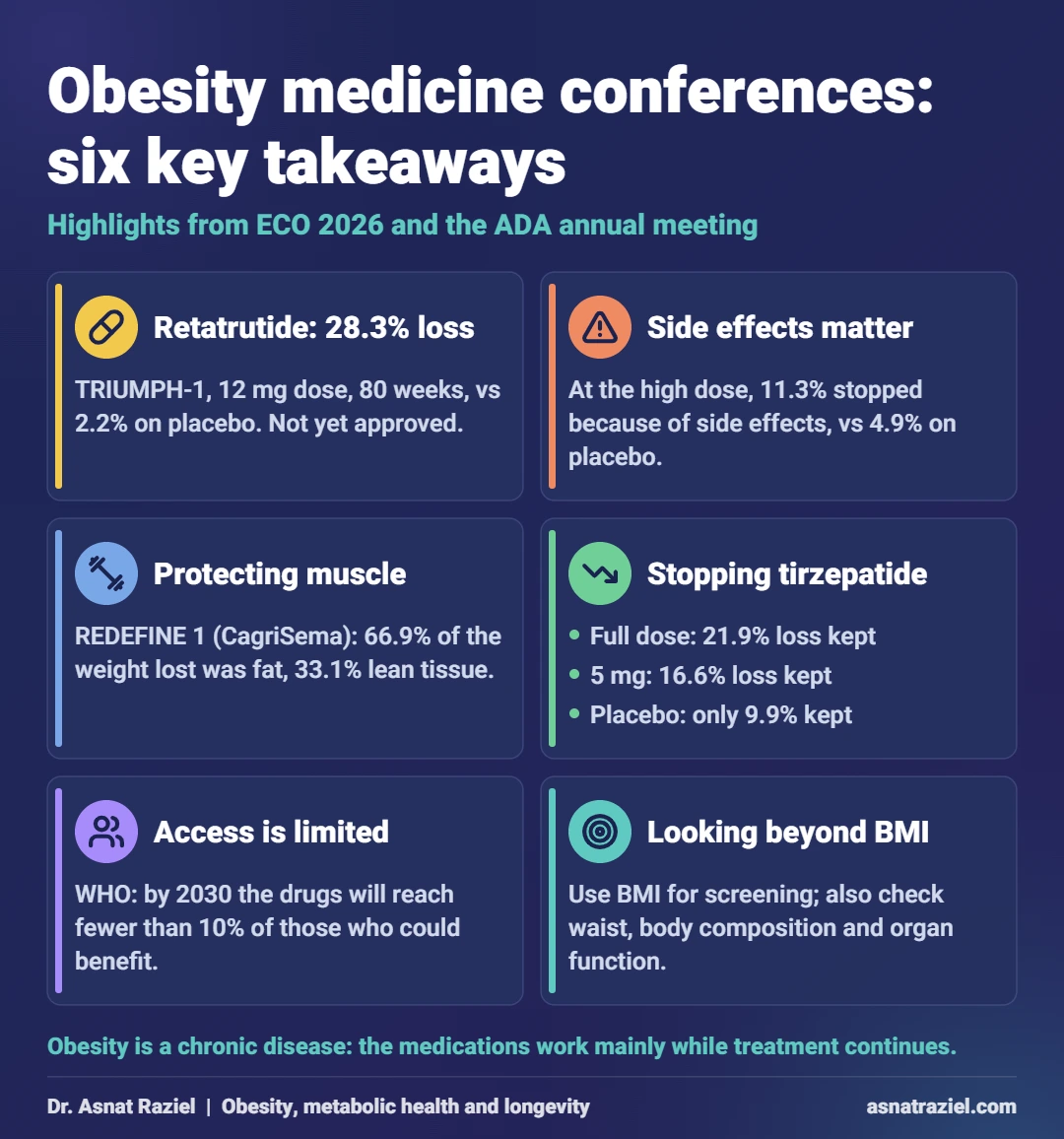
Summary: key takeaways from obesity medicine conferences
The obesity medicine conferences of early 2026 reinforced the understanding that obesity is a chronic disease. The new medications are more powerful than ever, but they work mainly when treatment continues. Ultimately, the future points to personalized medicine. In that future, every patient will receive comprehensive care, including medication, nutrition, physical activity and emotional support, to maintain results over time.
This article provides general information and does not replace personal medical advice.
References
Lilly’s triple agonist, retatrutide, delivered powerful weight loss in pivotal Phase 3 obesity trial
ECO 2026: REDEFINE-1 demonstrates CagriSema’s improvement in body composition
Obesity rise plateaus in developed nations and accelerates in developing nations
WHO issues global guideline on the use of GLP-1 medicines in treating obesity
Definition and diagnostic criteria of clinical obesity
Eli Lilly funded the retatrutide, tirzepatide and orforglipron trials; Novo Nordisk funded the REDEFINE 1 trial.