By Dr. Asnat Raziel, bariatric surgeon specializing in obesity treatment, metabolic health and healthy longevity; Director of the Multidisciplinary Center for Obesity Treatment, Assia Medical, Assuta Ramat HaChayal, Tel Aviv
The future of obesity medicine: what we learned at the European obesity congress
The future of obesity medicine looks very different from what we knew just a few years ago. The European Congress on Obesity, ECO 2026, made this clear. It was held in Istanbul from May 12 to 15, 2026. In the past, most of the attention went to the number of kilograms lost. Today, however, the approach is far broader, more precise and much more personal.
Experts at the congress highlighted three main directions. First, tailoring treatment to each patient, based on how they respond and on what matters to them. Second, a wider range of choices, mainly thanks to obesity pills. Third, new biological mechanisms that go beyond today’s familiar drugs. In a separate article, I also wrote about obesity as a biological disease, another key message of the congress.
Direction one: an early response to treatment
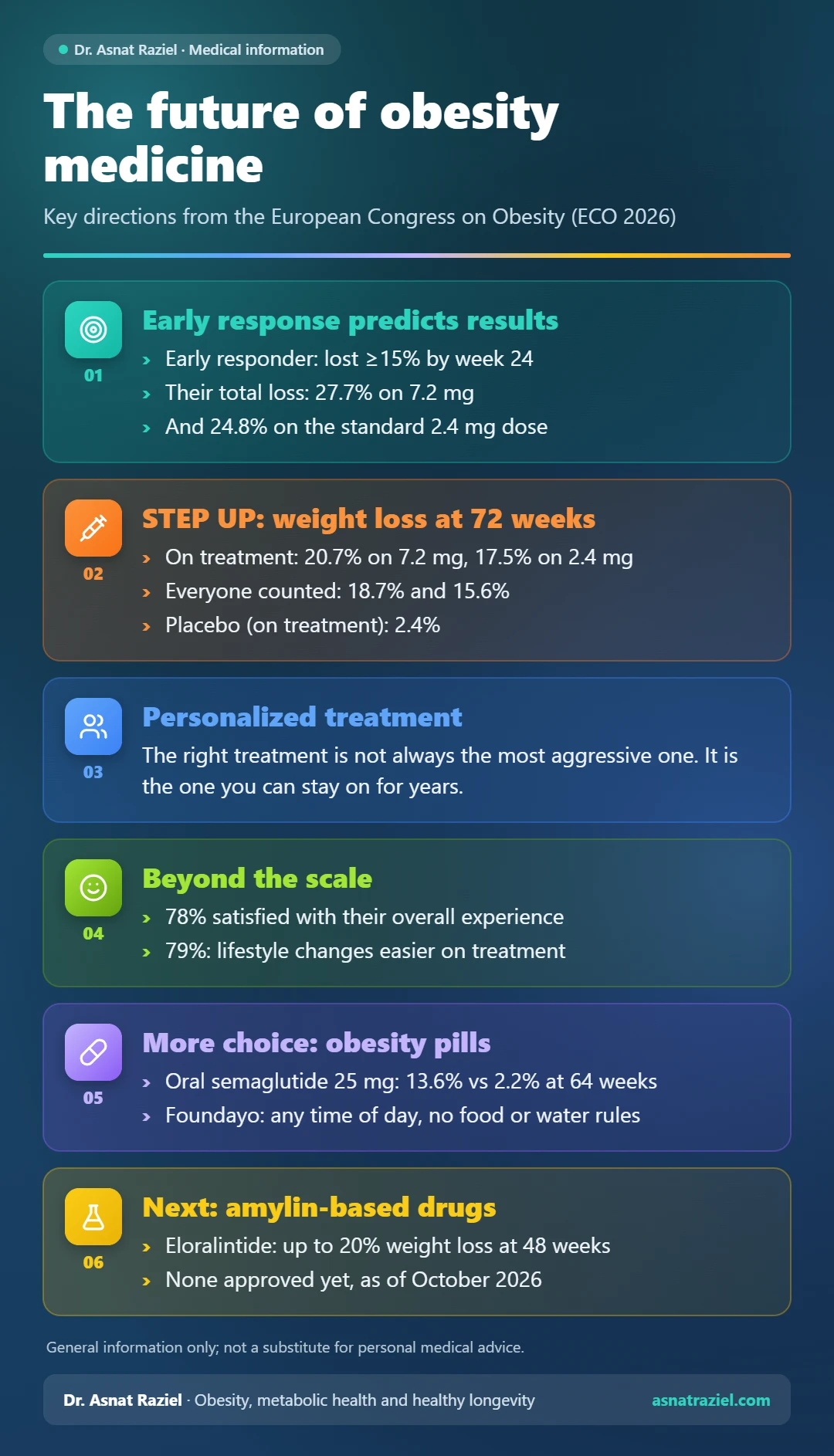
One of the standout messages came from a new analysis of the STEP UP trial. This trial tested once-weekly semaglutide injections at a dose of 7.2 mg, compared with 2.4 mg and placebo. More than 1,400 adults with obesity and without diabetes took part. After 72 weeks, weight fell by 20.7% with 7.2 mg, by 17.5% with 2.4 mg and by 2.4% with placebo. These figures refer to people who stayed on treatment. When everyone was counted, weight loss was 18.7% and 15.6%, respectively.
The researchers defined “early responders” as people who lost at least 15% of their body weight by week 24. On the 7.2 mg dose, 27% of patients met this definition, compared with 21% on the 2.4 mg dose. By the end of the trial, early responders had lost 27.7% on the higher dose and 24.8% on the standard dose. In other words, the response in the first few months is a strong predictor of long-term results. The higher dose was approved by the FDA in March 2026 under the name Wegovy HD.
The future of obesity medicine is personalized treatment
These data strengthen the case for personalized medicine. We are moving away from a one-size-fits-all model, where everyone automatically climbs to the highest dose. Instead, the doctor assesses each patient individually. This means looking at the strength of the response, side effects, feelings of fullness and quality of life. In addition, the doctor considers whether the patient can stick with the treatment over time. I wrote about this approach in detail in my article on matching the dose to the treatment goal.
The clinical meaning is significant. The right treatment is not necessarily the most aggressive one. In many cases, it is simply the treatment the patient can stay on for years.
Beyond weight: the measures that matter to patients
Another trend at the congress is that counting lost kilograms is no longer enough. A striking example is the OUTSTEP 1 study, which looks at the experience of patients starting semaglutide injections. Its interim analysis included 389 patients from Germany and Australia. Of these, 78% were satisfied with their overall experience. Moreover, 79% said that keeping up lifestyle changes was much easier while on treatment.
Many studies now track measures that patients report themselves: hunger, fullness, energy, mobility, sleep, mood and quality of life. As a result, the way doctors judge success is changing too. For example, consider a patient who loses a little less weight. If that person sleeps well, walks easily and feels in control of eating, the health benefit may still be large. I expanded on this in my article on how we measure success in obesity treatment.
Direction two: the future of obesity medicine in a pill
Oral medications drew a lot of interest at the congress. In the OASIS 4 trial, 307 adults without diabetes received either oral semaglutide 25 mg or placebo. After 64 weeks, average weight loss was 13.6% with the pill, compared with 2.2% with placebo. The FDA approved the Wegovy pill in December 2025, and the European Union approved it in July 2026.
At the same time, the FDA approved Foundayo in April 2026. This pill contains orforglipron, and in Israel it has been available since mid-September 2026. The practical difference between the two pills is striking. You take the Wegovy pill in the morning on an empty stomach and then wait half an hour before eating. By contrast, you can take Foundayo at any time of day, with no food or water restrictions. So each patient can choose what fits their routine. You can find a detailed comparison of the two drugs in my article Wegovy pill vs. Foundayo.
The experts stressed that more choice may improve persistence and satisfaction. Obesity is a chronic disease, so the ability to fit treatment to the patient’s life is especially important. Ultimately, the question is not only how effective a drug is. It is also how well it fits into a person’s daily routine.
Direction three: amylin-based drugs
Some of the discussions carried real excitement about treatments based on the hormone amylin. Amylin is a hormone that the pancreas releases together with insulin, and it contributes to the feeling of fullness. GLP-1 treatments work mainly through satiety and appetite-regulation mechanisms. Amylin-based treatments, on the other hand, act through complementary pathways.
The data are encouraging. In a phase 2 trial of eloralintide, a drug that activates only the amylin receptor, weight fell by up to 20% after 48 weeks. A 2026 review also summarizes zenagamtide (formerly amycretin), which combines amylin and GLP-1 in a single molecule, as well as CagriSema. However, as of October 2026, none of these drugs has been approved yet. I wrote about this new generation in my article on amylin drugs for obesity.
Researchers at the congress expect to see advanced combinations of GLP-1, GIP, glucagon and amylin in the future. Together, they would form a multi-system biological approach to treating obesity.
The bottom line on the future of obesity medicine
Perhaps the most important message of ECO 2026 was a shift in thinking. Obesity medicine no longer focuses only on rapid weight loss. Instead, it is moving toward long-term, personalized care that takes into account biology, behavior, quality of life and patient preferences. Therefore, the future of obesity medicine will combine advanced drugs, a wide range of options and new measures. These measures will look not only at how much weight came off, but also at how much life has changed for the better.
The information in this article is general and does not replace personal medical advice.
References
Higher-Dose Semaglutide Nears 28% Weight Loss in Early Responders
FDA Approves Fourth Product Under National Priority Voucher Program: Higher-Dose Semaglutide
OUTSTEP 1 interim analysis: Patient experiences with injectable semaglutide for obesity management
Oral Semaglutide at a Dose of 25 mg in Adults with Overweight or Obesity
New Amylin-Based Agonists for the Treatment of Obesity and Type 2 Diabetes Mellitus




