By Dr. Asnat Raziel, bariatric surgeon specializing in obesity treatment, metabolic health and healthy longevity; Director of the Multidisciplinary Center for Obesity Treatment, Assia Medical, Assuta Ramat HaChayal, Tel Aviv
Personalized obesity treatment starts with the right question
Personalized obesity treatment starts with understanding that the number on the scale does not tell the whole story. Body mass index, or BMI (the ratio of weight to height), is a useful tool. However, it does not show where fat builds up or how it affects health.
A new framework from the European Association for the Study of Obesity proposes a broader view. It also looks at fat distribution, health status and day-to-day function. In addition, it calls for tailoring treatment to the personal goals of each patient.
Two people, the same BMI, a different story
Imagine two people with the same BMI. One has no known health problems and is active in daily life. The other is dealing with diabetes, joint pain and difficulty climbing stairs. Does it make sense for both of them to receive the same assessment and the same treatment plan?
The European Association for the Study of Obesity (EASO) answers this question in a framework it published in 2024 in the journal Nature Medicine. Its starting point is simple: obesity is a chronic, complex disease that tends to relapse. Therefore, as with other chronic diseases, the first step is to assess its impact on health. Next, we set treatment goals and track progress over time.
This approach builds on the EASO position statement, which defined obesity as a chronic disease based on adipose tissue. I discussed this concept in more detail in my article on obesity as a chronic disease.
Why BMI alone is not enough
BMI relies only on weight and height. As a result, it does not show where fat accumulates in the body. Nor does it tell us anything about muscle health or how weight affects a person’s life.
The paper places special emphasis on abdominal fat. This fat is linked to cardiometabolic risk, meaning the risk of heart disease, diabetes and blood lipid disorders. This risk exists even in people whose BMI is below 30.
Waist-to-height ratio: a simple, smart measurement
For this reason, the authors recommend measuring waist circumference as well. Another tool they suggest is the waist-to-height ratio. You simply divide your waist circumference by your height, with both measured in the same units.
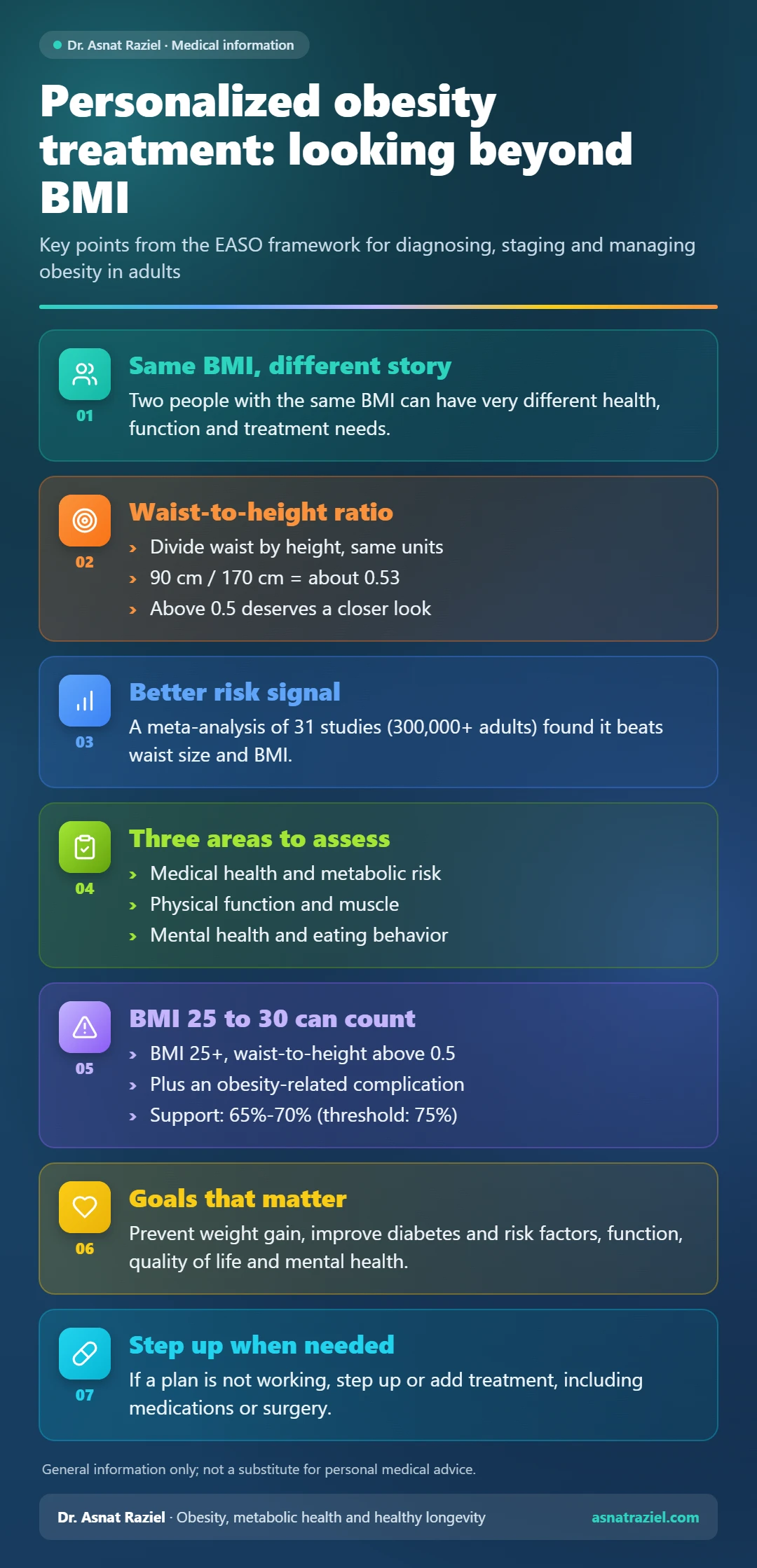
For example, a waist of 90 cm and a height of 170 cm give a ratio of about 0.53. A ratio above 0.5 signals that fat distribution and health risk deserve a closer look. Still, it is not a diagnosis on its own.
A meta-analysis of 31 studies, which together included more than 300,000 adults, found that the waist-to-height ratio identifies cardiometabolic risk better than waist circumference or BMI. It is also important to remember that BMI cutoffs are not the same for all ethnic backgrounds.
What personalized obesity treatment assesses
The framework proposes an assessment in three areas. The first area is medical health: diseases and complications related to obesity, along with metabolic risk factors.
The second area is physical function: mobility, exercise capacity and the ability to carry out daily activities. When there are relevant signs, the assessment also includes muscle strength, physical performance and body composition. This helps identify obesity that comes with a loss of muscle mass or muscle function. I wrote about this in my article on sarcopenia and obesity.
The third area is mental health and eating behavior: symptoms of depression, eating-related difficulties and their impact on quality of life. Food noise, meaning intrusive thoughts about food, is also part of the picture.
The result is a comprehensive clinical picture. The paper proposes grading the severity of obesity by the severity of its medical, mental and functional complications, not by BMI category alone. However, it does not present a new, detailed scale of severity stages.
Can a BMI below 30 also point to obesity?
One of the most interesting proposals in the paper concerns people with a BMI of 25 to 30. The authors suggest considering a diagnosis of obesity in these people when three conditions are met. The first condition is a BMI of 25 or higher. The second is a waist-to-height ratio above 0.5. The third is a medical, functional or mental impairment or complication related to obesity.
Here it is important to be precise. The statements on these measurement definitions received support from most of the experts, between 65% and 70%. However, according to the full text of the framework, they did not reach the predefined 75% consensus threshold. So it is best to see them as a proposal to change clinical thinking, not as an agreed diagnostic rule.
The European framework and the definition of clinical obesity
In January 2025, an international commission of the journal Lancet Diabetes & Endocrinology published a complementary definition. The commission distinguishes between “preclinical” obesity, in which the organs still function normally, and “clinical” obesity, in which excess fat already impairs function. It, too, recommends confirming excess fat with an additional measurement beyond BMI, such as waist circumference. I wrote about this definition in my article on the new definition of clinical obesity. The two approaches differ in the details, but the message is similar: we look at the person, not just the weight.
Personalized obesity treatment: a health goal, not just a percentage
The practical message of the framework is to set meaningful goals together with the patient. For example, these may include preventing further weight gain or improving diabetes and other risk factors. Other goals are relieving symptoms and improving function, quality of life and mental health. Finally, it is important to maintain these gains over time.
The plan can include nutrition therapy, physical activity, better sleep and stress reduction. In addition, it can add psychological treatment as needed. I wrote about combining these components in my guide to holistic obesity treatment.
Medications, surgery and stepping up treatment
Treatment can also include anti-obesity medications, or the care team may consider bariatric and metabolic surgery. The decision depends on the clinical situation, previous treatments, the patient’s preferences and the relevant indications. And what happens if the first treatment does not achieve its goals? The paper calls for considering stepping up or adding treatment, rather than repeating a plan that is not working over and over.
The framework even suggests considering drug treatment from a BMI of 25, below the usual threshold of 27, when there is increased abdominal fat and complications. Even so, this is not an automatic expansion of the approved indications. Any actual prescription must match the drug’s approval and the guidelines where treatment is given.
What changes in the consultation room
Instead of asking only “How many kilograms do you need to lose?”, we can start with different questions. What bothers you today? Which complications have already appeared? What would you like to improve in your function and quality of life? Which treatments have you tried before, and what will help you stick with it?
A personalized obesity treatment plan grows out of the answers to these questions.
Bottom line: personalized obesity treatment
The European framework gives this conversation a clear medical structure. It reminds us that weight is an important measure. But we also measure the success of treatment by health, function and the ability to maintain improvement over time. Ultimately, personalized obesity treatment sees the whole person, not just the number.
The information in this article is general and does not replace personal medical advice.
References
A new framework for the diagnosis, staging and management of obesity in adults




